In this series of articles, we explore how the German state prosecutes politically active Palestinians outside the judicial system. The standard model—”break law X, be fined Y or appear in court and receive sentence Z”—can be circumvented using asylum, residency, and citizenship laws. These techniques deliberately hide behind a wall of legal jargon and a veneer of dysfunctional bureaucracy. But in reality, they are purposeful, targeted, and exert severe psychological, financial, and material pressure on the affected people. For this, we interview Khaled, a Palestinian man who experiences these attacks first-hand.
The German government has insisted and still insists on taking an active part in the genocide in Gaza and on propping up Israeli and US-American supremacy in the region, gutting any legitimacy for international law and institutions. But how can they engage in such criminal and unpopular policies while making sure that the millions of Palestinians, Arabs, Muslims, and those in solidarity in Germany don’t stand in the way? It is by unleashing a wide spectrum of their counterinsurgency arsenal on the anti-genocide movement.
Crushing the movement in solidarity with Palestine and deterring the overwhelming masses has been a top priority during the past three years. To achieve their objective – the uninterrupted active participation in genocide – it requires the suspension of all democratic tools that allows the population to legally stand in the way of, or at least protest, these policies.
While many of these counterinsurgency measures are widely known, like banning demonstrations, conferences, slogans, organisations, and the overwhelming police brutality against demonstrators, the more sinister and existentially threatening crackdown techniques are those that circumvent “criminal law” and weaponize asylum, residency, or citizenship laws to punish activists and deter the migrant communities.
This takes us to the story of Khaled, a Palestinian mechanical engineer who has been living in Germany for 12 years. He came to the country on a student visa, finished his studies and is now settled after building a family and life in the federal republic. Previously a student activist, a turning point in his political life has been “Sayf Al Quds” military operation and the popular uprising in May 2021
“it showed us that we, the Palestinian people, can take initiative … that period marked the rapid rise of two Palestinian organisations in Germany: Samidoun and Palestine Speaks. This phase continued until October 7th 2023 and the prohibition of Samidoun and tightened restrictions on Palestine Speaks. During the Genocide in Gaza I was active as an individual in the university camps in Bonn and Düsseldorf and Köln.”
The attack on Khaled started with the confiscation of his passport during a train ticket control in December 2022. He was told to pick it up from the immigration office, who stonewalled the process for three years until January 2026. “They had a series of excuses: they claimed the passport took a year to arrive from the police station, and when I moved cities the excuse was that my old city’s immigration office didn’t send them my passport yet”. After assigning a lawyer and going to court, they handed him his passport shortly before the court date.
On October 9th 2023 the police confiscated his residency permit as well after arresting him at a protest:
“After keeping me in the station overnight, they released me in a rush with all my belongings thrown in the bag in a messy way – including the content of my wallet. They didn’t give me an arrest protocol that shows that my residency permit has been taken or that I was arrested to begin with. I only realized that it was missing a couple of days after”.
On that night in the police station, Khaled recalls “I was left in solitary confinement for a night and was not given my inhaler after having an asthma attack from the bad air. They purposefully cut off the communication from my cell through the intercom.”
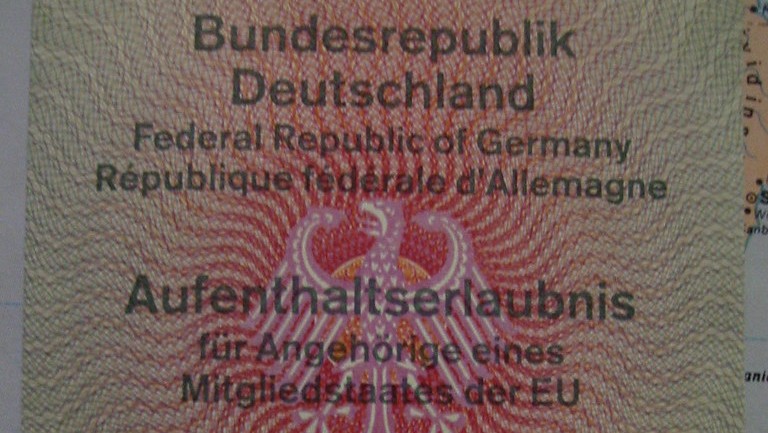
As for his residency card, the police instructed him to pick it up from the immigration office, which in turn denied having it. “It remains till this day that I don’t have a functional residency permit because my card is missing and I need to present it to renew my residency.”
While this scenario might be difficult to follow for a European, who can travel with an ID that can be renewed at any time without issue, it is a nightmare for a migrant. Without a valid passport, you are not allowed to board a plane. And without a German residency permit, you are not allowed to re-enter Germany once you leave. Khaled, like many other migrants who face similar kinds of attacks, is living in an open air prison “I cannot really travel anywhere. I was only allowed movement within Germany. My parents, of course, do not live in Germany, and that meant that visiting them was not possible for the past four and a half years.”
The implications go beyond the ability to visit home. As a migrant residing in Germany, you have two ways to identify yourself in any official procedure: a valid passport or a valid residency permit. “I wanted to get married, and up until very recently I was unable to do so.” As absurd as it sounds, he is referring to what’s called Identitätsfeststellung (identity verification), which is a part of the marriage procedure where they “confirm your identity” by checking your valid passport or residency permit. Without it, the Standesamt (Registry Office) can refuse to allow you to marry in Germany. “Marriage in Germany is a bureaucratic blackhole on a normal day, just imagine doing it without papers.”
After finishing his studies, he was trying to find a job. Many applications fell through because he was unable to provide the company with a valid residency permit. As a migrant in Germany, he is also ineligible for social aid, so making ends meet was a continuous struggle. “I recently got a job in my field after retrieving my passport, but I am still unable to travel without a residency permit, and have missed because of that an important business trip abroad.”
Migrants in Germany, through residency, asylum, and citizenship laws, live under a parallel legal system which is weaponized to the extreme in the context of Palestine solidarity. A migrant with an on going court proceeding can be denied residency renewal until the case is closed. In other words, the tens of thousands of banal “From the River to the Sea”, “resisting arrest” and “assaulting a police officer” cases, while they might mean a fine and psychological pressure for an EU-citizen, it can be existentially threatening to a migrant like Khaled, who can’t renew his residency as long as his court cases are still ongoing – which can take years “Right now I am very determined to win all my cases and seize my rights.”