Berlinale, Berlin’s international film festival, opened last week with a display of cowardice that will surely go down in history.
When the journalist Tilo Jung asked about the jury’s selective solidarity with people in Ukraine or Iran but not in Palestine, Ewa Puszczyńska declared: “Films are not political,” and wondered why no one is talking about the genocide in Senegal. (Is there a genocide in Senegal? Did she mean Sudan?) Wim Wenders added: “We are the opposite of politics.”
In response, Arundhati Roy pulled out of Berlinale with a bold statement. While Neil Patrick Harris said he avoids political roles, numerous other filmmakers used their platform to speak out against the German government’s support for genocide.
On Saturday, Berlinale director Trisha Tuttle issued a long, defensive statement reassuring us that no one at the festival is “indifferent to… the immense suffering of people in Gaza and the West Bank, in the Democratic Republic of the Congo, in Sudan, in Iran, in Ukraine, in Minneapolis, and in a terrifying number of places.”
In other words: Berlinale is political—they just don’t want to talk about Palestine.
Everyone sees what’s going on. Berlinale gets about a third of its funding from the German state. Far-right culture warrior Wolfram Weimer, who once made a career of decrying left-wing “cancel culture,” has been using his position as culture minister to cancel events that don’t align with the interests of German imperialism (besides lining his pockets).
We can all see the sword hanging over the jury’s head. Berlinale can be “political” as long as it doesn’t criticize the German government in any way. As the noose tightens around the neck of the largely state-funded cultural scene, we can expect fewer films criticizing the Far Right and more cinema praising the glorious Bundeswehr.
So what did Berlinale have to offer?
Red Hangar
It did not feel like a coincidence that a film about the military coup in Chile on September 11, 1973, premiered in Germany. Red Hangar follows Jorge Silva, a taciturn officer in the Chilean Air Force, as the coup unfolds around him. When his superiors ask about his loyalty, he repeats that he only follows orders. Should he join them? Should he join a resistance cell planning to flee the country?
As the military academy where he works is converted into a provisional torture center, Silva is willing to carry out interrogations, but he draws a line at shooting prisoners. As we learn from a title card at the end, he was subsequently arrested, tortured, and forced into exile.
The film offered a perfect yet involuntary metaphor for what filmmakers are going through right now. Should they obediently cash checks from the German government as it provides weapons for mass murder? Or should they take risks and speak up?
After the screening, I got to put this question to director Juan Pablo Sallato. After dedicating years to make a film about moral courage, he decided to keep his head down with a Wenders-style deflection. This is a “violent world,” he affirmed, “in Palestine, in Ukraine, in the U.S.” The film, he said, was just posing questions, not providing answers.
But it’s actually quite easy to provide an answer about the 1973 coup: It was wrong. Aren’t the lessons for today equally obvious? Unlike Silva, Sallato would not have been tortured for saying “Free Palestine.” If the film didn’t strengthen his resolve, even at the risk of being criticized in the German press, then what was the movie for?
As I was asking the question, my microphone was turned off, and a handful of Germans behind me complained loudly about my “propaganda.” I might have turned around and yelled that they all would have supported the coup in Chile. But afterwards, five people came up to thank me. It’s not that hard.
Chronicles of the Siege
Despite all the censorship, following last year’s international scandals, a number of films related to Palestine did make it into the program.
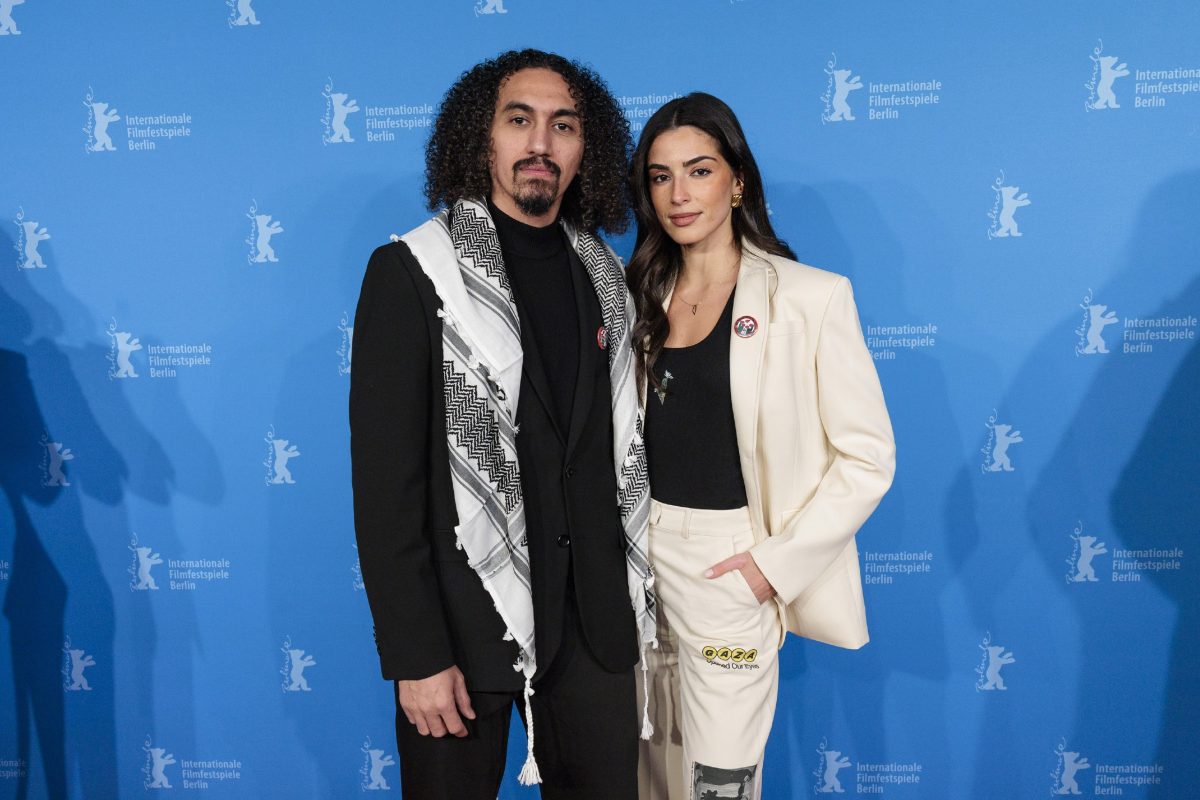
Palestinian director Abdallah Alkhatib presented Chronicles From the Siege. The blurb fails to mention Palestine, while The Berliner magazine refers to the director as being “from Yarmouk, a district of the Syrian capital Damascus,” without mentioning that Yarmouk is a Palestinian refugee camp. Yet at the premiere on Saturday, the room was full of keffiyehs and the director gave a powerful speech.
Five interwoven stories show people trying to survive in a besieged city that is not named but where people speak Palestinian Arabic. Alkhatib did experience a brutal siege during Syria’s civil war, so this isn’t quite about Gaza—but title cards refer to the genocide that has been ongoing since 1948. Without a specific place, the story is universal. Alkhatib presents Palestinians not as perfect victims, nor as angelic heroes, but as people: The stories are full of debasement and despair, as one would expect, but also of humor and warmth.
A documentary, Who Killed Alex Odeh?, looked at the assassination of a Palestinian-American activist in the Los Angeles area in 1985. Law enforcement knew right away who had planted the bomb: three fascists from Meir Kahane’s Jewish Defense League. But two were allowed to leave for Israel, where they continue living to this day, easily found by a single reporter. One of them changed his name and became a lawyer, eventually mentoring the fascist Itamar Ben-Gvir. Odeh’s widow and daughter, still fighting for justice, were present at a moving screening.
This year’s Berlinale is part of a wider authoritarian turn to strangle Berlin’s cultural scene. The government wants to make the country “kriegstüchtig” (fit for military service), and this requires stamping out critical art. But on the margins, a few artists can still use Berlinale to present critical art—while the Palinale Film Festival (complete schedule) doesn’t have to deal with government censorship.
As a right-wing government attacks artistic freedom, some film makers will bend the knee in the hopes of preserving their funding—and others will have the courage to bite the hand that feeds them.
Red Flag is a weekly opinion column on Berlin politics that Nathaniel has been writing since 2020. After moving through different homes, it now appears at The Left Berlin.