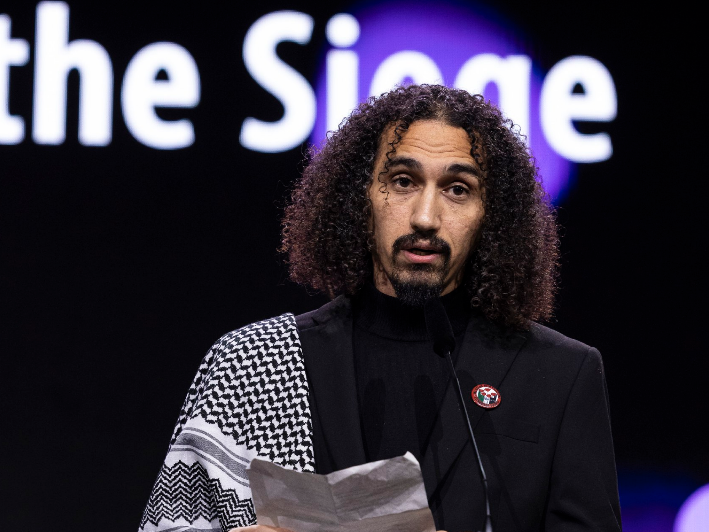
At the closing ceremony of the Berlin international film festival on Saturday, the Palestinian director Abdallah Alkhatib used his acceptance speech to call the German government a “partner in genocide.”
The German public broadcaster accused Alkhatib of “hate speech.” Even after they changed the headline to “scandal,” without explanation, they maintain that his words provoked “outrage.” Far-right (and shamelessly corrupt) culture minister Wolfram Weimer rejected the “malicious false accusation.” Alexander Hoffmann (CSU) rejected the “threats against Germany.”
What “threat”? Alkhatib said: “We will remember everyone who stood against us … or who chose silence.” Obviously the German ruling class does not like the idea that people will remember their crimes.
Readers of Tagesschau would never know that Alkhatib’s words reflect not just the views of most human rights organizations and genocide scholars, but those of 62 percent of German citizens as well.
Not Politicians
Numerous filmmakers used the Berlinale platform to speak out against the Israeli genocide in Gaza. That only highlighted the cowardice of those who chose not to, such as Ethan Hawke (“not my agenda”) or Neil Patrick Harris (who is interested in “things that are apolitical”). Was this the same Harris who was the official international ambassador for Tel Aviv’s Gay Pride Parade?
The tone was set by the jury during the opening press conference, insisting that “films are not political.” Wim Wenders despicable excuse is that: “We are not politicians.” This has turned into a meme, with Paul Thomas Anderson repeating the line at the BAFTA awards.
We should all pause to think about how absurd this statement is. As tens of thousands of children are slaughtered in Gaza, these wealthy, well connected, highly educated artists say they lack the qualifications to form an opinion. What kind of special knowledge do they think politicians have? Berlinale director Tricia Tuttle added that artists should not “be expected to speak on every political issue raised to them unless they want to.”
Fourth Estate
The dregs of moral depravity came from Germany’s “fourth estate.” Journalists from big capitalist media rushed to defend cineastic cowardice: Why should directors speak out on a genocide by the German government while cashing checks from the same government? They shouldn’t be put on a “Prüfungsstuhl” (examination chair) to extract a “Bekenntniszwang” (forced confession).
Tip Berlin, a publication of my former employer, said that Channing Tatum had “faced political heckling” when a reporter asked what he thought of actors demanding that Berlinale take a stand. The press is reflecting Germany’s authoritarian turn: it’s journalists demanding that journalists refrain from asking questions that could irritate the powerful.
After 1945, the German bourgeoisie faced the question why they had—not just passively, but actively—supported the Nazis’ unspeakable crimes. The big capitalists came up with all kinds of convoluted theories about why speaking up had been downright impossible.
By the 1990s, however, official state ideology called for “Zivilcourage”—for moral courage in daily life. In the face of right-wing violence, citizens should resist the deep-seated urge to look away. Now, in the face of the genocide in Gaza, any pretense of bourgeois morality is slipping away. We are expected to keep our mouths shut unless experts at the Foreign Office let us know when we’re allowed to feel outrage.
Victimhood
Today, Germany’s ruling class is filled with a sense of righteous victimhood. Although they command violent police thugs, obedient journalists, and near-unlimited cultural budgets, they feel terribly oppressed by… filmmakers giving one-minute speeches and journalists asking questions. They are outraged—outraged!—by anyone calling on them to oppose war crimes.
Their hypocrisy is impossible to overlook. Even as they celebrate films about government censorship of artists in Turkey, they demand that artists here be arrested for criticizing the government. This is a reflection of their isolation: they know, at some level, that their support of genocide is extremely unpopular, abroad but also at home.
This is why they loudly insist on their right to remain silent—while they keep sending weapons to Israel. As much as German bourgeois tell themselves they would have been in the resistance against Hitler, anyone can see how they keep their heads down.
As Germany’s ruling class embarks on a massive armament program, they will need much more censorship and jingoistic propaganda. Every artist who chose silence in Berlinale is part of this authoritarian turn—and indeed, a partner in genocide.
Red Flag is a weekly opinion column on Berlin politics that Nathaniel has been writing since 2020. After moving through different homes, it now appears at The Left Berlin.