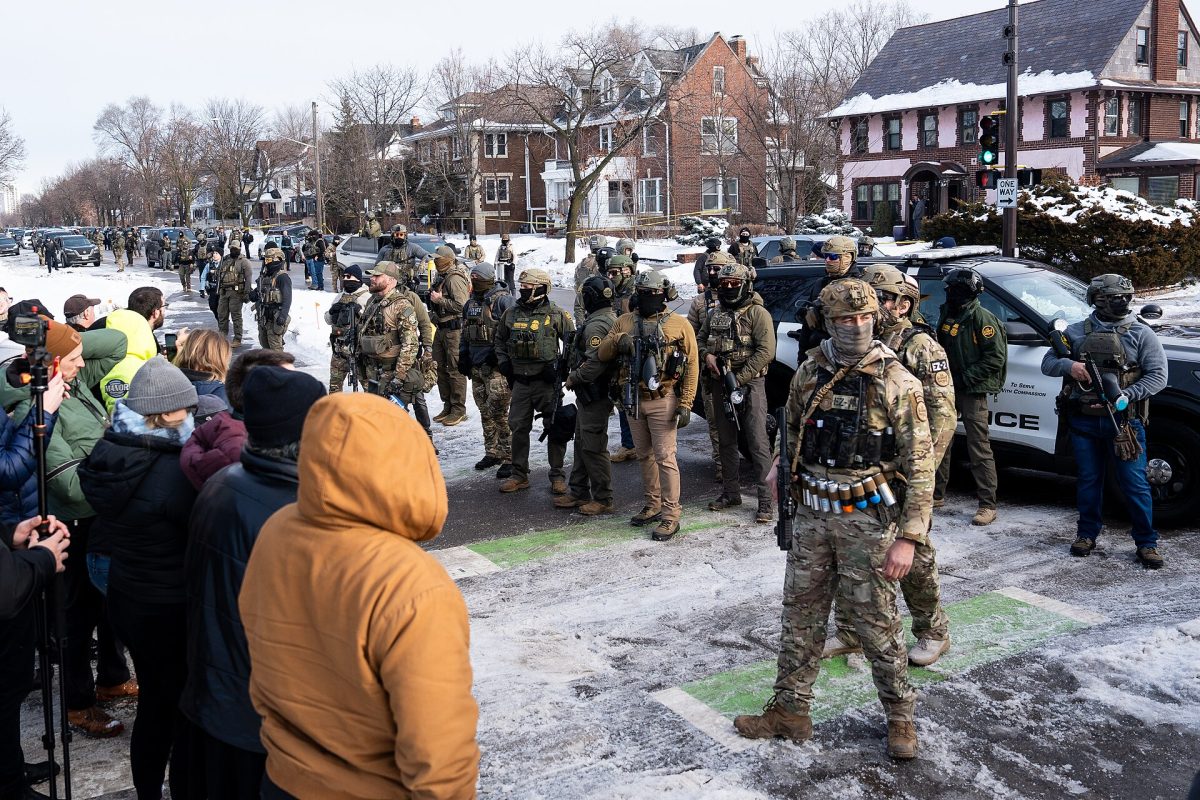
The brutal terror on the streets of Minneapolis, with masked thugs arresting people for having the wrong accent or the wrong skin color, reminds many people of the Nazis. The podcaster Joe Rogan, after enthusiastically endorsing Trump in 2024, has been wondering: “Are we really going to be the Gestapo? ‘Where’s your papers?’ Is that what we’ve come to?”
Minnesota governor Tim Walz said: “We have got children in Minnesota hiding in their houses, afraid to go outside. Many of us grew up reading that story of Anne Frank. Somebody is going to write that children’s story about Minnesota.”
Right-wing actors, including the U.S. Holocaust Museum and the Department of Homeland Security, energetically reject the comparisons. (Even as the DHS account is a constant stream of white nationalist memes). They point out that ICE is merely targeting “illegals” whereas the Gestapo went after German citizens—as if the Nazis didn’t attack Jewish immigrants from Eastern Europe for not having proper papers.
Comparisons
Historical comparisons do not claim two things are identical—no two historical phenomena are exactly the same. A comparison highlights both similarities and differences. As the liberal commentator Masha Gessen explained—after they were cancelled in Germany for pointing out parallels between the genocide in Gaza and the liquidation of Jewish ghettos —“comparison is the way we know the world.” Or as Leon Trotsky put it:
To judge the correctness or erroneousness of a historical analogy it is necessary to clearly define its content and its limits. Not to resort to analogies … would mean simply to reject the historical experience of mankind. The present day is always different from the day that has passed. Yet it is impossible to learn from yesterday in any other way except by the method of analogy.
In that spirit, what are the similarities between Minneapolis in 2026 and Germany in 1933? What are the differences?
Fascist Ideas
It’s easy to note the similarities, not just because of the state-sponsored racist violence on the streets, but also because ICE agents are clearly fans of fascism, with Gregory Bovino marching around in an SS-style coat as he mocks the “chosen people” (he’s a classical antisemite).
ICE has absorbed a lot of fascist thugs, which is why the Proud Boys and other far-right gangs are less visible than a few years ago—many have changed their uniforms.
Stephen Miller has had a fascist worldview since he was in high school, and this extreme violence is in the service of a desire to build national strength through racial purity. Miller would clearly love to be at the head of the Gestapo in 1933 (in spite of his Jewish heritage, since national identities are always contradictory).
But just because individuals in the White House have fascist views, it does not mean fascism is in power.
Trump’s Weakness
We also need to look at the limits of this comparison. The Nazis created the Gestapo, short for the Secret State Police, in April 1933, by amalgamating different police agencies and supplementing them with their own fascist militia, the Nazi stormtroopers of the SA. The Gestapo was later put under the control of a different Nazi squad, the SS.
The Gestapo came into being several months after German elites had put Hitler in power on January 30, 1933. The Reichstag had burned and the Nazis had carried out a reign of terror against their opponents, setting up concentration camps across the country and banning the Communist Party.
In early 1933, the Nazis had two million stormtroopers in paramilitary formations—enough to terrorize opponents in every corner of a country of 66 million people. Down to the last village, antifascists were being murdered, tortured, or forced out of the country.
This shows us a crucial difference: ICE, despite a rapid expansion, has something like 22,000 agents in a country of over 340 million. The Border Patrol has several tens of thousands more.
While the Nazis were able to consolidate all German police under their control, we are seeing how the repressive forces in the U.S. are fragmented. (This does not mean that the national guard or the cops can ever be our allies, but they are not part of the ICE campaign either). This is because the U.S. ruling class itself is fragmented and not solidly behind Trump.
The heroic and relentless protests in Minneapolis have forced Trump to make a tactical retreat, recalling the Nazi cosplayer Bovino. The masses in the U.S. have not yet suffered a historic defeat—they are capable of levels of mass resistance that were completely impossible in Germany before the name Gestapo ever appeared.
Despite all the cruel spectacle, Trump is actually rather weak. The majority of people in the U.S. oppose the ICE terror, and Trump’s coalition is showing fractures—his actions are “outside the relation of forces.” The campaign, up to and including multiple public executions, was designed to break the will of people to resist the far-right agenda—but it has backfired.
Bonapartism
What we are seeing in the U.S. is not fascism but rather a weak and unstable Bonapartist government. Bonapartism can be a prelude to fascism—see Brüning, von Papen, and Schleicher, who were Hitler’s immediate predecessors. But Bonapartism does not automatically pave the way for fascism—that is determined by the class struggle. Only if the masses’ independent organizations are crushed can fascism roll over their skulls like a tank. Trump and Miller would obviously love to do that, but they currently lack the power to pull it off.
That’s why a comparison between ICE and the Gestapo, between Trump and Hitler, has important limitations. Trump has more in common with Louis Bonaparte, the “grotesque mediocrity” who proclaimed himself Emperor of the French in 1852. Napoleon III, the nephew of the original emperor, had to precariously balance between opposing classes, relying on a base of lumpenproletarians in the cities and peasants in the countryside. Like Trump, the latter Bonaparte was a buffoon who relied on constant spectacle, and concentrated the entire executive power in his hands. It is no coincidence that both need gold and jewels as signs of their power.
Marx’s analysis of Bonapartism shows how, in a time of great unrest, the ruling class can come to rely on a strongman who appears to make the state independent of society. But such a regime is necessarily unstable.
Fight
To say we are not under fascism is not to call on people to chill out. It’s the opposite: An authoritarian wave is rolling around the planet, and fascist forces are growing in its wake. Many ICE agents are motivated by fascist ideology, and they use proto-fascist methods against civilians.
It’s precisely because we do not live in fascism that we can and must organize mass resistance—it is a time for boldness and optimism. As the strikes and grassroots resistance in Minneapolis have shown, the authoritarians are not all-powerful. They can be stopped. With a nationwide general strike, we could derail Trump’s whole agenda and stop figures like Miller from realizing their Nazi dreams. This was no longer possible in Germany by mid-1933, as the Gestapo was founded.
Red Flag is a weekly opinion column on Berlin politics that Nathaniel has been writing since 2020. After moving through different homes, it now appears at The Left Berlin.