Thanks for talking to us. Could you first introduce yourself?
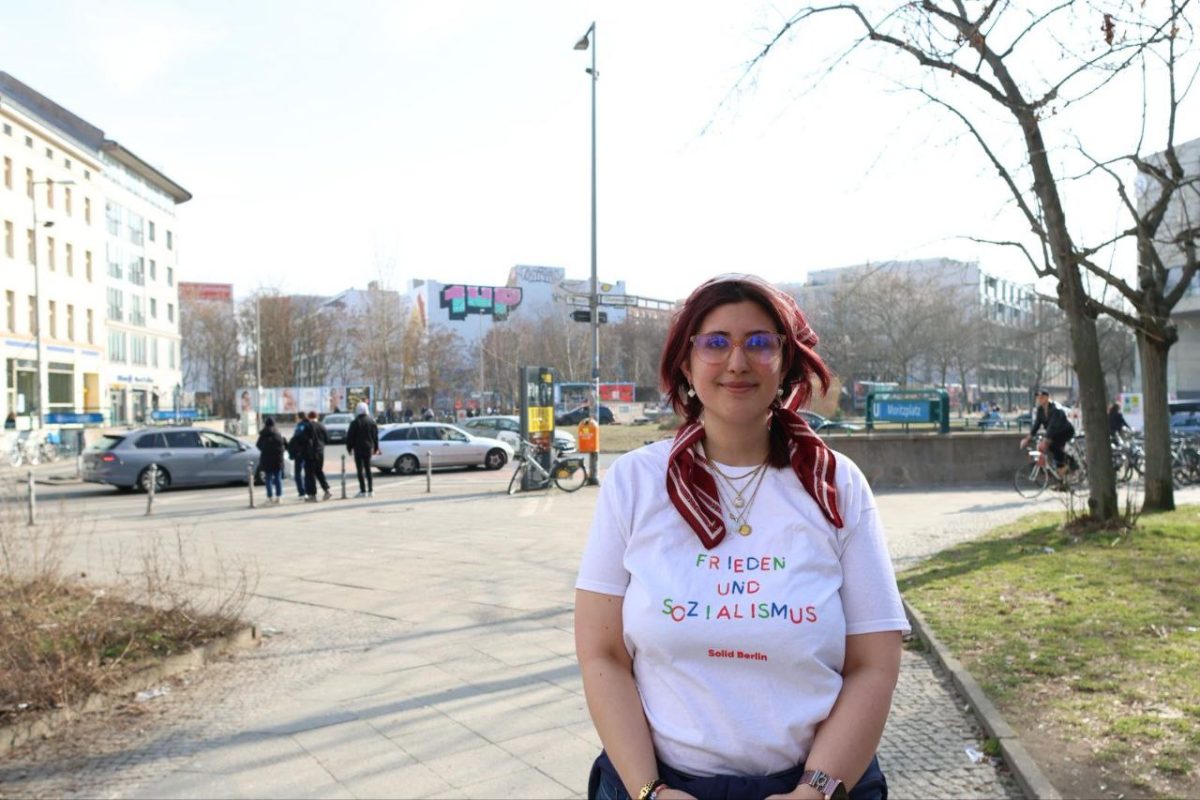
My name is Nessa. I am 24 years old, and I’m on the executive board of “Linksjugend” [solid] – the youth organization of the party “die LINKE”. I’m also part of the Nein zur Wehrpflicht Bündnis – “No to military conscription” alliance. We were part of the organising team of the demos against conscription.
It is just after the latest demonstration when thousands demonstrated in Berlin. How did you mobilise so many people?
It’s honestly crazy to me that it’s grown so much. The last one was also big, and though, in Berlin it’s about the same size (10.000 people), we had around 30 Cities additionally participating in the Strike this time, as well as international involvement across Europe .
We tried to get collaborators on Instagram. We worked our asses off trying to reach as many people, as many schools, as many students as possible. Ourteams went around the city and put up posters about the strike. We handed out leaflets in front of schools. We also talked to student representatives, principals and the parents’ committees.
Furthermore, we reached out to multipliers like Linke MP Ferat Koçak who mobilised for the strike on Instagram. We talked to the artists that showed up and played at today’s demo. We asked them beforehand to advertise the strike and call everybody up.
There were a few people on the demo with jackets from the GEW teachers’ union. Did teachers respond?
Yes, positively. We worked closely together with the GEW. They were also part of the planning meetings and are part of the alliance against conscription. We tried to mobilize together.
Yesterday, German Chancellor Friedrich Merz gave full support for Donald Trump’s war in Iran. Did that play a role in mobilizing people?
It definitely contributed to the mobilization, because there has not been a huge (leftist) demonstration for the cause of Iran yet.
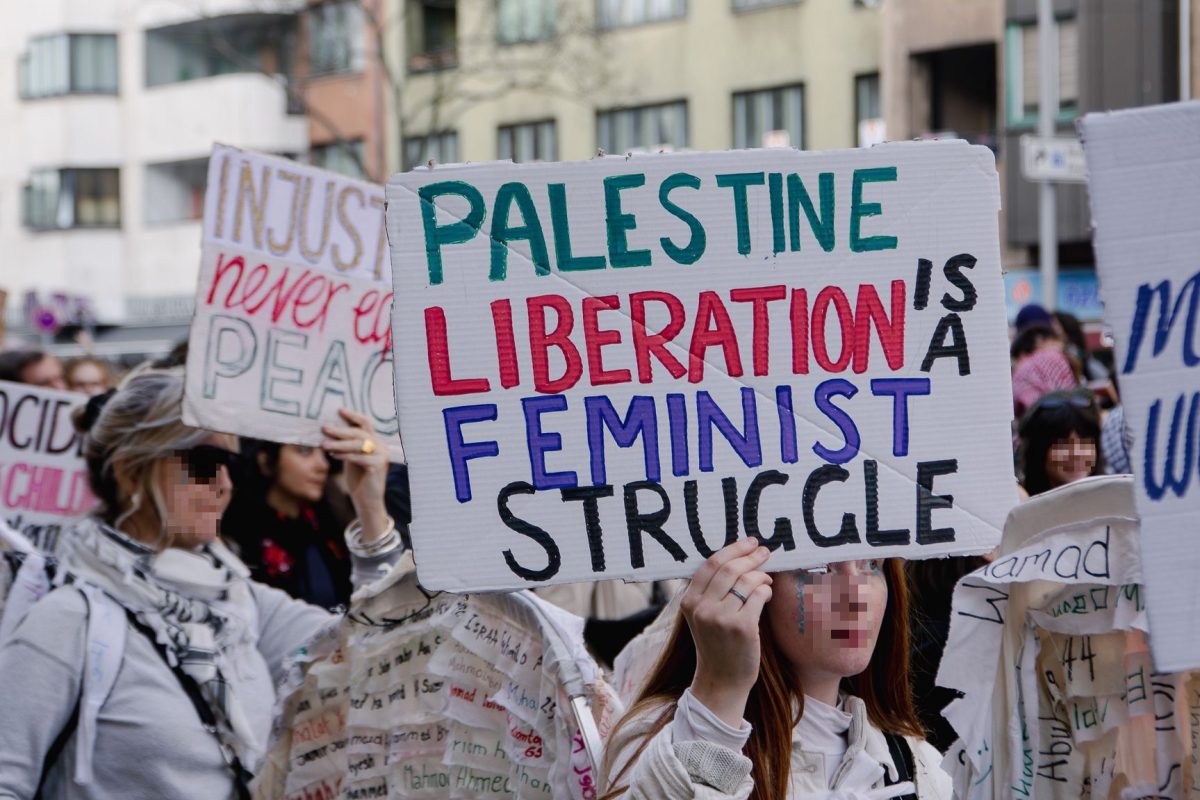
One thing that surprised me positively was the number of people today wearing kuffiyahs or holding Palestine flags. That was not usual for a demo in Berlin. Are you sensing a change in the mood on Palestine?
Definitely. The main change was in visibility. I think people were always in support of Palestine, especially after the situation became so grave. But back in the day, when you wouldn’t see so many kuffiyahs, people tried not to be so conspicuous and attackable.
The situation here in Berlin with the police regarding the topic of Palestine is quite authoritarian. We have lots of repression and violence against Palestine protesters. This meant that people were afraid to openly show their support for Palestine. But now, since the movement has grown so much, people are more and more comfortable about showing support and solidarity.
We also really tried hard to make the connection between the two topics. Oftenthere are single issue demos, and people have one topic which they care about very much, so they only go to those kinds of demos. We try to build the bridges and to intertwine the two topics together, allowingeverybody to be part of this movement, making formore people.
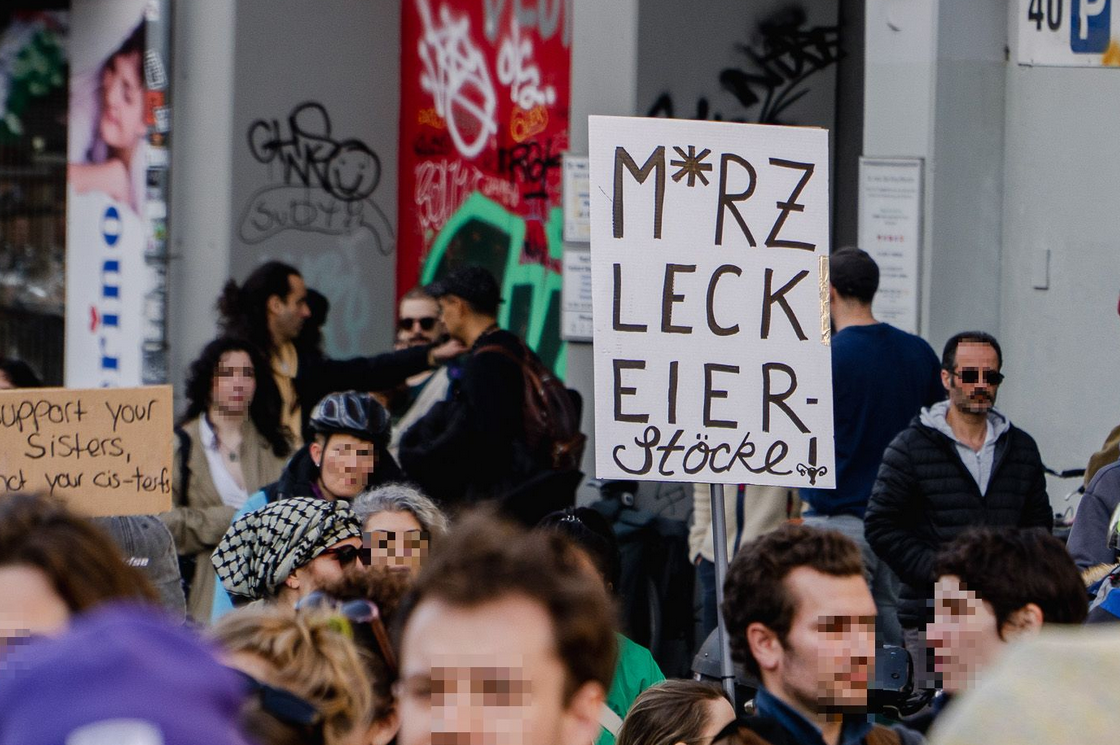
Talking about the police. The police intervened today to ban people from chanting “Merz, leck meine Eier!” (lick my balls Merz) => possible Link to Merz Leck Eier campaign: www.merzleckeier.de leads to: https://schulstreikgegenwehrpflicht.com/repressionen
Yes. A student was even arrested for holding up a sign with those words. They try intimidating us again and again, and people are holding back against it. But it’s a dangerous situation. People know what might happen. Just two days ago, there was a Palestine demonstration where people were very actively attacked by the police. It happens more on Palestine demos. Here, because it’s primarily minors and students, police are probably more hesitant to run into the crowd.
What was good today was that the school students didn’t let themselves be intimidated by the police.
Yeah, that’s also a thing that we tried to instill in them in planning meetings. We had organisers talking about how to handle yourself if you get into altercations with the police, and if they’re asking you questions and something happens.
We also had talks about legal stuff, so that everybody can be calm. These people are very young. For some of them, this is their first demo ever. We really try to have everybody safe at the demo, because it’s so big. Everybody should have a safe place around them and their friends.
How easy is it to coordinate around the different schools? Presumably, a lot of people don’t know each other.
We had different approaches to that across the city and across the country. In Berlin, there are many more schools as compared to smaller towns or cities. We had school working groups that met up regularly in different parts of Berlin, additionally to the central school strike committee meetings.
They gather as many people as possible, giving out flyers and stickers. That went very well. This is not surprising, because everybody loves stickers. We also made posters and Instagram posts. We tried to just reach as many people as we could.
In the working groups that regularly met up, we – for instance – spoke to the student representative on the student council. We also talked to the teachers and the principal. They were sometimes planning together.
It worked differently in different schools, because some schools were more supportive, some were less. But even those that were less in support weren’t necessarily against the cause at all. They were just hesitant to allow the students to organize and meet up because they just didn’t want any legal problems with parents. They were scared.
So organising in the stronger schools helped people in the weaker schools to organise?
Exactly
And as you say, this is largely people who’ve not been involved in any political activity before?
Yeah, not at all. That’s the most astounding part. There are people who you gain from these actions who you can win for the greater political cause. We were together with different youth organizations, parties and NGOs.
We’d get people from “Fridays for Future”, or political parties who would attract new members. It is a great opportunity to gainpeople for the movement and win them for later activism and organization. Politicizing these students and young people takes them on a journey.
This is interesting, because a lot of social movements are very wary of the involvement of political parties. You are saying that for you it was helpful?
Yeah, it was helpful. Because this is very political. You cannot deny it. For some other movements, you could say it’s just this one thing but that’s not very sustainable.
“Fridays for Future” is maybe a good example. They didn’t really have the sort of effect that they hoped for in the beginning. While this may have been the first contact with activism for many, even me, they couldn’t keep them engaged in the long run. That is because they didn’t quite make the connection to real-life politics as clear as we did; and how people get involved and how students can stand up for themselves. We really try to make this connection, and I think it really links to them.
This feeds very well to our next question, what happens next? We’ve now had two school strikes. We still have the Wehrpflicht laws. Germany is just about to get involved in another war. How can you be successful?
The next strike is already being planned. We have a new date, the eighth of May. We are trying to make it a regular thing. We’re just trying to reach more people, to grow more, and to organize and plan better. This puts more pressure on the government to act when everybody is pushing back. Maybe they will. They will find ways to talk about this issue again in the Bundestag.
We are also currently pushing Kriegsdienstverweigerung, or conscientious objection. The involved groups t are organising consultations where people who are affected by conscription can be informed about how to object.
“Fridays for Future” shows that you can have big demonstrations and a popular movement, but this alone doesn’t guarantee success. What else do you think you need to win this fight?
I think a big factor is education. We are really big on educating these young people about the importance of raising their voices and organizing and building these bridges, how everything in the world is politically connected to each other. That is one thing that I personally believe the “Fridays for Future” failed to manage.
We are working hard to push into these young peoples’ heads that if they have a voice – if they want, they can stand up and push back against the things affecting them negatively. There is always a way to make your voice heard. You can do something about the situation that you’re in.
I notice that 8th of May is the anniversary of the liberation of Germans from fascism. Is that deliberate?
Yes. We want to connect it to anti-fascism and the rise of right wing extremism. We want to remind everybody of how you can fight back. On top of that, there is an apparent remilitarisation process going on with the rising production of weaponry and, as you mentioned, Germany’s support in the war against Iran by Israel and the USA. Our students say “no war ever again”, meaning everywhere in the world and they’re very vocal about that. Because, as I said already, everything is tied together.
Germany is not the only country experiencing school strikes. How are you linked to the similar movements in other countries?
We received a request from Italy – an Italian activist reached out to us to get connected. They are facing similar kinds of problems thereand they’re organising protests. We had a European zoom call, where we talked about organizing, and they even invited us to their summer camp.
They asked about how we are organized, and have been trying to get other European countries to join in. I don’t have every country in my head right now, but we now have Italy, Portugal, France, and Slovenia on our side, for example.
What can people do to support the strike, particularly people who aren’t school students, but support the aims
A big factor is talking about it with other people – everybody you know. Talk about the movement. Share it on the social media platforms that we’re posting it on. We have different accounts, like Nein zur Wehrpflicht, Nein zur Wehrpflicht Berlin, Schulstreik gegen Wehrpflicht, and Schulstreik gegen Wehrpflicht Berlin, but many other Cities across Germany have their own accounts.
Get organized, talk to people, go to the meetings. Even if you’re not a student, you can be part of the planning meeting and just organise. If you’re young and have never been politically active at all, talk to your parents about it. Talk to your aunts and uncles and your grandparents about it. Maybe they have knowledge and you wouldn’t even know that they were once politically active.
Just get organised. Get friends to go on the journey with you.
And everyone is welcome to demonstrate on the eighth of May?
One hundred percent!