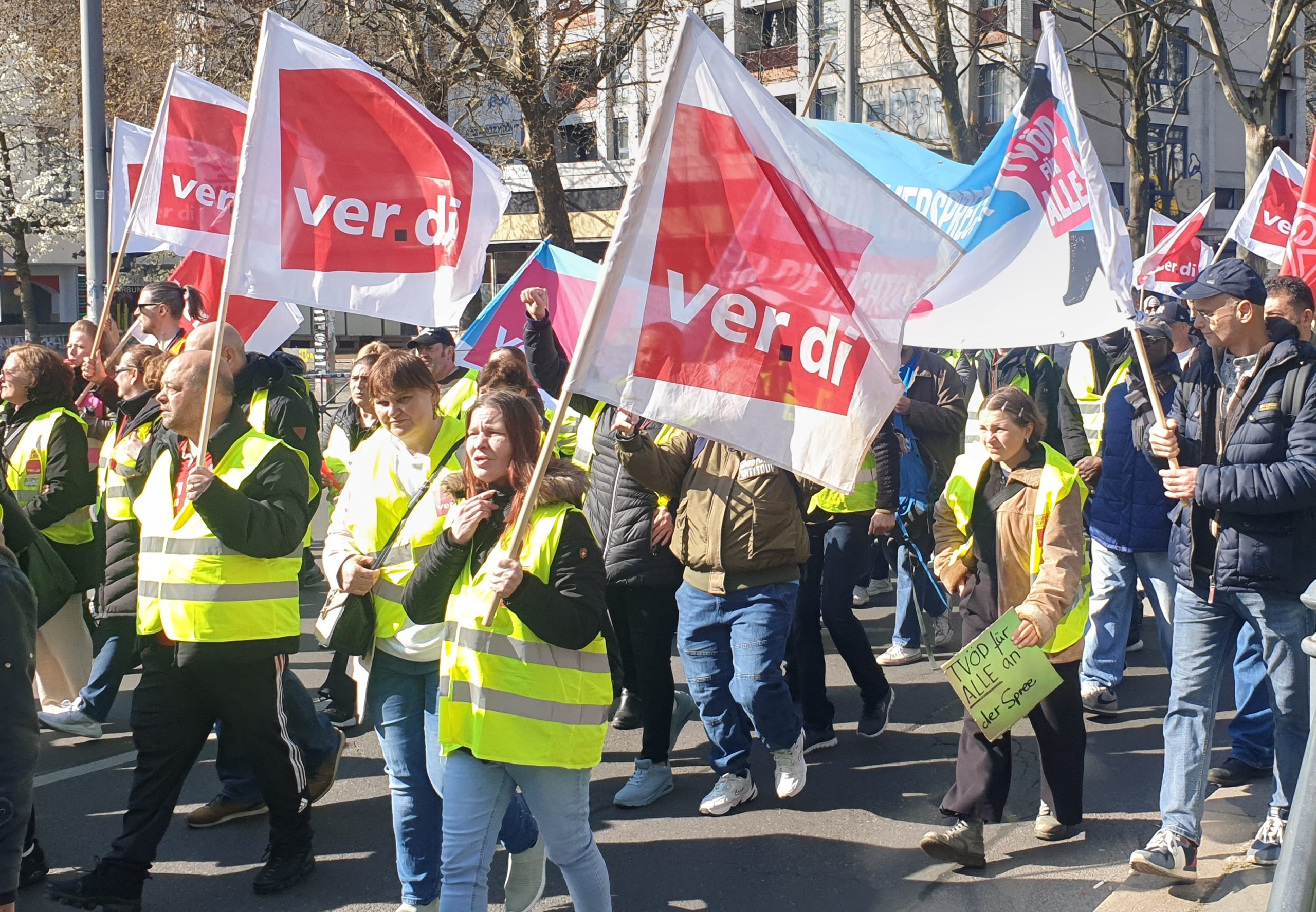
Ancillary workers at Berlin’s Vivantes hospitals began an indefinite strike on Wednesday, 15 April. Their demand is simple: proper pay and conditions under the public sector contract. The city, which owns the hospitals, promised exactly that in 2023, but failed to deliver. Now these striking ‘key workers’ need our support.
Ancillaries are the ones who do all the non-medical work required to keep the hospitals running: cleaning, cooking, security, transport, technical services, stock-keeping, sterilisation and administration. Although they are essential to the hospital’s functioning, their jobs were outsourced in 2005 to a string of subsidiaries known collectively as ‘Vivantes Töchter’. Their pay and conditions are considerably worse than they would be under the general public service pay agreement (Tarifvertrag für den öffentlichen Dienst (TVöD)). According to the union Verdi, the pay gap ranges between 10 and 15 per cent, and other aspects such as pension arrangements also need improving.
The current indefinite strike follows on a longer campaign to increase union membership and create structures for action (team reps as delegates, for example). This included shorter stoppages. The strike ballot found 98.2 per cent support for an indefinite strike. Altogether 2,200 ancillaries are affected. About 500 are members of the union Verdi. On any one day, an activist told me, between 150 and 200 are on the picket lines. The demonstration and mass meeting on Wednesday were attended by around 300. That is worth explaining, as conventional wisdom would suggest that 100 per cent backing is required for a successful strike.
On the one hand, the law requires that minimum skeleton staffing be maintained where a strike affects ‘vital services’. Fundamentally the union agreed to this, but the employer demanded higher levels and obtained a court order. At the mass meeting on Wednesday, workers affected by this explained to their colleagues how they were organising a work-to-rule.
On the other hand, all these workers are hard-pressed financially, and there is understanding for those who feel unable to join the strike every day. Disgracefully Verdi has refused to supplement the normal strike pay of 60 percent. And that’s not to speak of the loss of bonuses for weekend working. Donations are being collected to top up the strike pay (see here). As evidenced by similar industrial action at Berlin’s Charité hospitals last year, a minority strike can certainly be successful in this sector. (In that dispute, Verdi boosted strike pay to 90 per cent.)
The strike is also notable for its high level of participation. Every location is picketed, with regular events bringing together all the strikers. On day one, they all met at Klinikum am Urban in Neukölln and marched through Kreuzberg to a mass meeting at SO36. The decision to continue the strike next week was unanimous by show of hands. On day two, they demonstrated at the CDU headquarters, and the negotiating committee rejected the employer’s blackmail attempts—an offer of a one-off payment of one thousand euros each to be taken off the table if they failed to settle in full (i.e. concede defeat) by 28 April. Supporters are very welcome to attend picket lines and demonstrations (info via WhatsApp channel, see below).
The affected hospitals are: Klinikum Neukölln (Buckow), Auguste Viktoria Klinikum (Schöneberg), Humboldt Klinikum (Reinickendorf), Klinikum am Urban (Neukölln), Klinikum Spandau and Klinikum Friedrichshain. Two hospital catering centres (Versorgungszentren) are also involved,in Reinickendorf (Oranienburger Str.) and Neukölln (Buschkrugallee).
The firms in question are: Vivantes Service GmbH (VSG), Speiseversorgung und -logistik GmbH (SVL), and Vivaclean GmbH.
For up-to-the-minute information on picket lines, demonstrations and developments, join the Vivantes Töchter Info channel on WhatsApp.
Donate here to the strike pay top-up fund.
Robert Dale lives in the Berlin region, where he has been active in socialist politics since the 1980s.