Hi Usayd, great to meet you. Can you start just by introducing yourself? Who are you and what do you do?
I’m a British documentary director. I mainly make films about the global majority and improving the representation of People of Colour on screen. I’m currently based in Berlin.
What brought you here?
Nothing glamorous, really. My partner is studying here.
You have a film coming up in the British Shorts Festival. What’s that about?
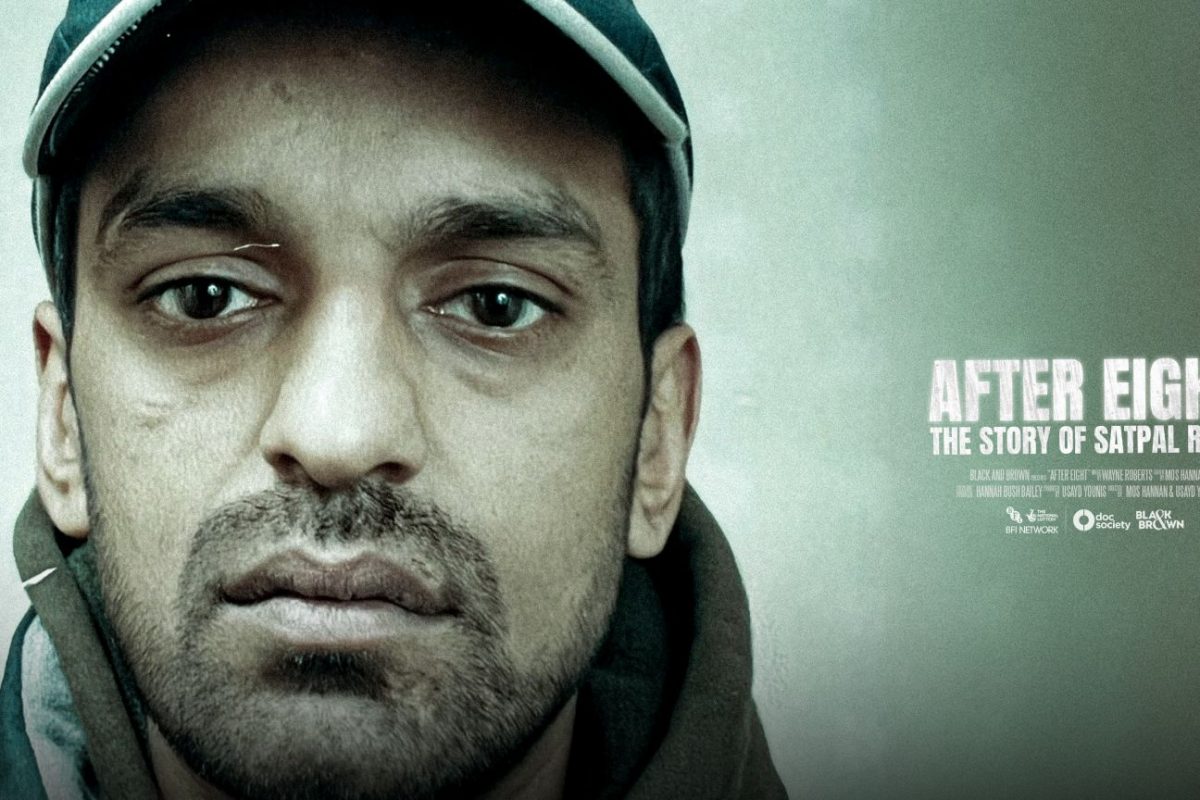
After Eight – The Story of Satpal Ram is about a British Asian man who went to jail in 1986 for defending himself against a racist attack. It’s set against the backdrop of Britain’s post-pub curry culture. From the 1970s to the 2000s you had this thing where a lot of British people would ‘go for a curry’. It was a cheap meal, but many people arrived inebriated and primed for confrontation.
Sometimes that transpired into violent racism, which is what happened here: Satpal was having a meal with some friends, and there followed an altercation where these guys were racially abusing the waiters and saying they didn’t want this “Paki” music on. Satpal objected, and he was cut in the face by this white diner. Satpal defended himself with a pocket knife.
Both of them ended up in hospital, and the assailant ended up dying of his injuries. Due to a series of failures by the judicial system, Satpal was not able to plead self-defence and got convicted of murder by an all-white jury.
Why was Satpal not able to plead self-defence?
A lot of the evidence was not taken into account. There was a presumption of guilt. It is important for the wider context of this project that still today there’s this assumption of guilt when certain types of people are arrested.
In Satpal’s case, this man had sustained multiple injuries. Satpal’s state-provided barrister had not really done his homework, and saw an autopsy saying that the man had sustained multiple injuries. He thought that no-one would believe that it was self-defence.
But most of the injuries were likely from falling on glass. Only two of them were sustained by Satpal’s knife. This completely changes the trajectory of what happened next, because once you change your plea from self-defense to provocation, you’re immediately admitting some degree of guilt.
Other miscarriages took place in the trial itself. The Bangladeshi waiters who witnessed the event were not provided with interpreters. So the jury only got one side of the picture, with no mention of any provocation or violence. The testimony of the people who work in this restaurant and witnessed this racism was completely dismissed. In the film you’ll see how the jury were laughing when the judge said he was going to translate himself.
So Satpal served 24 years in prison?
Exactly. This happened when he was 19 years old. He came out a much older man. We get to see him in the film grappling with the consequences today. It charts this incident, but also what actually happened in prison. The racism and injustices didn’t stop at the trial.
In a world of ever increasing incarceration, it is important to reckon with what is actually going on behind these high walls and metal bars. In Satpal’s case, there was a lot of violence and racism. He experienced many beatings at the hands of the prison guards.
As a result, he was left with the condition of Parkinson’s disease, which is something that you might associate often with boxers, who’ve been beaten around the head a lot.
Like Mohammed Ali…
Exactly. Satpal had a doctor’s note to prove that his condition was clearly brought on by contusions to the head, which would have been the result of violence by prison guards.
He became known for standing up for the rights of other people. He wasn’t just trying to get himself free from the injustice he’s experienced, but also witnessing what was happening to his comrades in prison. He was very vocal about that, and the guards really didn’t like it, and tried to make an example of him. He resisted throughout, and as a result, his sentence was elongated. His appeals were rejected.
But there is an upbeat side to this narrative. His friends and family led a campaign on the outside. This grew into something much bigger. One of the campaigners, Helen McDonald, is a jazz musician. She said ‘we need to do something bigger here, and get some musicians involved’.
She got a number of groups, including Asian Dub Foundation, who were up and coming at the time. Their song Free Satpal Ram reverberated around the globe. Suddenly, people all over the world were singing his name, and he was on the news. He gained a degree of fame that could no longer be ignored by the powers that be in parliament.
Bringing it into today’s context, where we’ve got so many political prisoners, so many people who are in prison explicitly for standing up against injustice. I think that there is a real strength in showing the story of a man who was freed from prison because of extreme pressure from the outside.
The fact that there was so much solidarity: people would visit him in prison and send him letters from all over the world. He said it himself – it kept him alive. One of the things I’d really like people to take away from this is what can we do to support our comrades who are currently experiencing something similar, perhaps even more pernicious.
It’s now become legalized. It’s less miscarriages of justice, and more that this is what justice looks like – with arrests and convictions for people standing against a genocide or against climate catastrophe.
You say the campaign was huge. I’m from Bradford, one of the UK cities with the most people with a South East Asia background. Asian Dub Foundation played Free Satpal Ram at the Bradford Mela – a multi-cultural festival – and the place was buzzing. Then yesterday, I spoke to a friend, a politically aware British Asian, and she hadn’t heard of Satpal Ram. How could such a massive campaign disappear from our consciousness?
This is exactly why we’ve done this project. As a documentary filmmaker, my goal is to bring to light stories that haven’t been kept alive or have been silenced. Ultimately, I think a lot of our narrative as non-white people is rendered invisible. A lot of the time we are presented from a very particular lens.
What really stood out to me about this story is that he didn’t take this thing lying down. He did not say: “Yeah, it’s fine, just be racist and attack me”. He stood up against it, and it cost him in many ways. That’s so important for us now. We’re seeing so much violence towards our communities. So much is reminiscent of a time that people had thought was behind us.
But the race riots in the UK last year, where asylum hotels were attacked, are exactly the same kind of things that happened then. You’ve got Asian restaurants being set alight by arson attacks today. This is all happening now. It’s even more important that people are aware that it has a history. It has a context.
You’ve mentioned two reasons why the film is relevant today. On the one hand, there are the ongoing cases like Palestine Action, on the other active racism on the streets. How can a film change this?
A film is just a cultural piece that aims to galvanize people. It’s part of the wider movement of coming together and being able to draw solidarity from each other.
When we’ve done screenings we’ve had the opportunity to have conversations with people who were involved in the campaign – to gain inspiration and feel recharged. Educating people so that these things are not forgotten is important, but it doesn’t end there.
The film is part of a wider campaign to draw attention to what’s happening now and how you can utilize some of the techniques that people used back then that were actually really innovative at the time. The Internet was barely a thing, but people were flooding the Home Office fax machines. How can we translate that to today’s context? It’s so important to learn from our history, especially a history that may be otherwise completely forgotten.
How much chance will you have at the British Shorts Festival to discuss issues raised by the film?
One of the challenges with making a 30 minute film like this is that it stands alone, so having to program it alongside other films has been a challenge. We’re available to do a Q&A and hopefully there is a chance to have a conversation. I’m going to be there with my co–director, so there will be at least the opportunity to talk to us.
We do have the tools now to be able to take something that you see in a physical environment and carry that conversation on. Some showings will be accompanied with a Q&A, but in some instances, like the Shorts Festival, just being part of the festival makes a lot more sense. It’s quite hard to get programmed as a single short film.
But as you’re based in Berlin, the possibilities of organizing further screenings will still be there?
Of course. This is not just a British experience, though there are some uniquely British elements to this film. The UK has a much bigger South Asian population, for example. But I think Germany has some serious reckoning to do when it comes to racism and the right.
Germany has a lot to gain from learning from experiences of other parts of Europe, and thinking about how you treat your own non-white people who live here. I saw a staggering study recently saying that one in four people who come and live in Germany consider leaving. As someone who has been living here for 2 years I can fully understand that.
The racism here is even more blatant and direct. In the UK, they learned the language of shrouding some of that racism. And maybe it’s not always as blatant, but here It’s really transparent, Germany will gain from learning from these stories as well.
Do you think things are getting worse in Germany at the moment?
Absolutely. You can’t ignore the fact that for more than two years, there’s been a genocide that Germany has taken an active role in. We have had to reckon with the fact that many of our compatriots here are not willing to advocate for the rights of people who don’t look like them, and are actually happy to allow their country to fuel extreme violence towards the Palestinian population.
Germany has many facades about reckoning with the past, but justice is not the agenda here. A lot of people have just been trying to make themselves feel better about their history.
Do you think there’s a direct link between the demonization of Palestinians and racist attacks?
Yes. It would be a lie to say that this isn’t something that’s been here all along. When you constantly and consistently claim that one particular community are the villains, that is the pretence that can be used to recreate many of the conditions that already existed here in another context,
Let’s get back to your film. When and where can people see it?
After Eight is screening on 24th January at 5pm in Sputnik Kino next to Hasenheide as part of British Shorts. If you can’t make that, then look at our website and Instagram page where we’ll have future screenings listed. We are also planning to get the film available online. We’re in talks with some fairly big online platforms, but that will be later in the year. Keep an eye out.
If someone sees the film and is appalled by what they see, what can they do?
Firstly they should spread the word about the film itself. It’s important that people know this story. But ultimately, it is about questioning in your context, how does this narrative apply?
In Germany so many have been arrested with spurious charges just for daring to speak out. It’s important to think about what we can do to help. Can you offer material or emotional support for these people? What did you take from this film in terms of the strategies, the organizing and the collectivizing?
I think the individualization of struggle makes you feel small. But one of the things that stands out is that this really was a campaign. The way we found Satpal is a good example. We found him through somebody in Canada, even though we were in the same country as him. It ‘s all about the strength in numbers.
So it’s not just a film for British Asians?
No, definitely not.
Is there anything we haven’t covered that you’d like to say?
One thing. As a documentary filmmaker here, I think it has been a challenge for me to figure out how to do this kind of work here, which is really directly challenging the status quo in Germany and in Berlin. It doesn’t seem like there is an environment which encourages independent work.
I think that is why organizations like The Left Berlin are so important, because it seems like most cultural production is tied to institutions. This became very apparent post October 7, where funding was being cut left and right. Why are so many people dependent on the state, when the state itself is what should be challenged?
The work I’m trying to do is to be directly challenging and to reset the narrative. And to be able to do that, you have to be independent.
After Eight – The Story of Satpal Ram is directed by Mos Hannan and Usayd Younis. You can see trailer here. You can buy tickets for the screening in Sputnik Kino on 24th January here.