At the EU-Western Balkans summit, Commissioner von der Leyen claimed that the European Union “will not be complete without the Western Balkans.” This chorus has been sung for over 20 years, but is a changing world forcing them to sing it with feeling?
Two years ago I was driving along a pristine yet empty road of charcoal-coloured tarmac with bright white markings, cutting a corridor through the green hills and golden meadows of the Serbian countryside. In GDP per capita, Serbia ranks below Kazakhstan, Russia, and Turkey, but this highway shamed that of Austria or France. I approached an underpass with an exit leading to farmers’ fields and small holdings. Painted across the side of this titan of infrastructure were the words: ‘Built by the People’s Republic of China.’
In 2018-2019, China produced almost as much cement as the US did throughout the entire 20th century. Building is a compulsion of the Chinese state — and in the case of this Serbian road, an export. The People’s Republic has pumped $1 trillion worth of loans into almost 150 countries worldwide, financing Southeast Asian high-speed rail projects, the expansion of European ports, and a huge number of infrastructure projects on the African continent.
The infrastructure is about more than utility. It is a way of commanding legitimacy. The claim made by the Chinese state to its citizens is that they are being propelled into the future, and the continuous sprouting of roads, buildings, and railways gives that story a feeling of physical credibility. Projecting this logic internationally, the sign on the Serbian highway is a claim to the driver that partnering with China is a path to development.
Western Europe has long projected a similar claim. In the post-war settlement, with each generation feeling better off than their parents, Western European states enjoyed widespread legitimacy among their publics. The economic model proved an attractive offer to many in Eastern Europe and the Balkans looking in from the outside at the end of the Cold War, and the political class tied their careers to moving closer to Europe. In material terms, this usually meant joining the European Union.
The costs of this move went beyond just democratisation. What took place was a rapid and intense restructuring of economies, and an unleashing of private capital on industries previously owned by the state — public banks, state assets, and energy infrastructure were bought out by European multinationals, and a new class of economic elites was born. The promise of ‘Europeanisation’ was leveraged to force a convergence of the economic and social order of the continent towards the EU’s model of capitalism.
This worked as long as it presented itself as the only and inevitable path to prosperity. But, a continued cost of living crisis is shaking the EU’s internal stability; the slow withdrawal of the US from Europe is causing the bloc to think about what an independent security architecture looks like; and the rise of China is placing other offers on the table. With these things combined, the landscape is changing.
The Iron Friendship
During the COVID-19 pandemic, states in the Western Balkans who relied on the EU for their vaccines suffered due to long delays. Serbia was a country that hedged its bets and was able to access vaccines from the Russian and Chinese markets, and dress their doctors in PPE provided for free by Russia and China. Serbs were vaccinated before their neighbours, and Serbia was a frontrunner in all of Europe for vaccine rollout.
The COVID response was a win for the authoritarian president, Vučić, who strengthened his own legitimacy by presenting himself as leading the way in pandemic management, and a loss for EU membership. Public opinion in Serbia continues to swing away from Europe and towards its “Iron Friendship” with China; Serbs are more likely to trust China than the EU; and many view China as a bigger supporter of the country’s development. Despite applying for EU membership in 2009, the country is feeling fatigued, and only 33% would be likely to vote for it now in a referendum.
The EU attaches conditions to cooperation, but Russian and Chinese support comes with fewer strings attached. This is typical of Western partnerships, and a pattern familiar to the Global South. As the popular (though likely apocryphal) saying goes: “every time China visits we get a hospital, every time Britain visits we get a lecture.”
The EU-Western Balkans Summit
“The commitment of the European Union to the Western Balkans is real,” said the European Council president, Antonio Costa, in anticipation of the EU-Western Balkan summit in Tivat, Montenegro last week. This refrain has rung out every year since the first summit in Thessaloniki in 2003, where it was declared that “the future of the Western Balkans is in the European Union.”
Croatia is the only one of the Western Balkan states to have joined the EU, Eurozone, and Schengen. Serbia applied for membership in 2009, but negotiations stalled in 2021; North Macedonia applied in 2004, only opening negotiations 17 years later; Montenegro hopes to be the next state to join the EU by 2028, 20 years after it dropped its application onto the desk of Commission President Barroso in 2008.
EU accession is based on conditionality — that is, the ability of states to meet conditions relating to their democratic institutions, their market economy, and their ability to take on the obligations of membership. Together, they are known as the Copenhagen Criteria.
The criteria mix democratisation and the transition to capitalist social relations into a single process, and they have been implemented in the Western Balkans under the banner of state-building and modernisation. In an era when Western liberal democracy was hailed as the end of history, reforms could easily be sold as following the flow of the river to avoid being thrown up against its banks.
Serbia has opened 22 out of 33 accession chapters, but negotiations have now stalled — mainly over the unresolved issue of Kosovo, and Serbia’s refusal to join EU sanctions on Russia.
For the EU, enlargement has always been less about Balkan development and more about its own strategic goals, its institutional capacity, and its willingness to absorb a growing political union.Hungary’s lifting of their veto on Ukraine’s EU accession (and by extension Moldova’s) has brought enlargement back to the surface. Progress for Ukraine will create further disillusionment without tangible accession progress in the Balkans.
In what the EU-Western Balkan summit called an “increasingly complex geopolitical landscape”, the strategic goals are beginning to realign with the wants of the political class of the Western Balkans, forcing the EU to find that institutional capacity and willingness from somewhere.
An indecent proposal
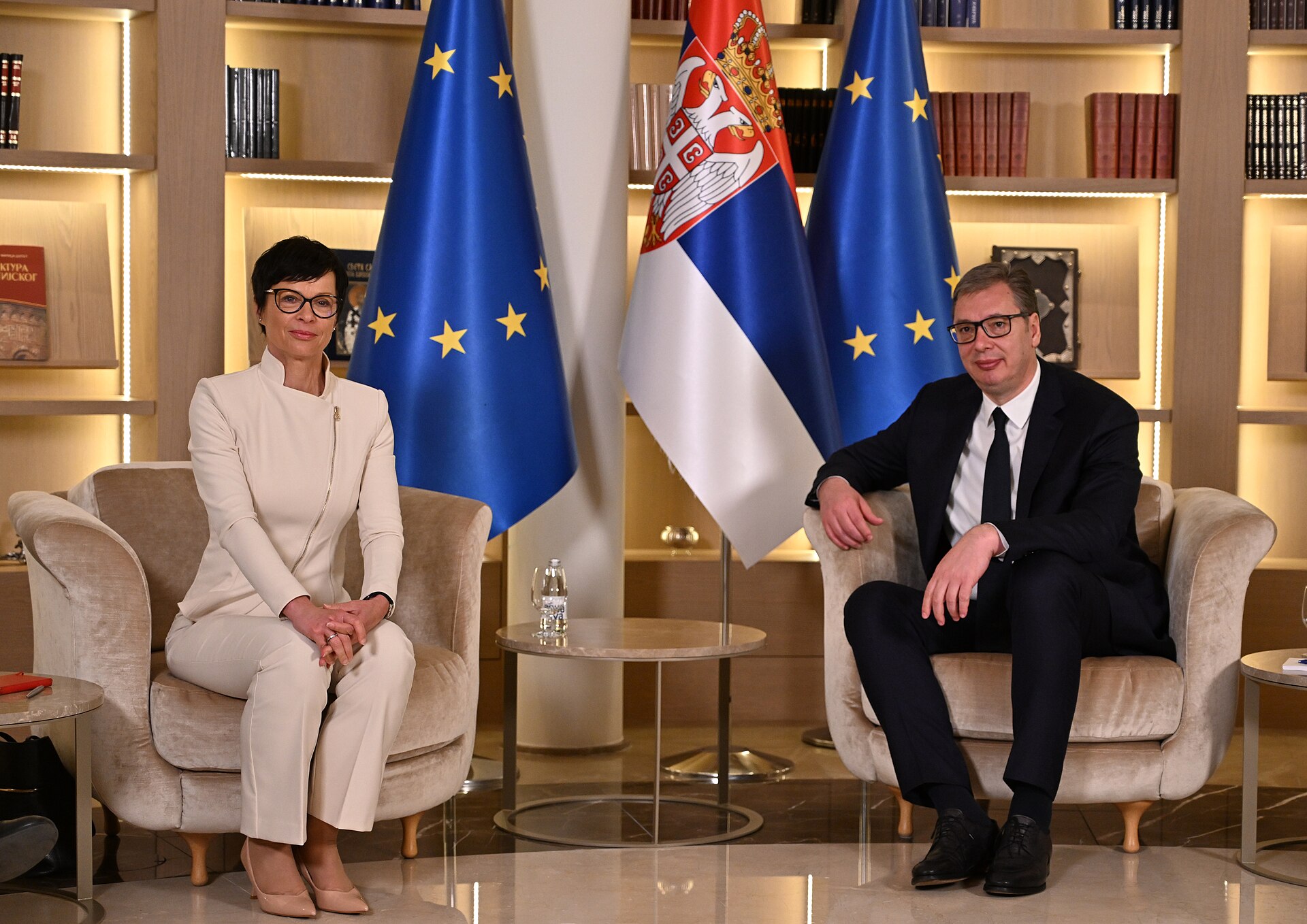
Two months before the summit, Vučić and Albanian Prime Minister Edi Rama presented European Union leaders with a proposal. Published in German newspaper Frankfurter Allgemeine Zeitung, the op-ed argued that candidates had become lost in the weeds of accession, and something needed to change. The proposal was a faster access to member benefits in exchange for second-tier membership. They offered to initially waive their right to veto as well as representation in the European Parliament and European Commission, while entering the single market and the Schengen zone.
The EU has tried in the past to enforce reform after states have already achieved membership. When Romania and Bulgaria acceded in 2007, it was under the condition that the rule of law, justice system, and public administration would continue to be monitored, but once membership had been won, the major incentive vanished.Since then, the EU has taken an all or nothing approach to new members.It worked with Croatia — the newest member of the EU — but no new members have been admitted since.
And so, at the summit in Montenegro, Chancellor Merz and President Macron circled their own proposal strikingly similar to that of Vučić and Rama. It was one for “gradual integration”. They suggested offering benefits that would amount to partial membership to strengthen the incentive structure of EU accession.
The official framing of enlargement into the Western Balkans was as a “crucial geopolitical investment.” The EU affirmed the financing of armies of the Western Balkans through the deliciously Orwellian European Peace Facility. Citizens were promised an additional sweetener at the summit too, in that they will soon be able to make calls across the EU without any charges — roam like a European.
Economic liberalisation matters more than democratisation
So Vučić —minister of information under Slobodan Milošević — had some good news to return home with. But home is where journalists face regular harassment, where large media outlets are rewarded or pressured into favourable reporting of the government, and where the police have cracked down violently on anti-corruption protestors since the canopy for a newly opened train station collapsed and killed 16 people in Novi Sad in 2024 (to complicate matters, the station was renovated as part of the same Belt and Road Initiative that laid the new highway).
Serbia has reverted to the kind of authoritarianism that existed under Milošević, but now with the social relations of capitalism. Brussels remains critical of Serbia for its democratic backsliding, but the Serbian economy is already deeply integrated into the EU, and joining the single market and Schengen zone would deepen economic integration further.
The EU flirting with the idea of partial membership could be a sign that the economic elements of the Copenhagen Criteria were more important than democratisation, and that authoritarianism can be tolerated, as long as geopolitical aims are being served. Vučić can now return home with a chance to further cement his own legitimacy.
A genuine turning point?
Vučić and Rama’s intervention, and its apparent endorsement by France and Germany, would have been unthinkable just a few years ago, but the global dynamic has changed. Progress on Ukraine’s accession has created a sense of urgency, and hanging over everything is the fading of the US security umbrella that has hovered over Europe since the end of the Second World War. In the face of these changes, the EU is pulling its neighbours close.
The apparent embrace of simplified accession at the summit in Tivat is a sign that the EU can no longer rely on its position at the end of history, calling down the road towards non-member states to come and join them in the lush rolling hills of liberal democracy.
Instead, the EU is scrambling to pin down its position in a changing world in which it is losing its leverage. A world in which leaders like Vučić can carve out roads towards the benefits of membership without shaking the ground beneath them — smooth roads of charcoal tarmac with bright white markings.