What has “Widerstzen” achieved?
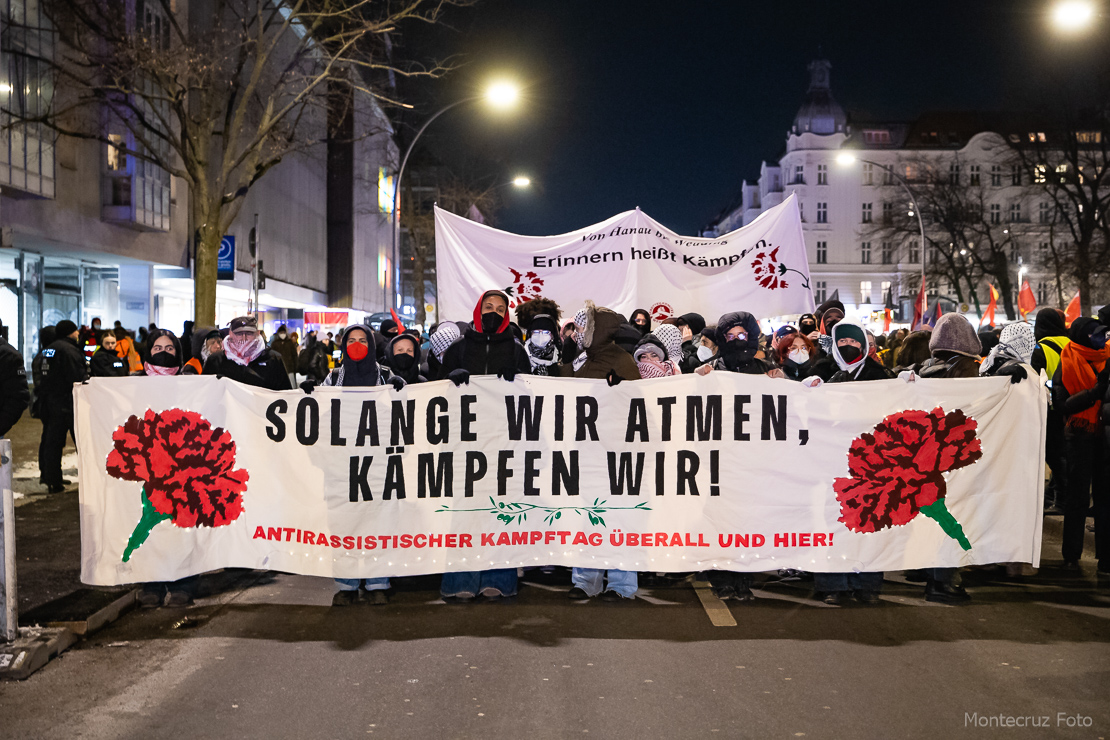
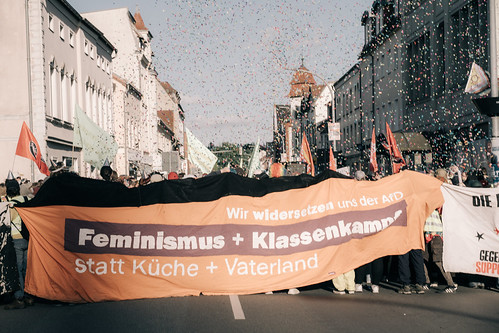
After Giessen comes Erfurt. For over a year and a half, the alliance “Widersetzen” (Resist) has been organizing acts of civil disobedience against AfD party conventions and the founding of the new AfD youth association. Previously in Essen (June 2024), Riesa (January 2025), and Giessen (November 2025), they succeeded in disrupting and delaying travel to and the staging of party meetings on a massive scale. With great media coverage, the message was: no room for the right wing.
“Widersetzen” operates locally at a high level of logistical expertise. This must coordinate the nationwide arrival of buses and the traffic blockades of the various “fingers” / demonstration groups despite the police presence. [editor’s note: the Fünf-finger Strategie (five finger strategy) involves several demo blocks trying to break through police lines simultaneously. It was developed at anti-capitalist protests such as that against the G8 in Heiligendamm in 2007)].
At the same time, they use a high level of social competence in the preparation and follow-up to train the participants’ awareness and give them a sense of security in collective structures. “Widersetzen” thus generates self-efficacy in times of fear and “action gridlock.” ‘Widersetzen’ sees itself as part of “movement building” with its “networks of solidarity.” Its “campaign logic” and focus on the AfD (Alternative for Germany) triggers both criticism and discussion.
Widersetzen does not organize demonstrations, but rather it organizes civil disobedience by means of blockades. This means that participants need a dose of courage to physically position themselves on streets and intersections and thus literally resist the large contingent of AfD personnel and police. They also have to put up with hours of night-time travel in all kinds of weather. The group focuses on coalition politics, bringing in activists, trade unionists, for example Omas gegen Rechts, among others. This has to do with the urgency of the motivation, but also with the way the action alliance addresses, welcomes, and supports them.
Widersetzen is a relatively new action alliance that has carried out three campaigns in less than two years, but has had—with quite spectacular results. Fifteen thousand people traveled to Riesa and Giessen, significantly delaying the AfD events. Eighty-five thousand people now follow “Widersetzen” on Instagram. Around a hundred local groups have been activated nationwide., and sStrategic discussions are being held in specific working groups. For example: “How can an anti-fascist movement in Germany grow and act efficiently without falling into rituals of exclusion?”
Especially – after the brief mobilization following Correctiv’s investigation into the secret plan (early 2024) and the Brandmauer discussion in winter 2025. – grow and act efficiently without falling into rituals of exclusion?
How does ‘Widersetzen’ organize itself and its supporters?
Anyone who wants to participate takes part in action training. This instructs a large group of people, both precisely and kindly, on the various legal aspects and strategies of joint protection and resistance behavior. Those who attend these meetings learn and are prepared for joint action. The collective preparation leads to joint action and allows a follow-up, both personal and political. Such interactive care behavior is unusual for a political initiative, especially since it involves thousands of people, some of whom have no experience of resistance. The introductory meetings are about imparting experiential knowledge, care, and practical training. This is not a theory course nor one on the history of civil disobedience, nor to debate strategies for anti-fascist resistance. This makes it easy to get started immediately without arguments between different political positions. The focus is on the obvious action: no room for the right wing. Many can agree with that.
The homepage “Widersetzen” (resist) suggests neither an anti-fascist theoretical organ nor a militant left-wing project. In April 2024, the first online-meeting took place with 170 participants, who decided after 90 minutes to organize a nationwide resistance. After only 10 weeks of mobilization, around 7,000 people took part in their first actions.But the group also acknowledges its own weaknesses. Initially insufficient resources led to “unstructured work to defend against repression.” There was a lack of systematic legal review of the protests and clear agreements. Almost all processes were improvised spontaneously (www.widersetzen.com).
Learning from this, six months later, preparations for the blockades of the AfD federal party conference in Riesa were more thorough., Many, many preparatory action trainings took place nationwide, in union rooms, left-wing centers, and social spaces. They drew on the experiences of a network of movement-oriented action trainers in the run-up to and during the 2007 G8 summit in Heiligendamm.
On the website skillsforaction.noblogs.org, they offer their knowledge in the form of workshops, comprehensive manuals, and handouts. This knowledge transfer increased individual and collective capacity for action, and reduced fears and new things were learnt collectively. Anyone who wanted to board the buses to Riesa at 2:00 a.m. at the Berlin bus station had the chance to be prepared. They knew about the idea of civil disobedience; communication structures among themselves; mutual protection during the action; how to behave in the event of police intervention; the contact numbers of the investigative committee; practical equipment, and the action sticker. These preparatory meetings, some of which were attended by 60 to 80 interested people, already generated a feeling of group spirit, reliability, solidarity, and resistance “at home.”
Widersetzen is a network in the making. An activists’ conference was held in Leipzig in October 2024. Thereafter structures became more professional, large digital planning meetings were introduced, and a clearer division of labor was established within the nationwide network. In addition to the network of local groups allowing decentralized anti-fascist initiatives, working groups meet to discuss awareness, repression, press, etc.
Formally, “widersetzen” has no legal form; it is a donation-based alliance. Almost 100,000 euros were raised for the action in Giessen. In terms of press law and accounting, the VVN / Association of Victims of Nazi Persecution – Federation of Anti-Fascists e.V. is listed in the imprint. In Berlin, a group of about 80 people now meets weekly forming.As Mila from the Berlin group reports, it is:
“a completely separate local group with its own understanding of political work. Like many other local groups from Mecklenburg-Western Pomerania, Rostock, Hamburg, and Greifswald, we supported the protest against the Nazi march in Demmin, but also last fall’s migrant-led We’ll Come United caravan from Thuringia to Berlin… “Widersetzen is an action alliance of groups that work in very different ways and have different political analyses, but nevertheless say: we can at least agree that we see the AfD as a great danger to democracy, to social cohesion, to solidarity, and that with the AfD, fascism is becoming increasingly likely. Mass civil disobedience is important because demonstrations alone no longer have any effect. There are a lot of people who no longer know: what can I actually do? Widersetzen offers them a collective space.”
How have “Widersetzen” activists assessed the organisation themselves?
Back in June 2025, Raul Zelik asked in an article “Drivers of Fascism” whether fascism stems from fascist movements, or whether it “represents a deepening of existing power relations, in which the self-restraint of sovereign power (…) is lifted in the face of a crisis?”
However in issue 720 from last November, Antifa AG of the Interventionist Left warned against underestimating the independent danger of organized fascism, and sees Widersetzen as more than just as a one-off campaign.
“Through its reach and networking, ‘Widersetzen’ is more than an action alliance. It is a place for discussion, strategy development, and anti-fascist (initial) organization. (…) An anti-fascist movement must be able to build social counterpower. But that takes time and movement building.”
In December, the group “Demos neu denken” (Rethinking Demos) criticizes that the greatest strength of ‘widersetzen’ is also its limitation, namely its “campaign logic”. It calls instead for demonstrations to be understood as “movement publics” and “spaces for collective opinion-forming,” promoting self-organization and small groups. On January 20, Mine Pleasure Bouvar writing for a&k 722 summarizes these critiques with a 1932 quote from the German communist Ernst Thälmann:”The Anti-Fascist Action was too focused on demonstrations, conferences, and the offensive against Nazi terror, which undoubtedly has a good revolutionary side; but the Anti-Fascist Action was not sufficiently oriented toward strategic work in the factories and at the stamping stations.”
What is the current focus of work?
January 26, 2026: Just seven months before the state elections, the AfD in Saxony-Anhalt presented a 156-page draft of its election program, which is to be adopted at the state party conference in April.The party wants to counteract the alleged “extinction of the German people,” as it says verbatim, and to no longer provide state support to churches. A proposed “voluntary citizens’ watch” is to be introduced, subordinate to the public order office. Authorities are no longer to check the political views of gun owners. The State Agency for Civic Education is to be abolished as a “left-wing indoctrination institution.” Inclusion is to be ended, and children with disabilities are to be placed in special schools. History lessons are to teach the origins and “success story of this state.” The “normal family consisting of a man and a woman, from which children are born” is to be the model, and rainbow flags will be banned in schools. Associations should only receive funding if they have made “a credible commitment to the democratic order and a patriotic attitude.” Etc.
The AfD currently enjoys 40% voter support in Saxony-Anhalt. Regardless of differing analyses of fascism and capitalism, resistance – Widersetzen is necessary: now!