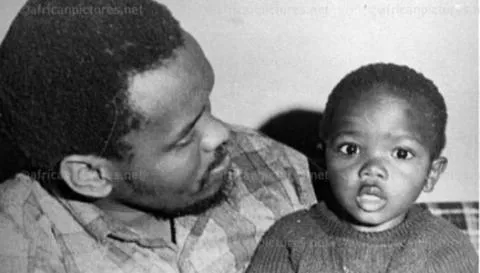
September ‘77
Port Elizabeth weather fine
It was business as usual
In police room 619
So begins Peter Gabriel’s 1980 song “Biko.” By the end of the day, Black Consciousness activist Steve Biko would be dead—murdered by the police of apartheid South Africa. He was just 30 years old. Thirteen days later, more than 20,000 people attended his funeral. Many more who tried to attend were turned away by the police.
After the Sharpeville massacre in 1960, the apartheid government banned the ANC and the Pan African Congress. Morale among Black activists was low when, later that decade, Biko became the first president of the South African Students’ Organisation (SASO). SASO fought for Black self-organisation, separate from the leadership of white liberals who had dominated previous movements. As Biko wrote: “True to their image, the white liberals always knew what was good for the blacks and told them so.”
Biko’s Black nationalism was influenced by the international revolts of 1968, Malcolm X, Frantz Fanon, and Stokely Carmichael’s call for “Black Power” in the USA. When Black resistance in South Africa regained strength with the Durban strikes of 1973, Biko became one of the most important voices in a movement that was gaining confidence. That same year, the state placed him under a banning order. He would go on to play a leading role in the Soweto uprising of 1976.
Soweto was a reaction to the government’s demand that Black students be taught in Afrikaans—the language of their oppressors. It followed school boycotts in the preceding months and began with a student demonstration on June 16. The protests were met with brutal violence, with the police killing 176 protesters, mainly children. Despite the repression, the Soweto uprising achieved its immediate goal: the policy of compulsory teaching in Afrikaans was dropped in July. Many see Soweto as the first step towards ending apartheid.
In August 1977, after being arrested at a police roadblock, Biko was captured, tortured, and held naked for 20 days in handcuffs. As a result of the beatings, he suffered a brain haemorrhage but was not given medical treatment. Instead, he was driven for 12 hours to a prison hospital 700 kilometres away in Pretoria. He died there on the night of September 12. Justice Minister Jimmy Kruger responded by saying: “I am not saddened by Biko’s death. His death leaves me cold.”
Today, if people know Biko’s name at all, it is usually because of Peter Gabriel’s song or Cry Freedom—a film told largely from the perspective of the white liberal journalist Donald Woods. He deserves better than this. You do not have to agree with all of Biko’s politics to recognise that he was a courageous fighter against apartheid who died too soon. At a time when South Africa’s ANC government is showing signs of corruption, we need more Steve Bikos—both in South Africa and throughout the world.