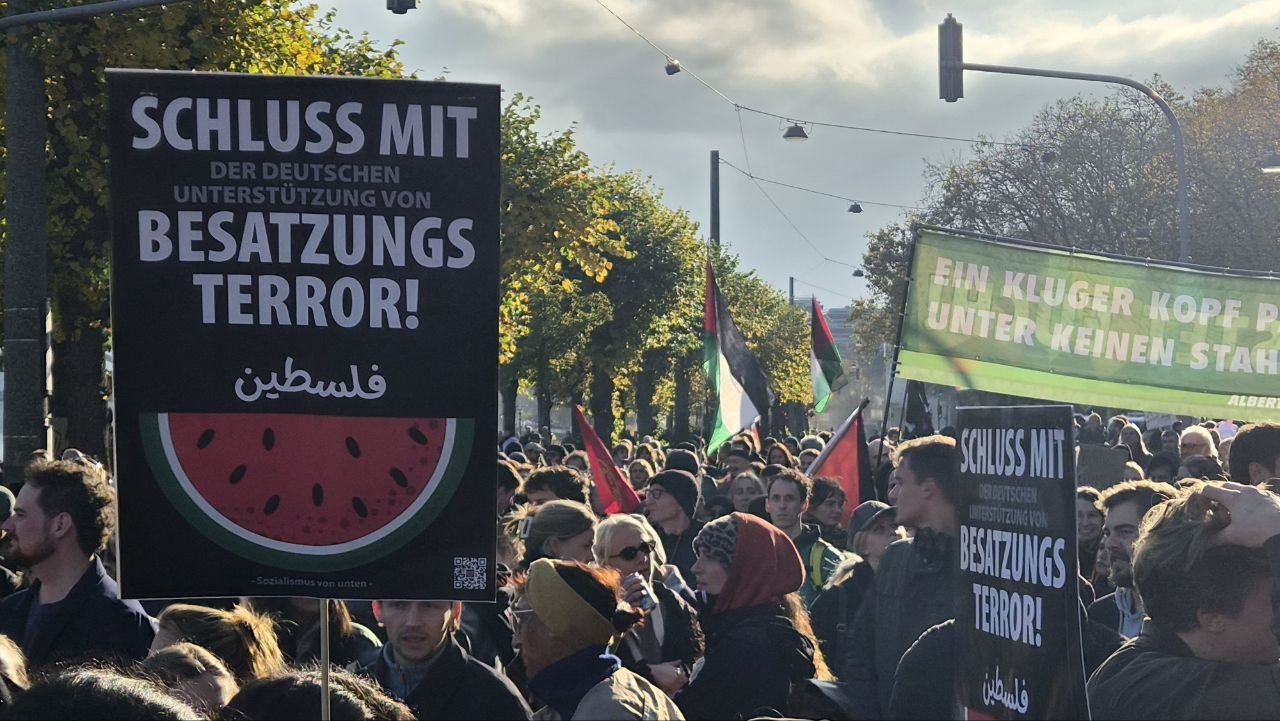
The Gen Z protests that erupted in 30 cities across Germany over the weekend are certainly not comparable in magnitude to their counterparts in France, despite all the moral panic that has flooded the media in the past couple of weeks and luxury boutiques barricading themselves in wood. However, they are significant in other ways.
Unlike in France, they have erupted in a context, where labour militancy has been far more contained, owing to the German trade union bureaucracy’s timidness and greater level of integration within German capitalism.
One of the reasons for the crisis of the French political system in the past two decades has been the inability of governments to push through reforms of the labour market. By contrast, the SPD government led by Gerhard Schröder in the early 2000s was able to push through the Agenda 2010 reforms with the blessings of a trade union bureaucracy which was able to prevent too much workplacce resistance.
This means that German Gen Z protests are pushing new layers of youth into the political arena that lack clear frames of reference for mass militant struggle (as opposed to specific campaigns, for instance, antifascist protests or the 2017 G20 protests in Hamburg), unlike the French youth that can look to the experience of more recent mass struggles by the trade unions or the Yellow Vests.
Another difference concerns the lack of political representation. While Jean-Luc Mélenchon appears as the de facto institutional representative of the protests, building on numerous insurgent presidential campaigns, there is no similar political figurehead in Germany. While Die Linke rank-and-file have participated in the protests, the leadership has been far more busy hashing out the details of its treacherous coalition deal in Berlin, while engaging in damage control over leaks to the Spiegel, according to which mayor-elect Elif Eralp feels “threatened” by radical pro-Palestine elements (the media spins this story as Die Linke being incapable of governing Berlin – “Look! Their own candidate admits to not having a grip over her own people”). All the leadership’s discourse about a “socialist class party”, which, however, has nothing to say on key issues such as Palestine or the war in Ukraine, appears as nothing but hot air for consumption by the progressive, yet thoroughly electoralist millennial academic intelligentsia. The kids are far more ahead.
So, the protests are way to the left of the institutional representatives of the left, not just in their endorsement of Palestinian liberation, but also in their clear rejection of militarism and the drive to war. The last element represents the final nail in the coffin of the liberal astroturfed “solidarity with Ukraine” (a code for rejecting any moves towards peace) that erupted some five years ago, which proved fertile ground for the “peace” demagogy of the far-right AfD. The protests immensely complicate Merz’s drive to create Europe’s largest standing army and are threatening the AfD’s currency as a perceived anti-establishment force.
There are, of course, key similarities. The question of race has been prominent. Like in France, politicians have attempted to blame “migrants” and “migrant milieus” as instigators of the demonstrations. In Germany, this is not simply the result of prevalent state racism and Islamophobia. It is also an establishment response to the fact that this movement follows in the “post-migrant” footsteps of the Palestine solidarity movement, having overcome the longstanding division in Germany between predominantly academicised and white political activism on the one hand, and diaspora activism by those with “migrant backgrounds”.
Mainstream reactions to the protests span from calls by the conservative CDU’s Berlin youth organisation to deploy the army against “looters”, to less hostile coverage that casts these protests as being merely about better schools and future prospects, while silencing the strong anti-draft and antimilitarist sentiment, not to mention, of course, solidarity with Palestine. The pattern is all too familiar: Create divisions between “violent extremists” and those distancing themselves from them, often with racial undertones.
The movement can potentially generate the polarisation from the left that is needed to drive back the AfD. Meanwhile, the far right has been on the defensive last weekend. A number of videos commented on the number of Palestine flags, including one from Israel Today, which complained that the GenZ demos: “highlight[s] the obvious, with only communist and Palestinian flags and no German flags, these protests are about chaos, discord and anti establishment, much of it driven from the shadows of social media. ”.
One remarkable aspect I have noticed is the articulate way in which youth have drawn connections between budget cuts, militarism, and enabling a genocide in Palestine. Such clarity was missing, when I was studying, when the working class was allegedly dead and the future of organisation was “horizontalism”. Many have repeatedly urged the trade unions to join their struggle. In many videos, slogans such as “Siamo Tutti Antifascisti” and “Viva Viva Palestina” can be heard alongside “Jugend, Zukunft, Sozialismus” (“Youth, Future, Socialism”). It will be very difficult to cast this movement as one of well-meaning but well-off/naive dreamers, or that of a violent extremist fringe as one public television reporter in Cologne was forced to admit on air last Saturday. These youths are not well-off and the violence is the calculated result of state provocation,
Lastly, Palestine. The Palestinian flag has been omnipresent to the point of banality. This is important, as “left-wing antisemitism” based on support for Palestinian liberation has historically functioned in the liberal post-1990s eras as the weapon of choice for destroying movements in this country.
There is a very simple explanation for the ease with which the Palestinian flag is flown at demonstrations against budget cuts and militarism: Gaza has shown the world that you can resist against incredible odds. And genocide is the ultimate horrendous expression of a system built on exploitation, war, and oppression. Those that stood without compromise with the Palestinians since 2023 and before have been vindicated. Palestine is simply the spearhead of political clarity regarding everything in this era of tech-lord dystopia, climate catastrophe and rising fascism.
It is very hard to predict what will happen next. A short-term fizzling out is quite possible, although momentum is currently building for the Europe-wide youth strike on the 20th of November. Suffice to say, the situation creates openings for the revolutionary left, as well as opportunities for youth militancy to mutate into labour militancy.
These are certainly interesting times.