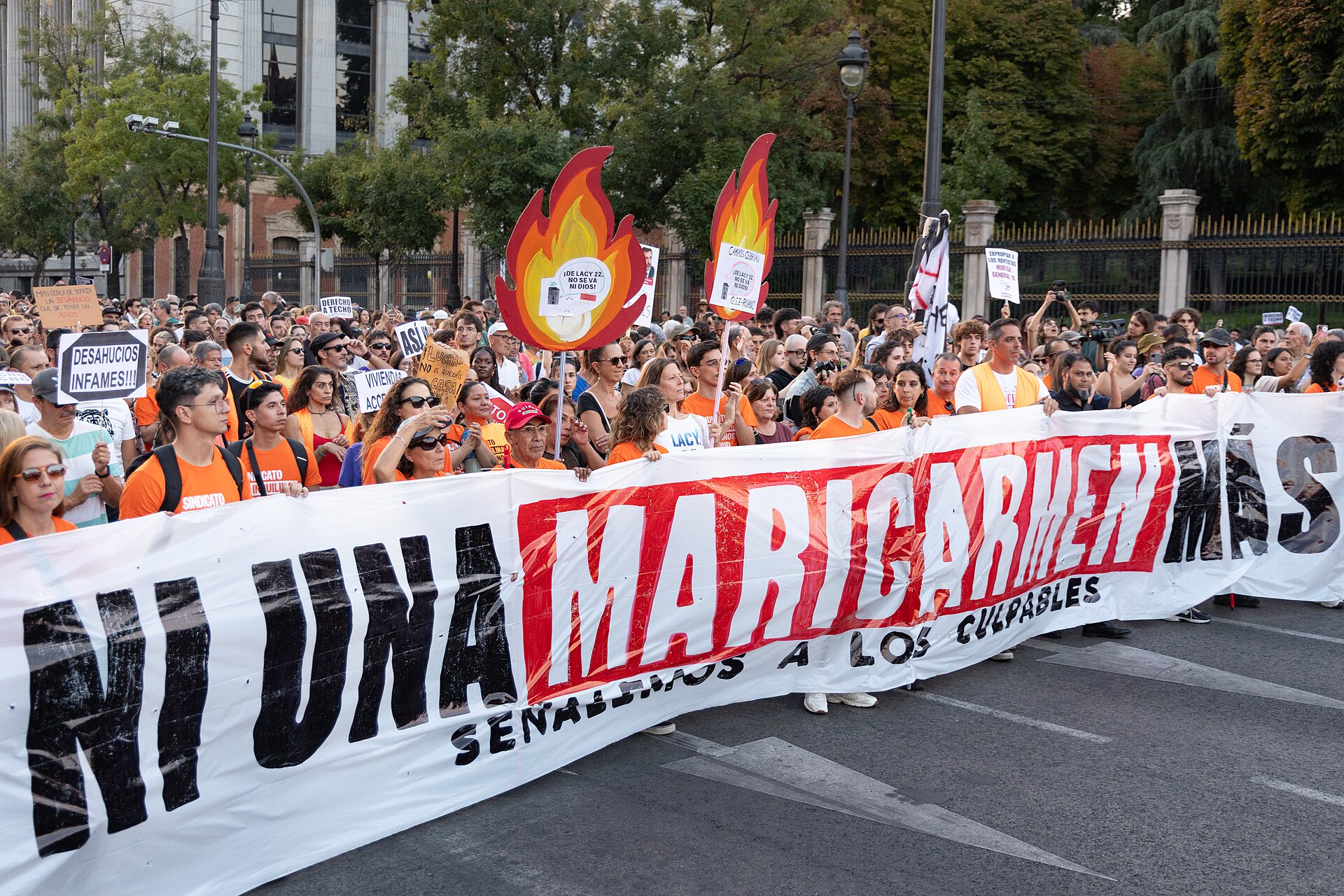
Maricarmen was the final straw, the spark that ignited outrage again in Spain this Autumn. Maricarmen is a very common name in Spain for women from past generations. It is the name of our mothers, of our grandmothers. But Maricarmen was also the name of an 87-year-old woman who had been living for 70 years in a rented flat in Madrid. Maricarmen had been fighting eviction for over a decade, after new landlords decided overnight to more than triple her rent, making the new amount higher than Maricarmen’s whole monthly pension. Maricarmen was not alone. She was organised with the Tenant’s Union, which had already helped her stop the eviction several times. Maricarmen’s case had prompted declarations from UNO’s representative for housing rights, calling for a negotiated settlement. Maricarmen was supported by hundreds of activists in front of her street, trying to avoid her eviction once more. Maricarmen’s case sparked a wave of outrage across Spain after it was picked up by news media. On the 23rd of September, the fourth attempt to evict Maricarmen was successful, after which Maricarmen was immediately hospitalised. On 7 October 2026, Maricarmen died in the hospital.
But Maricarmen’s situation is also a product of the draconian renting laws in Spain, a result of the increasingly untenable housing conditions in the whole country. And her case sparked a massive mobilisation with consequences and reach still to be seen.
How did we get to this situation? On the one hand, rental prices in Spain had been spared until relatively recent times. The turning point was the financial and housing crisis, which was especially strong in Spain. Until then, most working class people aspired to own the property they lived on by their early 30’s, aided by very permissive mortgage concessions and an economy that ended up being fuelled by housing construction. With the financial crisis starting in 2008, a huge housing crisis took place as well, with well over 600,000 evictions over the following decade. While banks were bailed out by the government, evictees remained in debt even after losing their homes, due to the crash in valuation of that same property after the crisis. This took a huge toll on the working class over those years, and a switch to renting as the main way to access housing from then on. Buying real estate became the prerogative of hedge funds that became interested in the relatively cheap post-crisis prices, and investors looking to make high profits by entering the massive short-term renting market for tourists, another staple of the Spanish economy in the last decades.
One of the main incentives for these investors was the regulation of rentals in Spain, which highly favours the landlord. A later evolution of a law passed in 1985 by the social-democrat and currently ruling Spanish Socialist Worker’s Party (PSOE) established no-renovation of rental contracts, which currently span for 5 to 7 years. This is combined with no maximum prices, with the tenant powerless if the landlord chooses to end the contract or exponentially multiply the rent.
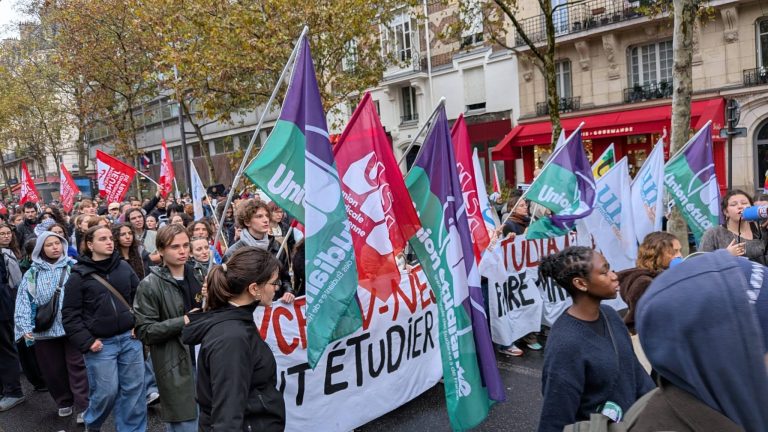
This all combined to put in place the circumstances leading to Maricarmen being evicted. It also resulted in a huge outcry in the wake of these events, with tens of thousands demonstrating in the street and a sit-in that became an occupation of the central Madrilean Sol Square, in an image strongly reminiscent of the Indignados (Outraged) movement from 15 years ago. Indignados mobilisation also stemmed from popular opposition to mainstream politics during the financial crisis. However, there are important differences in today’s mobilisation compared to the past one. Importantly, the organisers (Tenant’s Union is the most visible) have a clear goal in mind: affordable housing costs. And they propose grassroots methods to obtain it, including organising together to prevent evictions and gaining a collective voice to negotiate better terms with the landlords.
The Tenant’s Union is not a recognised trade union, which is only allowed for workers in Spain. Neither is it a Tenant’s Association in the style of Berlin, with their focus on defending tenants using the laws currently in place. Rather, the Tenants Union is a grassroots organisation focused on obtaining legal changes through mass organisation of the tenants, with tools including the tenants strike (organised and collective refusal to pay rental until demands are met) among others. Its sociological origins can be traced to the Platform for People Affected by Mortgages (PAH), an organisation from the previous housing crisis helping the scores of people affected by a default in their mortgages. They organised collective actions demanding negotiated solutions, political solutions to the housing crisis, and mass solidarity concentrations at houses of planned evictions—multiple of which succeeded. Many of these strategies and modes of action can be recognised in today’s Tenant Union.
Radical proposals on housing have only come to the centre of the political debate through organisation that has been going on for years in neighbourhoods and local assemblies across the country. This pressure and the mobilisation after Maricarmen’s eviction were taken by PSOE as a signal that housing could be the main issue in the coming months, leading the government to propose some mild changes to legislation, including a two-year moratorium on the termination of rental contracts and, in a second package, automatic renovation rental contracts. It is important to remember that PSOE has been in power now for over 7 years, with plenty of time to propose more advanced laws, and has previously welcomed hedge funds investing in housing in Spain, as well as acted as a defender of the so-called small landlord.
The decrees were foreseeably revoked in the hung parliament, prompting President Sánchez to call for snap elections that will take place on 29 November. With the government plagued with crisis and scandals in the last months, and besieged by the press and judicature, polls showed a clear majority for the right wing in the parliament. In the Spanish context, this probably means an alliance of the more classical conservative PP with the extreme right wing VOX, which is already in place in many regional and local governments.
In this landscape, the Tenant’s Union does not tie itself to the policies of either PSOE or other political parties more to the left, but rather calls for organisation from below. That is why they called for a general strike, which will take place on 11 November, the first general strike in over 13 years in Spain. With a constitution strongly inspired by the German Basic Law, the law states that the right to strike is guaranteed “for the defence of the worker’s interests,” which could lead to restrictive interpretations of this right. However, intense mobilisation periods in the 1980s meant the recognition by Spanish high courts of the right to strike at the state level on any issue not only directly related to working conditions, but also affecting the workers in general. Thus, a tradition of general strikes in Spain in the last decades when social mobilisation is high was established.
The call was answered by the main trade unions in Spain, leading to support from hundreds of sectors all over the country. Employers’ organisations and major conservative parties positioned themselves against the strike, predictably, and tried to sow dissent, arguing that this is a political strike (which it is, like all strikes!).
Now the strike came and went, with a level of participation above what was expected and a huge attendance at the demonstrations on the same day, despite adverse weather in most of the country. The goals were far reaching, but the mobilisation showed the huge support for a reform of the rental landscape in Spain, and in particular for organisation methods to impose the will of the population over speculator landlords. The Tenant’s Union has seized the opportunity to focus this mobilisation on specific measures, including the socialisation of housing used to speculate, and finally approve undefined rental contracts as the norm. It remains to be seen what the next elected executive brings, and for the organised tenants to obtain the recognition of these rights regardless of the political colour of said government.