“For too long we have borne your chains without thinking of shaking them off, but any authority which is not founded on virtue and humanity, and which only tends to subject one’s fellow man to slavery, must come to an end, and that end is yours.” — Letter to the French General Assembly, Toussaint Louverture (1792)
The 1791 slave revolt in Haiti is a pivotal event in the history of European colonization and marks the beginning of the Haitian Revolution. Precursor to the great decolonization movements, it is the first and only slave revolt to result in national independence—a symbol that would have a lasting impact on the colonial policies of empires. Moreover, it is also an event that resonates strongly in our present moment, raising questions about post-colonial reparations and the idea of just relationships between former colonizers and colonized.
In 1791, Haiti (Saint-Domingue at the time) was France’s most prosperous Caribbean colony (60% of the world’s coffee and 40% of the sugar imported by France and Britain). Its society was the culmination of what racial and colonial order can generate. The population was fragmented, stratified, and codified in classist and racist terms, with each category having its assigned place in the hierarchy. Broadly speaking, out of a population of 520,000: 40,000 (7.6%) were White, 28,000 (5.3%) were free Blacks and Mulattoes, and 452,000 were enslaved Blacks (87%). The white population owned 70% of the wealth and 75% of the enslaved in the colony. This utterly unbalanced ratio could only be maintained through extreme violence, turning the colony into a powder keg.
“Everyone—quite rightly—lived in terror of everyone else. Haiti was hell, but Haiti was rich.” — the historian Paul Fregosi
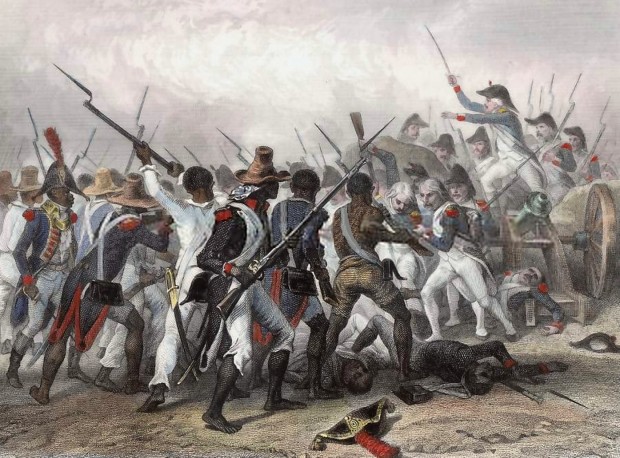
Two years earlier, in 1789, the French Revolution had weakened central authority. Wealthy planters saw it as an opportunity to gain independence from France, while the enslaved pressed their demands for freedom. Amidst this explosive context, the slave revolt of 1791 broke out, starting a long war of independence. Planned in advance by over 200 slaves, the revolt was launched on August 21 in the north of Haiti. Within months, more than 100,000 slaves joined the revolt, mainly led by Georges Biassou and Jean-François Papillon. In the first months, the violence was extreme between the vengeance of the enslaved and the panic of White planters. Within two months, the slaves killed 4,000 whites and destroyed hundreds of sugar, coffee, and indigo plantations. In retaliation, the surviving whites organized into militias and struck back, killing about 15,000 Blacks.
“We have no other resource than destruction and flame. […] Tear up the roads with shot; throw corpses and horses into all the fountains; burn and annihilate everything, in order that those who have come to reduce us to slavery may have before their eyes the image of hell which they deserve.” — Letter to Dessalines, Toussaint Louverture (1802)
The revolt’s consequences morphed into a full-scale war between empires. The English and Spanish invaded the territory with the support of the wealthy white owners. Through battles and shifting alliances, the Black coalition armies, notably led by Toussaint Louverture, gained control of Saint-Domingue in 1801, which became independent Haiti in 1804. However, Haiti remained entirely dependent economically on exports and isolated on an international stage dominated by colonial and slaveholding powers (English, French, Spanish, and American). In order to gain international recognition, Haiti was forced to sign the Royal Ordinance of Charles X in 1825. Through this ordinance, France recognized Haiti’s independence in exchange for an indemnity of 150 million Francs, justified as reimbursement to planters for the “loss of capital”. The debt was repaid in 1883, with the final interest payments ending in 1947; 122 years later.
Today, Haiti remains one of the most deprived countries in the world. France, bearing an at least symbolic responsibility, refuses any reparation, citing legal and financial issues. This injustice seems blatant, and raises the question to the world what fair reparations should consist of. Similar patterns can be spotted to varying degrees in other former colonizers/colonized relationships. It appears more than necessary in this post-colonial era, from within the former colonial center, to push the issues of past crimes and reparations into public debate. This subject stands as an essential foundation that could, in the near future, lead to equal and fair relationships between former the colonizer and former colonized.