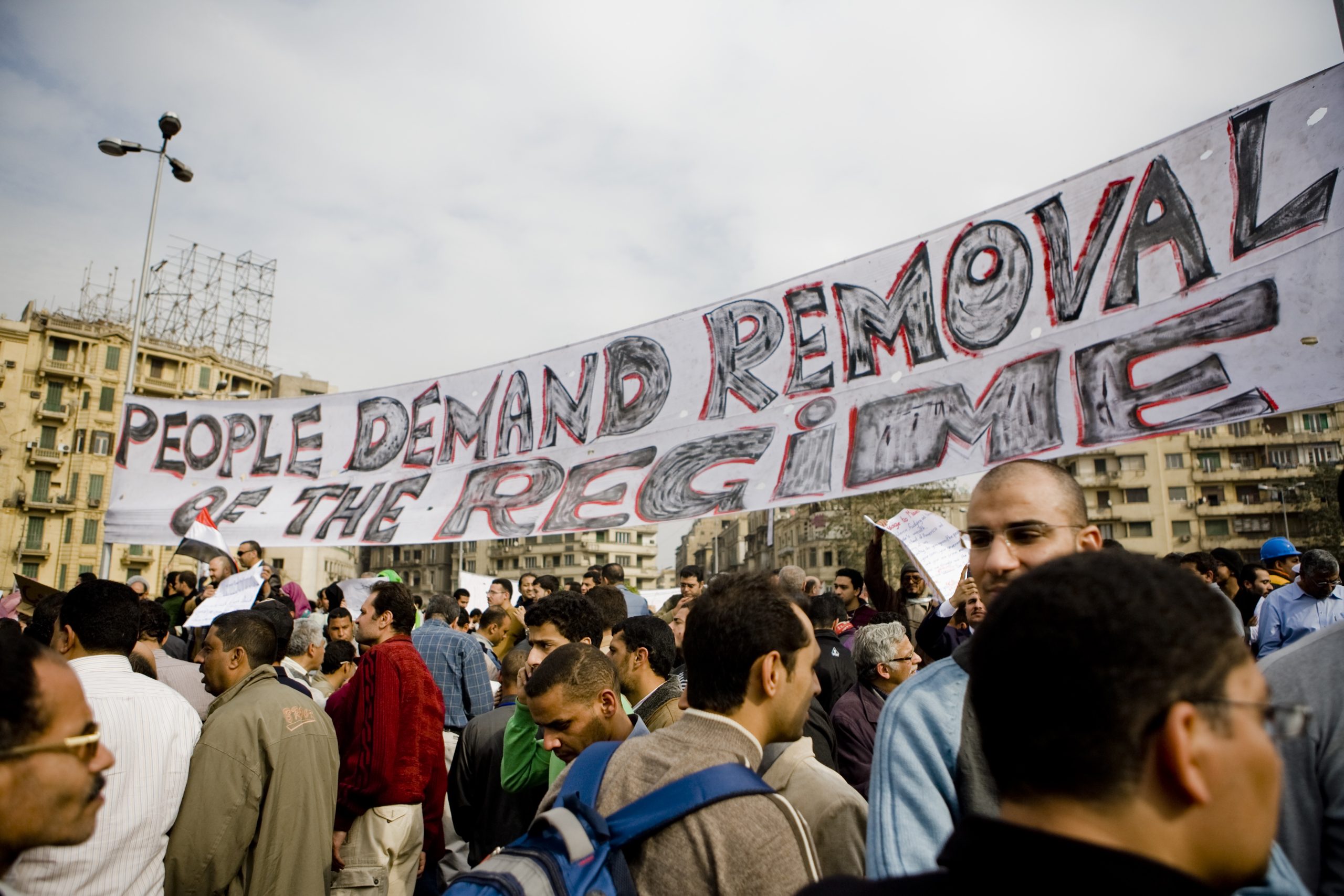
On 25th January 2011, National Police Day, mass protests erupted following the brutal torture and murder of young activist Khaled Mohamed Said. Under the slogan, “We are all Khaled Said,” demonstrators gathered to voice their outrage. One month earlier, the US-backed Tunisian leader Zine El Abidine Ben Ali had been overthrown by a popular mass movement, igniting a similar momentum in Egypt. A central demand during these protests was the insistence that President Mubarak should not be allowed to appoint his son as his successor.
By 28th January, the protests had convened at Tahrir Square, with demonstrators adamant about not leaving until their demands were fulfilled. Just two days later, workers from various sectors struck in solidarity with the youth of Tahrir. This escalation culminated in the infamous “Battle of the Camels,” during which government forces deployed armed thugs armed with live ammunition to attempt to quell the protests. However, these efforts were met with fierce resistance. By early February, approximately 300,000 workers were on strike, and on 12th February, after 18 days of relentless protest, Mubarak was ousted from power.
The Egyptian revolution did not arise overnight; it was the culmination of gradual socio-political changes that collectively spurred a movement against Mubarak’s regime. Notably, significant protests began in support of the Palestinian Intifada in Autumn 2000. In 2003, solidarity networks formed against the Iraq War, leading to the first major occupation of Tahrir Square. A wave of privatization in 2004 further fueled resistance and gave birth to the Kefaya (“enough”) movement against Mubarak.
By 2006, trade unions had joined the growing struggle. In December of that year, thousands of women textile workers in the Nile Delta town of Mahalla took to the streets, demanding that male workers join their strikes. This resulted in 24,000 workers striking in Mahalla, marking the onset of the largest strike wave in Egypt’s history. By 2007, strikes spread to the service sector and public health, and following the 2008 economic crisis, yet another surge of resistance emerged.
The Egyptian revolution faced defeat, first due to the Muslim Brotherhood’s accommodation with the state and later through the rise of counter-revolutionary General el-Sisi as Egypt’s president in 2013. Nonetheless, the spirit of the revolution endures. As revolutionary journalist Hossam el-Hamalawy, who documented the events, remarked in a recent interview with theleftberlin.com, “There are people who have seen this revolution, and they are still alive.”