After the regrettable death of a young fascist, Quentin Deranque, in a street fight in Lyon, the Right is hoping to use the situation to destroy the France Insoumise (France in Revolt, FI), the main organization of the radical Left, even if that means giving a huge boost to the fascists.
On Saturday 21 February, in the city of Lyon, three thousand fascist activists from across France marched “in honour of” their martyr, Deranque, after a commemorative mass. At the front was the “feminist-nationalist” group, Némésis, as well as well-known leaders of banned Nazi organizations, such as the openly antisemitic Oeuvre française (The French Cause). “Wake up, white people!” they chanted. Black passers-by were insulted, and Nazi salutes were performed. The government authorized the march despite the request of the ecologist mayor of the town to have it banned. A few anti-fascists gathered in the town centre behind a banner “Love is stronger than hate: stop fascism”, while mainstream conservative leader, Laurent Wauquiez, a well-known islamophobe, had a huge portrait of Deranque displayed on the front of the regional government headquarters.
Elsewhere, in Bordeaux, upwards of a hundred neo-Nazis congregated behind the banner of a Celtic cross, while, in Rennes, a counterdemonstration behind a banner, “We shed no tears for Nazis,” aimed to disrupt a planned fascist gathering of around a hundred people.
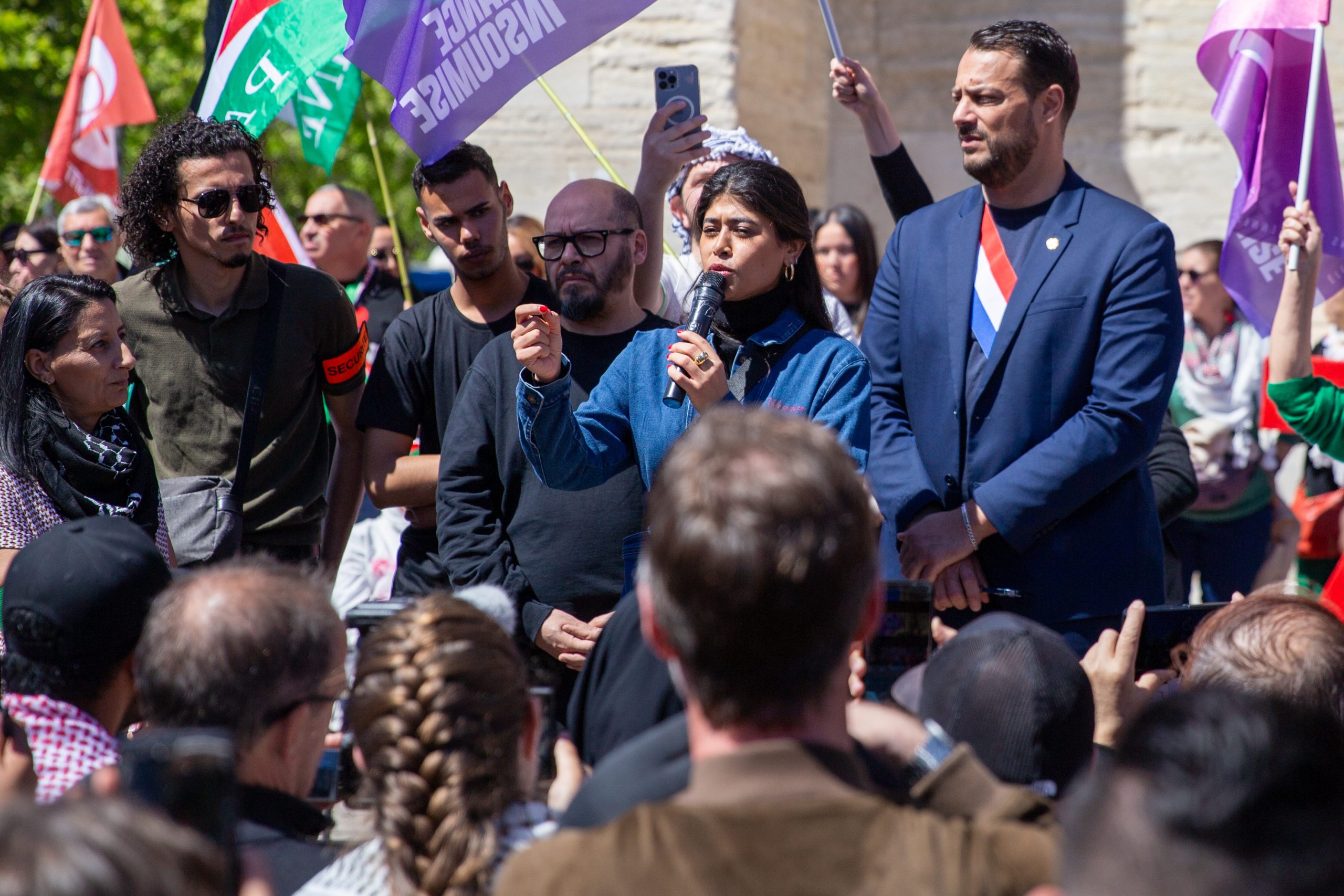
The death of 23-year-old Quentin Deranque—experienced streetfighter and leading member of multiple local fascist and antisemitic organizations—has been the catalyst for a surge of far-right attacks nationwide. Deranque succumbed to injuries sustained during street fighting between neo-Nazi and anti-fascist gangs on 12 February. These clashes were premeditated by the fascists, who arrived armed with pepper spray, motorcycle helmets and metal crutches. They were accompanying a provocative demonstration from the “feminist nationalist” network, Némésis, which was protesting against a university lecture on Palestine by France Insoumise Member of Parliament Rima Hassan.
The lecture took place a few hundred yards from the fighting. Although there was no contact between the fascists and the FI stewards, the Right has blamed the France Insoumise for the death. One of the parliamentary assistants of an FI MP, who was present, has been charged with “encouraging” the killing.
In the following week, FI offices were vandalized by fascists in Paris, Lyon, Lille, Metz, Rouen, Castres, Bordeaux, Toulouse and Montpellier. A mosque in Lyon, a Communist Party office in Saint-Pierre-des-Corps and several trade union and immigration association premises were also attacked. Slogans and Celtic crosses were painted, and windows broken. FI activists everywhere have been told not to travel to leaflettings or meetings on their own.
This far-right violence is an intensification of an existing trend. In recent years, attacks by the far right have been reported every month. In Lyon recently, a radical bookshop was vandalized for organizing a talk on Palestine, and lesbian pride meetings were attacked. Last week in Paris, six fascists stormed the offices of a Turkish workers’ organization, while Celtic crosses were daubed around the University of Tours.
Le Pen’s party, the National Rally (RN), is determined to capitalize on the situation. Its president, Jordan Bardella, claims the party has no links whatsoever with the neo-Nazi groups, and told RN members to stay away from this week’s demonstrations. RN leaders are invited on all the news channels to “explain” that the threat to democracy today comes from the Left. RN member of parliament, Laurent Jacobelli, declared, “the far Left is the new fascism”, while one RN parliamentary assistant posted on social media that he “was dreaming of four deaths”, naming leading figures of the France Insoumise.
Macron’s government, far more worried about the radical Left than about fascism, organized a minute’s silence in parliament for Deranque, and is encouraging the campaign against the FI. Bruno Retailleau, hard-right Macronist, demanded that the FI expel the MP who had employed the activist accused of involvement in the violence. Other mainstream conservative MPs have demanded that all parties, including the far-right, unite against the FI at election time. As readers can imagine, these politicians, shocked to the core by the violence in Lyon, are practically all enthusiastic supporters of genocide in Gaza.
The Left
The Socialist Party (PS) is divided on how to react. Many PS leaders are exploiting the situation to justify having propped up Macron’s austerity government for the last 18 months, arguing that any alliance with the France Insoumise would threaten the peace of the nation. One PS leader insisted that the FI was “morally responsible” for the death of Deranque.
The situation has served as a wake-up call, though, for much of the radical and revolutionary left, which has not generally been quick to defend the France Insoumise from the huge smear campaigns against it. The three most influential groups (New Anticapitalist Party, NPA-A and NPA-R, and Lutte Ouvrière) all put out statements in support of the FI. Locally, even some sections of the Socialist Party expressed solidarity, though the national bureau of the Communist Party expressed no such support.
Municipal elections
The local elections in France take place in two rounds on 15 and 22 March. Despite having 118 MPs, the National Rally—with its fascist core—holds a majority on only two local councils among the 279 towns with a population of over 30 000, and they have only 840 local councillors nationwide. This is partly because local elections depend on solid local activist and cultural networks, where the RN remains weak. Additionally, the rather complex two-round system relies heavily on forming alliances for the second round. While most of the traditional Right has not wanted to openly ally with the fascists, the section that is happy to do so is growing rapidly. The RN is hoping for big gains in these elections.
On our side, the France Insoumise is only ten years old. At the last municipal elections, in 2020, it won fewer than a dozen mayorships, and a couple of thousand council seats. We hope to move forward significantly this year—the second-round agreements with other sections of the Left will be a key, and controversial, factor.
Increasing political polarization, and crumbling support for the social-liberal PS, Macron, and the traditional right, mean that the FI and the RN are becoming the central poles of French politics.
It is important to keep a cool head. We are not in 1934, when tens of thousands of members of fascist leagues tried to storm the French parliament and overthrow the Third Republic. Le Pen’s organization did not dare to allow its leaders to attend the fascist rallies this week, and they are still concentrating on the electoral path.
The counterattack
The broadest left coalition for anti-fascist action is required to counter the strengthening of fascism. Small groups of young men fighting neo-Nazi gangs in the streets are not the solution, and can easily do more harm than good. We are certainly opposed to killing political enemies in street fights.
In this new context, the already planned march “against racism, against fascism and against state violence” on 14 March, coordinated by the Marche des solidarités, a broad coalition of left and migrant groups, and supported by the France Insoumise, is more important than ever.
But much more is needed. Mobilizations against the National Rally are common in France, but they are usually local and sometimes short-lived; though supported by the radical and revolutionary Left, they are rarely made a top priority. Recent actions show the potential: a debate with RN candidates at Amiens university last November was cancelled after an antifascist picket; in December, we saw rallies against neo-Nazi Headquarters in Bar-le Duc; and recent pickets have targeted the RN in Niort. On 22 February, there was a rally and concert against the far right in Marseille. What is really needed is a national mass campaign specifically focussed on stopping the RN from building, through consistent campaigning and harassment.
If 2025 saw state-sponsored militia conducting anti-migrant pogroms in Minneapolis, but not in Marseille or Bordeaux, it is largely because of the magnificent anti-fascist mobilization during the 2024 parliamentary election campaign in France. While opinion polls predicted a fascist government, the RN were pushed back into third place in numbers of MPs won. Nevertheless, this was only a tactical victory; Le Pen’s organization is more dangerous each year.
“We are antifascists and we are proud to be so. No-one will make us bow our heads,” declared Mathilde Panot, leader of the FI parliamentary group this weekend. The fight against fascism must be ramped up very considerably in the next few months.
John Mullen is a Marxist activist in the Paris region and is on the France Insoumise slate for the local elections. His website is randombolshevik.org