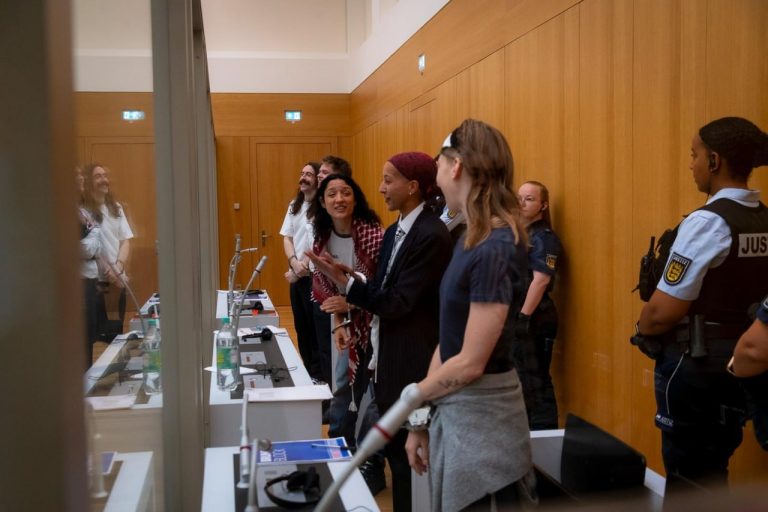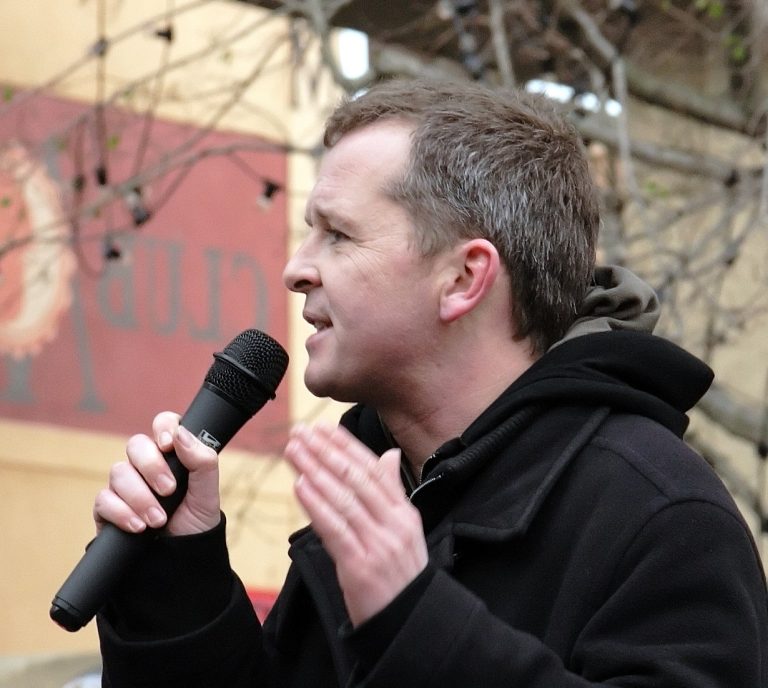
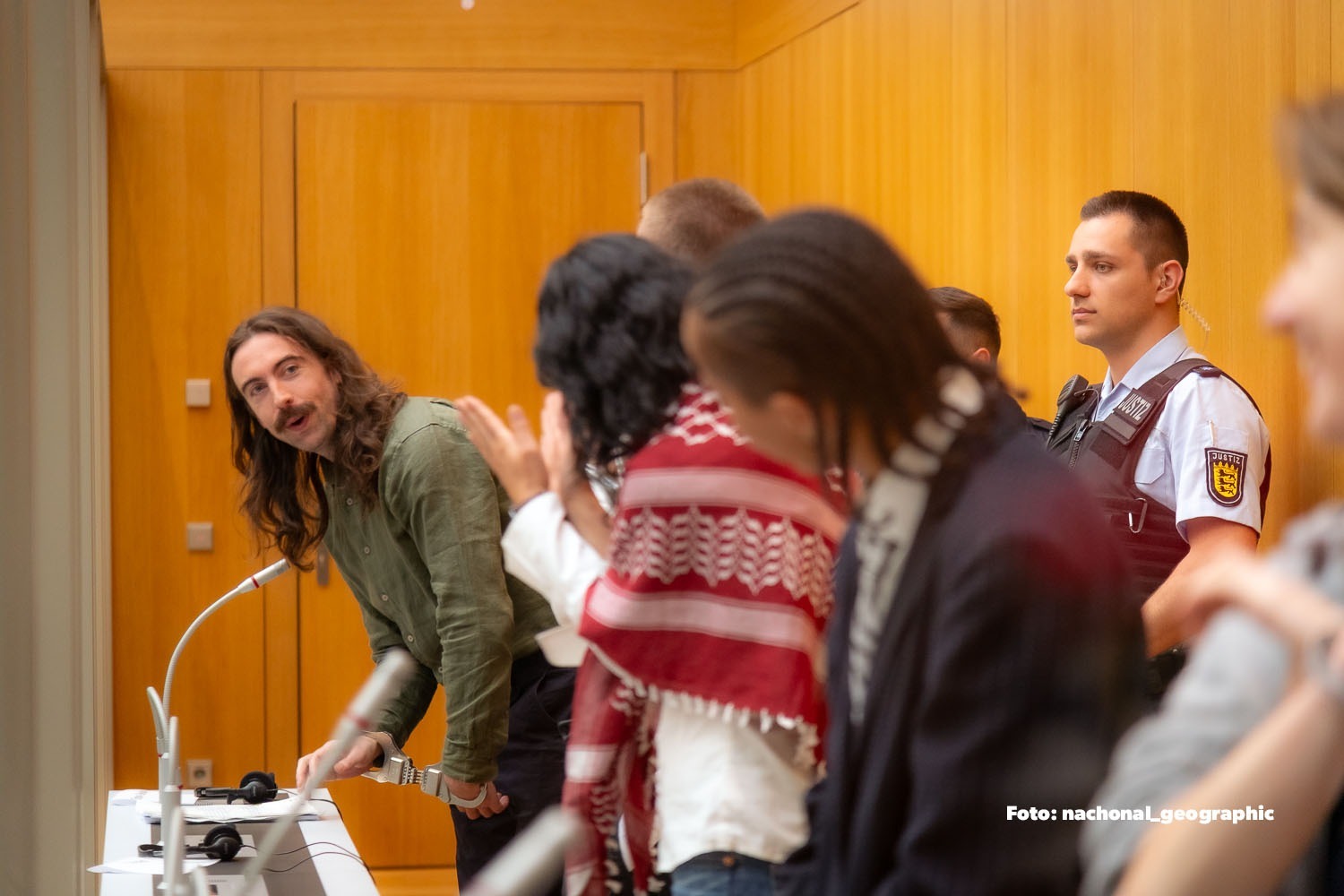
Daniel wrote their testimony in English, translated it into German, and read it in German
I would first like to say that what has taken place here to date means that I am not at all convinced that this is a fair trial, and I also doubt that the court will genuinely listen to me. However, it is still important to me to say what I have to say.
My actions at the Elbit facility in Ulm were motivated exclusively by urgent humanitarian considerations. In a sense their roots are long ago, in the recognition that Israel’s seizure of Palestinian land, its subjection of a population to apartheid laws, its detention of children without charge, and its widespread practice of sexual violence against Palestinian prisoners – that the sum of these practices is straightforwardly unjust, and that to provide material and diplomatic support for them is wrong.
Because I recognised these truths, when Israel began its ground offensive in late 2023, the ensuing pattern of its behaviour came as no surprise. Multiple international bodies – including an independent UN commission of inquiry – have concluded that Israel’s actions in Gaza meet several criteria for genocide, each of which is sufficient conclude that such a crime is taking place. These include the systematic killing of members of a protected group, the systematic destruction of conditions essential for survival, the destruction of all access to fertility and maternity care, and the withholding of food and aid in a manner conducive to an artificial famine.
To look the other way when genocide takes place is reprehensible; to provide the equipment with which it is carried out is worse. In the face of mounting evidence of Israel’s genocide in Palestine, Germany chose not only to continue providing and supporting its armed forces – it drastically increased its supply of weapons and war equipment to Israel’s occupying and invading army. There are many things I love about my adopted home, but that Germany provided steadfast support for the mass death of the people of Gaza, expressing approval in the form of material support, and going so far as not to honour ICC warrants issued for the arrest of those suspected of instigating genocide – this was and remains disturbing and heartbreaking.
Worse still were the government’s occasional statements of concern, as well as periodical announcements intended to be interpreted as meaning that weapons and other exports were no longer being sent to support the genocide – though on closer inspection, they did not mean this at all: these made it clear that Germany wished to be seen to be doing the right thing, without in any substantial way changing its behaviour.
It was in this context that I was compelled to do something that relates so deeply and yet complicatedly to democratic life, essential to it and yet rarely acknowledged: I took direct action.
By damaging the arms production facilities of Elbit Systems in Ulm, the aim was to stop – to the greatest extent possible—their material support for the crimes being committed in Gaza. For such support constitutes complicity in genocide. I acted in the hope that I might at least succeed in disrupting the continued supply of arms to the Israeli armed forces. Furthermore, I acted with the intention of publicly exposing the scandalous fact that the German government – along with arms manufacturers based in Germany – are actively supporting and profiting from the war against Gaza.
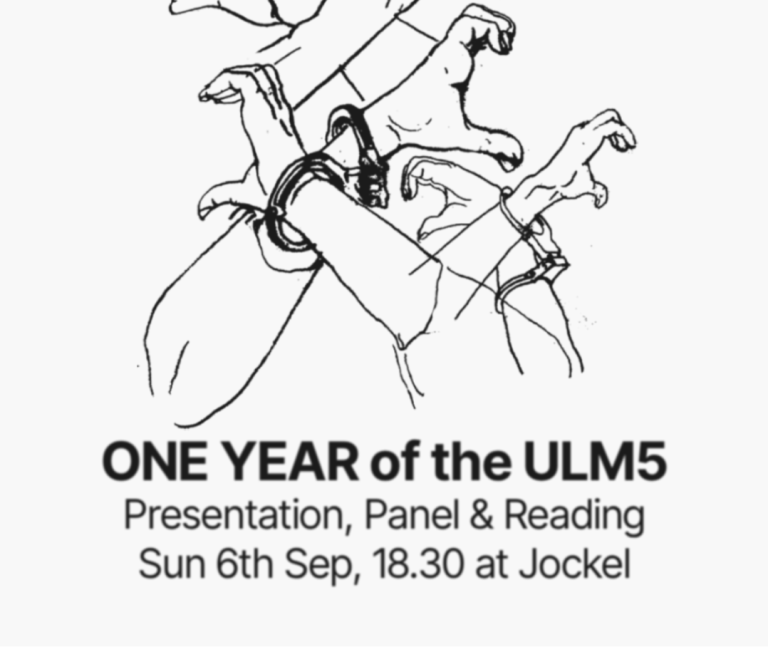
Since then, I have been held in pre-trial detention in Ulm. It is a deeply unsettling experience. I have grown accustomed to the sound of a cell door locking shut and closing me off from the world. I have only seen the sky for an hour a day – if at all. I have witnessed how kindness and deep cruelty can coexist so closely within this microcosm. I have seen the light slowly fade from men’s eyes as the world seems to forget them – and wrestled with my own guilt over the contrasting outpour of solidarity and affection towards myself. Two of these men, forgotten by the world, made attempts on their lives; one succeeded. For five months, I only saw my loved ones through a pane of plexiglas – the result of an administrative error.
When I saw in the indictment that the prosecutor had sought to portray us as antisemitic, in line with a tired and fallacious argument common in the German public sphere, I wasn’t surprised, though I was of course outraged. It is disgraceful to characterise resistance against occupation and mass murder as antisemitism. It was heartening, poignant and amusing to compare this rhetoric with the warm solidarity expressed towards myself by my many Jewish family members. Here I would particularly like to mention my stepfather, whose moral compass, kindness of heart, and resilience have influenced me since I was very young.
In September 2025, stopping Germany’s authorised arms shipments to the IDF was a matter of utmost urgency – even if only for a day or an hour. I considered what I did to be necessary to prevent great suffering. I did this in the full knowledge that I might pay an enormous personal price for it.
Since October 2025, there has been a so-called ceasefire in Gaza – a ceasefire which does not deserve its name. Since then, nine hundred Gazans have lost their lives to Israeli bombs – the vast majority of them, as always, people who could not possibly be combatants. Since the early 1990s, the IDF has kept power generators out of Gaza – and this remains the case today, in a Gaza where almost the entire infrastructure has been destroyed. Just today, the Israeli government announced that it will seize 70 percent of the Gaza Strip. The situation in Gaza is grave.
I stand here today, filled with the cautious but firm hope for a future which is fundamentally different from our present – a future in which neither the humanity nor the rights of Palestinians are viewed by European powers, or anyone else, simply as a troublesome obstacle; a future in which the displacement and persecution of these people are no longer regarded as a viable business model. A just and secure future for a free Palestine.