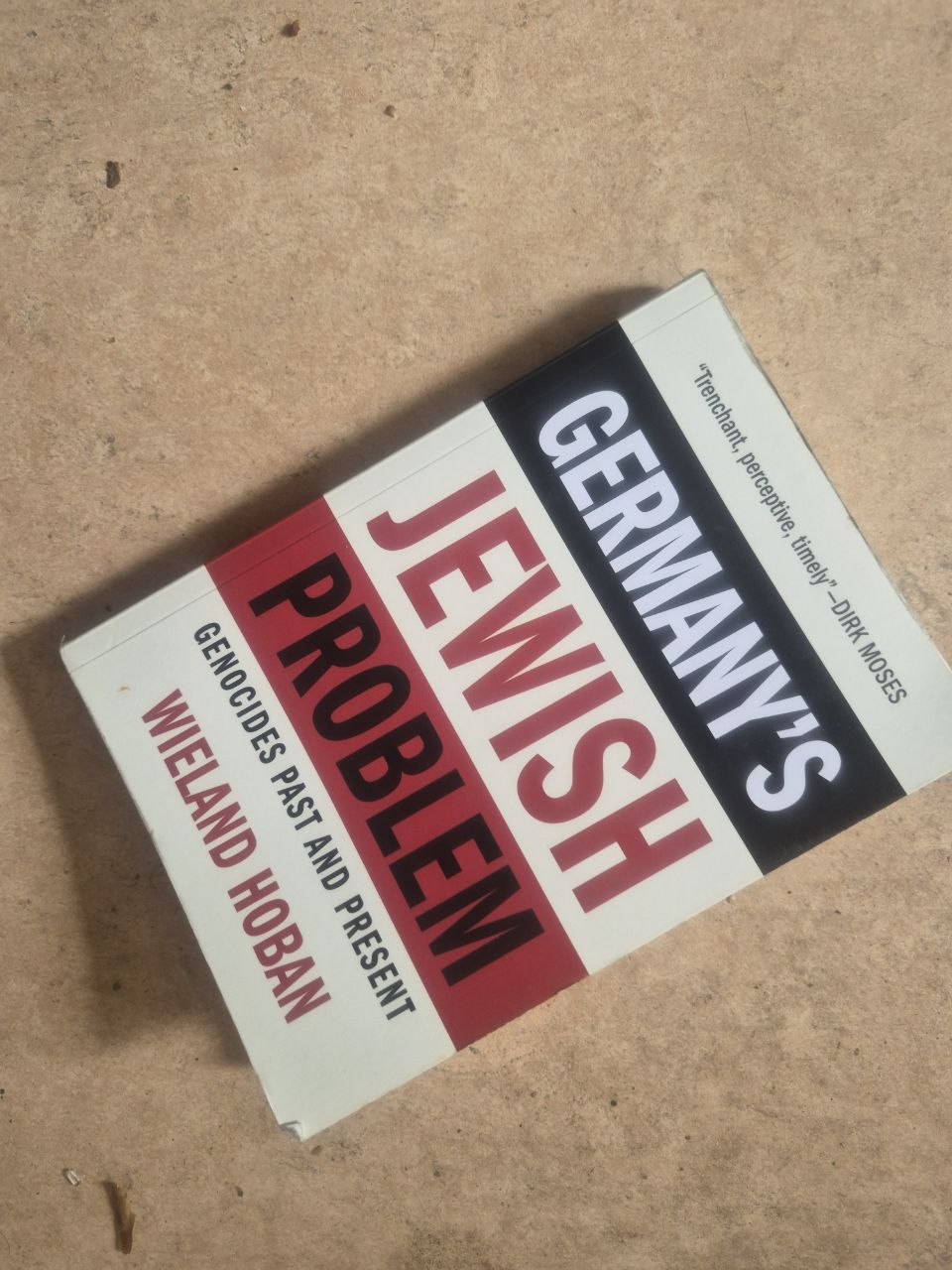
Wieland Hoban is a composer, a translator, and an activist. He is currently chair of the Jüdische Stimme für gerechten Frieden in Nahost, the German equivalent of the Jewish Voice for Peace. This book is a collection of articles which he has written over the last 5 years for The Battleground website. As the blurb on the back cover explains, “Hoban unravels the cultural and political cynicism that have made Germany a chief accomplice to Israel’s crimes.”
Before we start, perhaps I should declare an interest. Wieland is a friend and comrade. I have interviewed him more than once for theleftberlin.com, most recently about this book. In this sense, I am not an impartial reviewer (but then again, who is?)
Nonetheless it’s worth saying why I consider Wieland to be a comrade. For years he has been a courageous and articulate fighter for liberation and justice. The articles in this book are part of this fight. They help explain how Germany got to where it is now, but are also part of an intervention to change things.
(How) Is Germany different?
Iris Hefets, another leading member of the Jüdische Stimme, describes a problem in the book’s foreword: “Anti-Zionist Jews are, therefore, not welcome in Germany. As long as they were a small, marginal group, the state could tolerate them. But today they are organised.” As Jewish resistance in Germany has grown, we have seen increased repression of Jews in the name of “fighting antisemitism”.
Let me try to summarize some of the book’s main arguments. Unconditional state support of Israel, racist demonisation of Palestinians, and false accusations of antisemitism directed against Jews are not unique to Germany. But there are some specifics which make the debate slightly different here.
For obvious reasons, Germany does not have a large Jewish population. An estimated 225,000 Jews live in Germany. Few people have Jewish friends, allowing warped ideas about Jewish identity to fester. And German Jews have little proper representation. The Zentralrat der Jüden in Deutschland only allows synagogue members, although over half the Jews in Germany do not belong to any synagogue.
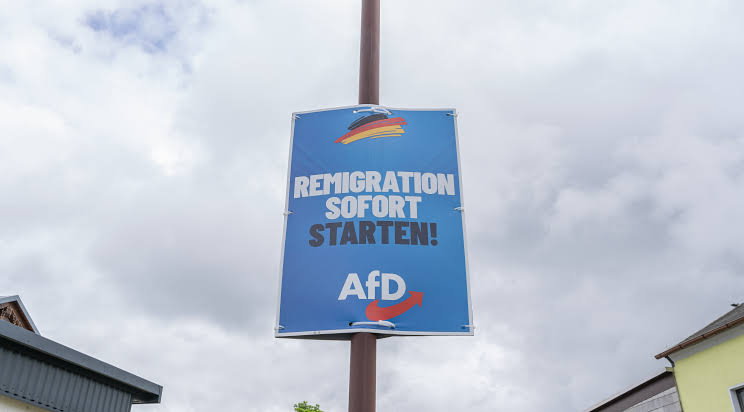
In 2018, Germany appointed Felix Klein as its first commissioner “for Jewish life and the fight against antisemitism”. By 2021, 14 of the 16 German Bundesländer had appointed similar officials, as had the Berlin police, some attorney generals’ offices, and even the AfD. Many of these “antisemitism tsars”, like Klein, are not Jewish.
Other racisms
German public concern for antisemitism stands in contrast with a general disregard by the German state for other racial minorities. The country is also home to around 200,000 Palestinians, 120,000 Sinti and Roma, and 5 million Muslims. But the current debate implies that antisemitism is the country’s only serious form of racism, and that Jews were the only victims of the Holocaust.
Up to 1.5 million Roma and Sinti were murdered in the Holocaust (70% of the total population), and “gypsies” were the first group for whom the Nazis used the phrase “Final Solution.” But they have never received the same reverence applied to Jewish people.
The West German state first acknowledged the Roma Holocaust in 1982. The first memorial to Roma and Sinti victims of the Holocaust was opened in 2012. Its entrance was moved to allow space for a bus stop. Later, the memorial was nearly demolished to make way for an underground train line.
It is not just the Roma and Sinti. In 2015, Germany accepted one million refugees from Syria. Many of these refugees were Palestinians. It is no coincidence that around the same time, Chancellor Angela Merkel started to talk about “imported antisemitism,” implying that Germany never had a problem with antisemitism until Muslim migrants arrived.
This is part of a pattern which constructs a hierarchy of racisms. Although antisemitic attacks are very real—most notably the 2019 attack on the Halle synagogue—the vast majority of racist incidents in Germany are aimed against Muslims and People of Colour, and 90% of antisemitic attacks are carried out by far-right white racists. Past German genocides, like that of the Herero and Nama, receive virtually no attention.
Wieland never makes the mistake movement’s fringe who deny the existence of antisemitism. But conflating all Jews with Israel makes them more vulnerable to this very real threat. Wieland cites a tweet from Ben Miller, a Berlin-based Jew: “I refuse to believe that armoured riot cops stomping out vigil candles protects my life in Germany or fights antisemitism.”
Interviews
The middle section of the book mainly consists of three extended interviews: Palestinian activist Ramsy Kilani, Jewish anti-Zionists Gal Levy and Michael Sappir from the group Jewish-Israeli Dissense (JID), and former Trotskyist Micha Brumnik.
I found these interviews to be of uneven quality. Ramsy is as articulate as ever, explaining how his politics had always been “gut left”, but after his father and step siblings were killed in an air strike in Gaza, he turned to Marxism. He discusses the usefulness of class in understanding Palestine and anti-racism and the limits of intersectionality theory.
Ramsy examines the removal of agency from Palestinians in German debate, including on the Left. Anticipating his later expulsion from die Linke, Ramsy notes a tendency in the Western Left to back down in the face of claims of antisemitism, arguing that this only emboldens the witch hunters.
The interview with Gal and Michael is less analytical, but it is fascinating to learn the experiences of Israelis who arrived in Germany to be lauded by the Left for all the wrong reasons. They talk about the head fuck of going to a “Leftist” club with an Israeli flag in the toilets. Gal says that it was only in Germany that she first perceived herself as a Jew or an Israeli.
And then there’s the prickly interview with Micha Brumnik. It covers important issues, such as the Jerusalem Declaration on Antisemitism, which Brumnik signed, or Jewish history in Germany, but Brumnik is a hostile interviewee, who sees fault with nearly every question which is put to him. Whatever his intention, this stifles debate, and makes the interview hard to read.
German Cancel Culture
Wieland recollects a number of cultural events which were cancelled, including a meeting which I helped organise as part of the Offenes Neukölln (ONK) festival with Wieland and a Palestinian speaker. The meeting’s original title was Cancel Palestine, although we revised this to Palestine: Limits and Possibilities of the Discourse.
We told ONK that we wanted to ask how much one could discuss Palestine in 2021 Germany. Our question was answered when ONK removed us from their programme. Shortly afterwards, the venue where we were planning to hold the meeting pulled out, after great pressure from the Berlin Senate, from which they received much of their funding.
What Wieland does not mention is that this venue was Oyoun, a multicultural centre which was later forced to close down after the Senate removed its funding anyway. Oyoun’s precarious position is shared by all public buildings in Germany which receive any state funding, meaning that debate on Palestine can be just shut down.
Financial pressure is exerted in other ways. In 2016 and 2019, the bank account of the Jüdische Stimme was closed. Wieland comments wryly: “not only did a German bank close a Jewish account for the first and then the second time since the Third Reich. But in addition, non-Jewish Germans presumed to investigate whether the Jewish holders of this account were conducting antisemitic activities, all in the name of ‘protecting Jewish life in Germany’”.
7 October and beyond
The final three articles, and the afterword, look at the changed situation following the 7 October attacks and Israel’s genocidal response. Wieland is quick to put the attacks into context. They were the almost inevitable result of a “life under blockade: the constant humming of drones overhead, the restriction of goods entering and leaving, mass unemployment, undrinkable water, four hours of electricity a day”.
Wieland’s initial reaction was to see 7 October as, “an image of inestimable potency, a symbol of liberation, a prison break. The presence of a bulldozer added a certain flavor of proletarian revolution, and shots of Palestinians with a captured Merkava tank seemed to show a disempowered population taking control, however limited and short-lived it might prove to be”.
The German media saw things differently: “The designation of armed Palestinian individuals or groups as ‘terrorists’ has long been the norm”, and “because the oppressor is….discursively dominant, any refusal to accept their terms is presented as evidence of savagery, reinforcing the idea that the oppression is justified, even necessary”.
Wieland describes a situation in which “the huge number of civilian deaths also horrified many who are otherwise sympathetic to the Palestinian cause, especially Israelis,” This description is almost certainly true, but how important is it? To what extent should Palestinian resistance be dictated by fear of offending their occupiers?
Wieland also says that “some on the anti-imperialist left insisted that one cannot dictate the rules of resistance to the oppressed and that what the world was seeing was not the domesticated form of postcolonialism but actual, messy anticolonial praxis”. His phrasing gives us the impression that he does not share this analysis. I would have liked to hear more around this discussion.
Repercussions in Germany
Wieland eloquently summarises the post-7 October repression within Germany. In the aftermath of the 7 October, protests were banned, as was the wearing of kuffiyahs in schools. In one school, a teacher struck a student for showing a Palestinian flag.
Josef Schuster, president of the Zentralrat der Juden, called demonstrators for Palestine “barbarians”, and the media routinely referred to these demonstrations as “pro-Hamas”. Former Nazis were allowed to pose as principled anti-racists.
A conference of Palestine was closed down by 2,500 police. The right-wing BZ paper, whose headlines are displayed in Berlin trains, reported “the biggest anti-Israel hate event in Berlin since the Hamas pogrom on 7 October.” The Jüdische Stimme’s bank account, which was being used to collect donations for the Conference, was frozen once more. In one sense, none of this was new, but the intensity of the repression increased.
But this is only part of the story. Wieland cites a poll saying that 61% of Germans are against what Israel is doing in Gaza (the current statistic is much higher). This is insufficient, he argues. We need these people on the streets. One year after the article was written, 150,000 Germans did indeed march for Palestine. Unfortunately the so-called “ceasefire” has since helped demobilise this movement.
Conclusion
Germany’s Jewish Problem describes what happened in the past, so we can better understand what is happening now—German philosemitism (just another way of picking out Jews and treating them differently), state-sponsored Islamophobia, and the demonisation of Palestinians while most of Germany remains silent
The book is more an explanation of how we got here than a strategic analysis of where we go next. I don’t mean this as criticism—any strategic discussion is useless without understanding where we are and why. This is still a very valuable book.
I have a couple of minor criticisms, neither of which is particularly harsh. Firstly, like many people who are used to writing in German, Wieland’s sentences are sometimes too long. There can be just too much information densely packed in a small space. The nature of the book also means that there is some repetition, and some of the articles have been overtaken by events.
Of the 26 articles in this book, only three were written post 7 October 2023. Some more recent analysis is necessary. So, let’s hope that a sequel is coming soon.Germany’s Jewish Problem: Genocides Past and Present by Wieland Hoban can be ordered online, or better still from your local bookshop.