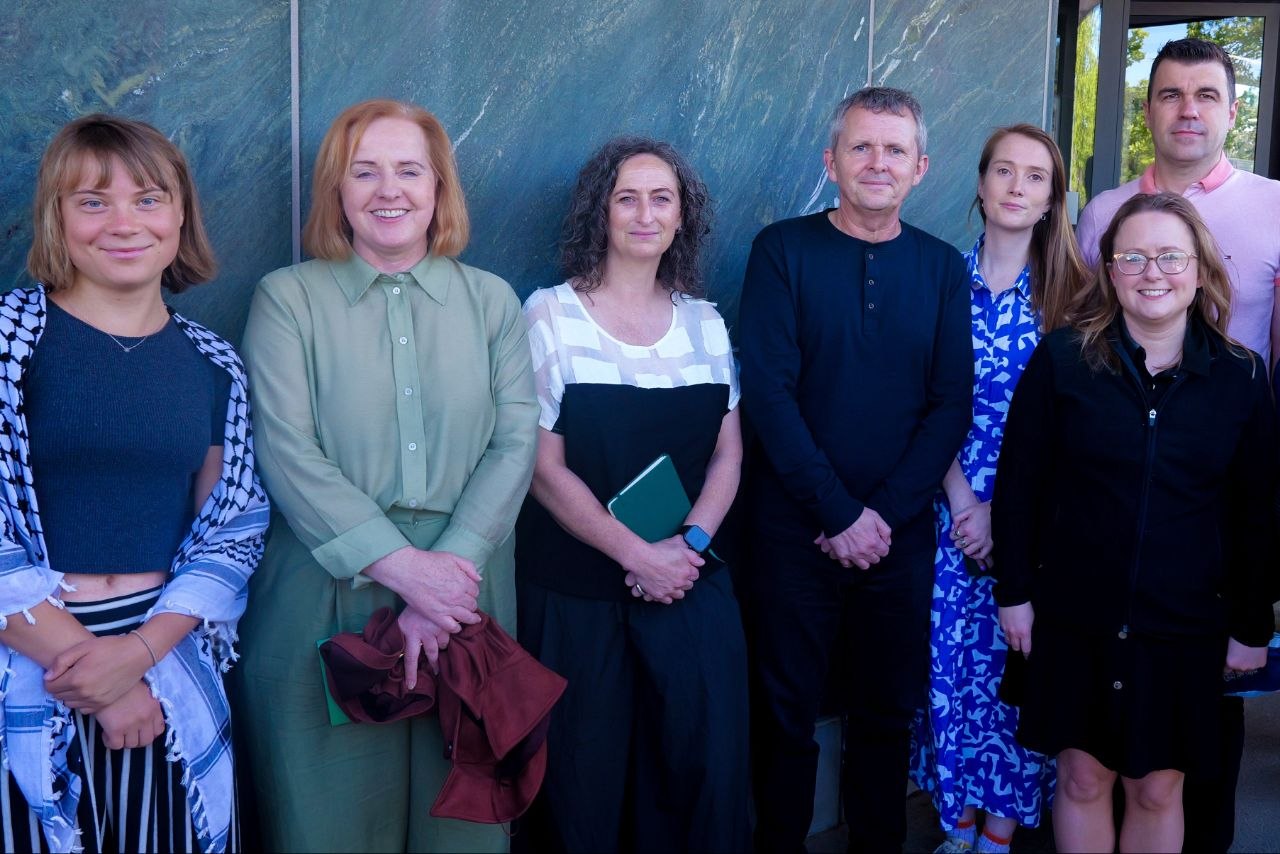
On Wednesday, 22 July, the Ulm5 court hearing in Stammheim was visited by a cross-party delegation of seven Irish politicians, led by People Before Profit’s Richard Boyd-Barrett. As the court broke for lunch, the Irish visitors talked to the press.
Boyd-Barrett described the proceedings as a “show trial” and a “travesty of justice,” with the Ulm5 being treated as if they were terrorists or dangerous criminals. He reminded the press and politicians in Ireland and Germany that their countries have signed the Genocide Convention, which means that they must do everything in their power to prevent a genocide.
Pointedly, Boyd-Barrett referenced another trial which was going on in the same building. Whereas glass partitions prevent the Ulm5 from effectively communicating with their legal representatives, active members of a fascist movement, who are charged with gun crimes and attempted murder, are allowed to sit beside their lawyers with no such restrictions.
Boyd-Barrett finished his remarks by stating that the delegation intends to go back to Ireland and demand once more that their government speak up on behalf of the Ulm5, send observers to witness the trial, and put pressure on the German legal and political system to ensure a fair trial. In the best of all worlds, said Boyd-Barrett, all charges should be dropped.
He was followed by Sinn Féin’s Mairéad Farrell, who spoke first in Irish “to do my piece for the Irish language”, and then German. Earlier, Farrell and other delegation members had visited Daniel Tatlow-Devally, an Irish citizen and member of the Ulm5, in prison. Daniel has been held in pre-trial detention for almost 11 months. Farrell noted: “Now that we’ve seen Daniel, we can speak much more clearly with the media and in Parliament.”
Labour Party spokesperson on foreign affairs Duncan Smith said that after activists had raised serious concerns, “we came to see for ourselves what is going on.” He continued: “What we saw this morning has only accelerated our concerns… This is not a fair trial”. Smith called for more parliamentarians to get involved and for more media coverage. “We need more journalists in Ireland to follow this cause.”
Social Democrat senator Patricia Stephenson reminded governments and journalists attending the press conference that “the right to a fair trial is one of the fundamental principles of the European Convention on Human Rights.” She questioned the lack of active involvement from the Irish State in supporting the Ulm5: “We’re here to fill a gap which has been created by our own government by choosing not to be here.” She repeated the call for EU observers to witness the injustice being carried out in Stammheim.
Sinn Féin MEP Lynn Boylan said: “What we’re seeing right now is a trampling of international law”. Citizens are forced to take actions that are the responsibility of governments into their own hands. She accused EU states of “trashing international law, and for what? To defend Israel.” Boylan promised that: “I’ll be calling on other members of the European Parliament to join us at the next trial date… it is the governments that are out of step with the people. We will not be defeated.”
Boyd-Barrett concluded the press conference by noting that even international politicians are being treated as criminals: “All of us as members of parliament had pens and paper taken from us by security.” In response to independent reporting being banned at the trial, and there being no recording or transcript from the case, Boyd-Barrett asked: “How can you have an appeal on whether there was a fair trial? It’s absurd, but it’s indicative of a show trial and an exercise of arbitrary power.”
A short round of questions from the press followed, before the visitors were rushed back into court. Boyd-Barrett stressed that Daniel and others are locked up for 23 hours a day under shocking conditions. Farrell added that visits from relatives are limited to one hour per month. Asked to compare the Ulm5 with the Irish hunger strikers in the early 1980s, Farrell said that the Ulm5 are even more isolated from one another than the H-Block prisoners, and that this restricts their sense of community.
Asked about a comment from the presiding judge calling herself a field marshal, Stephenson said that these comments were made on a different hearing date, but if they were true, it would be worrying for the German legal system if a judge compared themselves to a member of a military. Boylan noted that even a police officer had stated in court that this is “not a normal trial”, and said: “we’re not here to judge the judge, but our concerns are around the manner in which the court is being conducted. This is something which we have witnessed with our own eyes and we’ll take back.”
Boylan continued: “In relation to stopping Germany, we’re pulling our hair out at this point within the European institutions at the lack of a single measure against Israel. We’re still at the point where the bar is so low that we’re talking about illegal settlements. That would just bring us into compliance with the ICJ court ruling. It would be a tiny measure in the grand scheme of things while we’re on the 21st round of sanctions against Russia.” She called on Germany to stop blocking the EU implementing international law and hiding behind its past and history.
Barry Ward from Fine Gael and Ruth Coppinger of PBP-Solidarity, who were also part of the delegation, were not at the press conference.
The farce continues inside the court
Inside the court, conditions were as chaotic as they have been for the previous Ulm5 hearings. Once more, the defendants were placed behind a glass wall, which meant that they were unable to hear the translation of what was going on nor consult their lawyers. The hearing was adjourned only nine minutes after it had started.
Defence lawyer Benjamin Düsberg acknowledged the Irish visitors, and said, in English: “Welcome to Germany. Welcome to Stammheim. This is like Russia”—which caused the judge to storm out of the room for half an hour. When she returned, she said: “This is Germany. I want to remind you all that we speak German,” a phrase which was repeated several times over the day. On being asked for the reason for the break, she refused to answer. Düsberg referred to an earlier argument by defence lawyer Mathes Breuer, saying that “this is part of the repression”.
Later, when Breuer, as part of a motion to call the CEO of Elbit Systems Germany as a witness in the trial, tried to read out part of the ICJ ruling on Israel in its original English (as he is not a professional translator), the judge ruled that from now on, the use of English in the courtroom by the lawyers was banned, but then allowed it for one last time. This led to a surreal process where the judge ordered the court translators first to translate the English ICJ ruling excerpt into German, and then, bizarrely, to translate their own translations back into English “so the defendants understand what is going on”.
After many delays, the lawyers argued that procedures would be sped up if they were allowed to sit next to their clients. The judge referred to a previous case, where keeping nine defendants behind a glass wall had “caused no problems”. The lawyers responded that another case in which defendants were denied their rights should not be used as a precedent to do so once again.
A police witness appeared, looking very uncomfortable. He explained that the lead investigator (the previous police witness) had called him two weeks before the trial. He admitted that the police had sent him an unencrypted document by e-mail. He also said that he’s been a police witness for many years and had never been escorted into a high-security prison like this, and had been warned by the lead investigator that the conditions of this trial are “not normal”.
While a defence lawyer was describing Elbit System’s complicity in war crimes, the judge “rested her eyes” for a period of time, leaning back, and leading to theories that she had fallen asleep. Whether or not this is exactly what happened, it did nothing to assuage the perception among the Ulm5 and their supporters that the judge was not interested in enabling a fair trial.
Members of the Ulm5 were allowed to address the court. Vi talked about the demeaning treatment which they had experienced, including the use of foot shackles. Zo spoke of a 90 minute journey each way in tight handcuffs and foot shackles, which prevented them from eating, drinking, or reading. So far, the judge has declined to comment. Finally, in their statement, Daniel criticised the “dubious editing choices in the police super-cut” video of the action at Elbit Systems shown in court at a previous hearing, and argued that in a fair system, this evidence would have been sufficient to drop the charges against them.