“The Palestinian cause is not a cause for Palestinians only, but a cause for every revolutionary, wherever he is, as a cause of the exploited and oppressed masses in our era.”
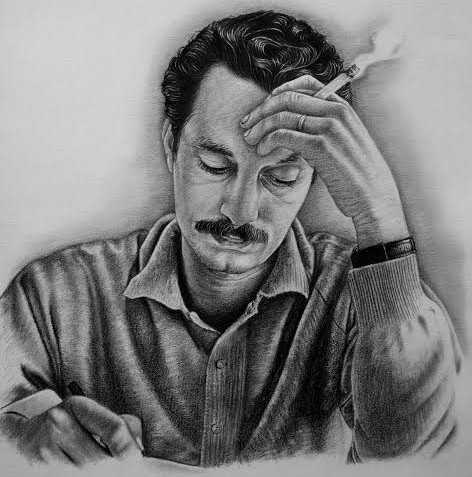
On 8 July 1972, Palestinian revolutionary, journalist and writer Ghassan Kanafani was assassinated by the Israeli intelligence agency Mossad, in Beirut. As Kanafani and his 17 year old niece, Lamis Najim, got into his car, a bomb hidden in the vehicle exploded, killing them both. Kanafani was only 36 years old. Israel claimed responsibility for the attack, posing it as retaliation for the Lod Airport operation, carried out by members of the Japanese Red Army in coordination with the Popular Front for the Liberation of Palestine (PFLP), with which Kanafani was involved.
Born in Acre in 1936, he was twelve years old when his family fled during the 1948 Nakba. They settled in Damascus, Syria, where Kanafani lived as a refugee. Before reaching international audiences as a novelist, he worked at a printing press and later as a teacher in UNRWA schools for Palestinian refugee children. Later he moved to Kuwait and then Beirut, working as a journalist and editor.
His fiction was always reflective of his own life and of the Palestinian liberation cause. His most famous work, Men in the Sun (1962), is an allegory of exile which follows three Palestinian refugees attempting to cross into Kuwait hidden inside the tank of a water lorry. Returning to Haifa (1969) addresses the trauma of a Palestinian couple who return to the home they fled in 1948, and confronts the life that has taken place in their absence.
Alongside novels and short stories, he wrote literary criticism, political essays and journalistic pieces, serving as editor of multiple magazines. He also produced one of the earliest historical studies of the 1936 – 39 Palestinian Revolution, analysing it as an anti-colonial struggle against both British imperialism and Zionist colonisation.
He defended that literature shouldn’t be a description of oppression, but a part of the struggle against it: “My political position springs from my being a novelist. In so far as I am concerned, politics and the novel are an indivisible case and I can categorically state that I became politically committed because I am a novelist, not the opposite”.
Following that logic, Kanafani took part in founding the PFLP – contributing to its adoption of revolutionary Marxism in opposition to pan-Arab nationalism – being elected to its political bureau and later becoming editor of the movement’s magazine, al-Hadaf. He wrote extensively on socialism, anti-imperialism and revolutionary strategy.
In the last lines of The Falcon (1961), Kanafani writes: “It went to die among its people. Gazelles like to die among their people. Falcons don’t care where they die”. He, too, died among his people, and through them he lives on.