“We are not on trial, this rotten stinking society is on trial.”
(Altheia Jones-LeCointe, Mangrove Nine)
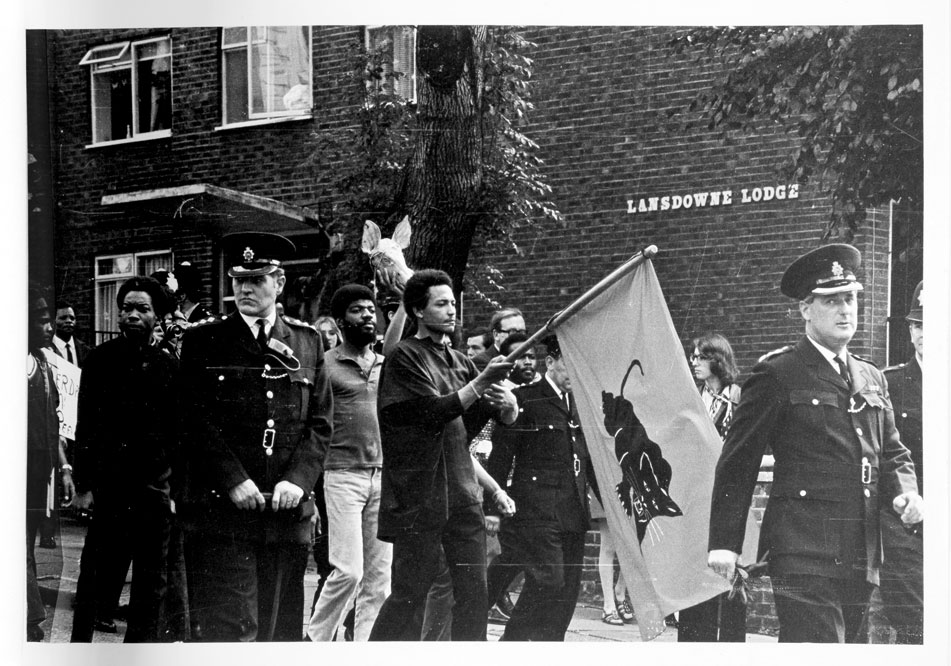
The Mangrove March on August 9, 1970, was a defining moment in Black British history, in which nine leading figures of the Black Power movement in London were arrested and later brought to trial. The protest was a response to the constant harassment and discrimination by the police toward the Mangrove restaurant in Notting Hill, which was a hub for the Black community. This week, we commemorate a trial that exposed institutional racism in the Metropolitan Police and was considered the first legal case to acknowledge evidence of racial hatred in the force; we remember those who became known as the Mangrove Nine.
Opened in 1968 by Trinidad-born Frank Crichlow, the Mangrove quickly became an important place for Black activists and intellectuals, a venue where international artists met and socialized, a spot where the British Black Panthers gathered, and a place where a community newspaper called Hustler was published. Almost every day, the restaurant was subjected to some kind of harassment by the police, ranging from surveillance outside to destructive drug raids. Although Crichlow was known for his opposition to drugs, the police conducted twelve raids on the Mangrove between 1969 and 1970—on all twelve occasions, no evidence was found. It was evident, however, that the police intended to harm the entire area by attempting to shut down the Mangrove, its heart and soul. The community responded to this threat by organizing a demonstration.
The protest, on August 9, 1970, was a peaceful march of around 150 people, met by a disproportionate 700 police officers who monitored the marchers and soon violently broke up the demonstration. Seventeen people were arrested, among them nine prominent Black activists: Altheia Jones-LeCointe, Frank Crichlow, Darcus Howe, Barbara Beese, Rhodan Gordon, Rupert Boyce, Anthony Innis, Rothwell Kentish, and Godfrey Millett. All of the Mangrove Nine were charged with incitement to riot and brought to trial at the Old Bailey, a court normally reserved for high-profile crimes. Darcus Howe and Altheia Jones-LeCointe chose to defend themselves and demanded an all-Black jury to ensure a fair trial, which was denied. In the end, the court allowed only two Black jurors but agreed to the group’s attorneys’ request for an all-working-class jury.
The 55-day trial started in autumn 1971, while the Mangrove Nine were free on bail. This allowed them to continue their work with the British Black Panthers—organizing daily demonstrations outside the court, coordinating their legal strategies, and distributing pamphlets and literature about their case. During their trial, the nine activists opened the eyes of the public to the day-to-day struggle of Black people in Britain by switching the narrative and pointing to the real perpetrator and defendant in this case: the police and the state that backed it. In December 1971, through the power of collective action, all of the Mangrove Nine were acquitted of the main charge of inciting a riot. Their victory marked the first time a British court officially acknowledged institutional racism within the local police force, and it remains an enduring precedent in the fight for civil rights in Britain—a fight that continues to this day. In England, and globally, Black people remain the most targeted and killed by white police; the case of 21-year-old Lorenz A., shot by German police in 2025, is only one of many incidents, part of a historical continuity of institutional police violence.