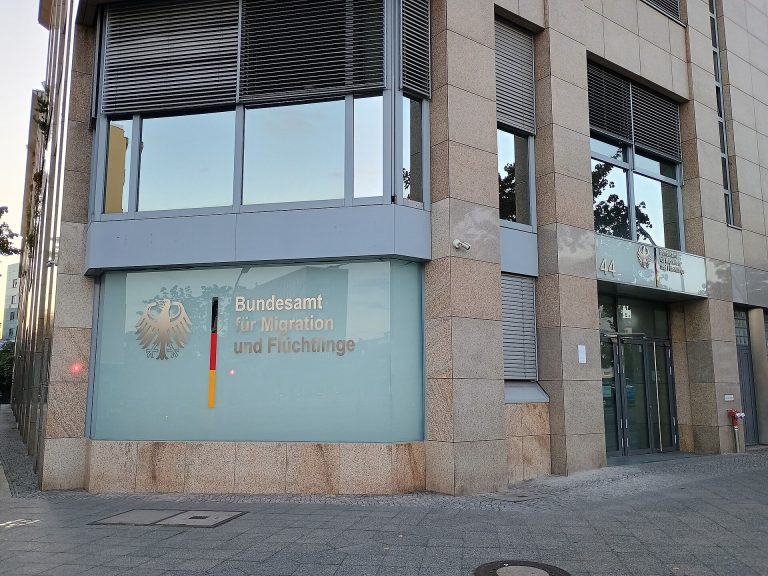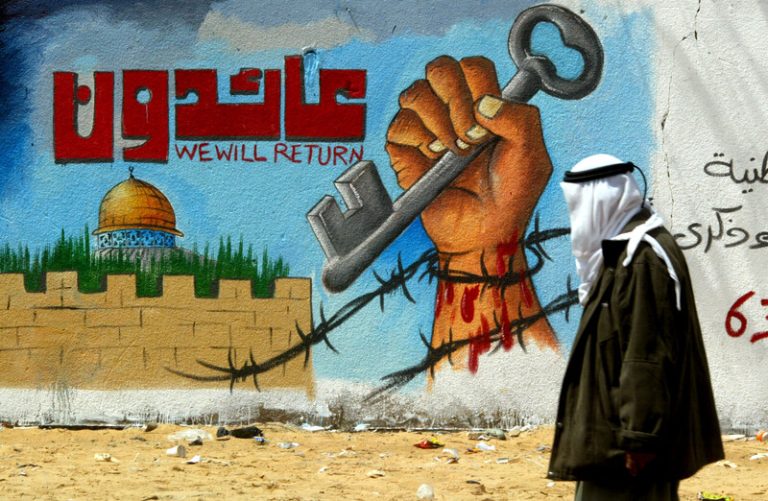

On the morning of Tuesday 18th August 2026, the ministry of the interior in Hessen announced the ban of the registered association Palästina e.V. The ban was announced, as the apartments of 5 Palestine solidarity activists were being raided. In this column, we will go quickly through the background, the ban, and how to understand it. This is by no way an exhaustive overview of the history of Palästina e.V.‘s struggle against ever growing state repression.
To start, some basic information:
- The association Palästina e.V. consisted of brave activists who continue to be engaged in Palestine solidarity work in Hessen. Collectively they had decades of mobilizing experience and knowledge. The association would organize informational events about the history of Palestine, co-organize cultural festivals, and lead mass demonstrations with their clear and principled anti-Zionist positions.
- The association dissolved itself on 14th November 2024, stating in their final statement: “If you thought we’d just sit here like rabbits frozen in fear, waiting for your next attack, you are mistaken! You wanted to ban our association? It no longer exists! We officially announce the dissolution of Palästina eV!”
For the former members, this step by no means meant retreating into inaction. They emphasized: “A period of heightened activity lies ahead of us, and every single one of us is full of drive! We are exercising our right to freedom of expression, assembly, and association! We are exercising our rights whenever, however, and with whomever we choose!” - On 22nd January, 2025 (already after the dissolution of the association) the homes of 9 activists in Hessen were raided to “gather evidence for the inquiry to ban Palästina e.V.”
- The ministry of interior justifies the ban by claiming: “by supporting the armed struggle against the State of Israel, using anti-Semitic narratives, and denying the State of Israel’s right to exist, Palästina e.V.acts against the constitutional order and the ideal of international understanding, thereby fulfilling the grounds for prohibition under Section 3(1), first sentence, options 2 and 3 of the Associations Act.”
- The ministry of the interior is using the following evidence to prove its claims:
- That the stated goal of Palästina e.V. is the “liberation of historic Palestine from Zionist occupation, from the Jordan River to the Mediterranean Sea.”
- That the association’s founding principles state that it stands “in solidarity with all forms of Palestinian resistance.” With a member of the association describing Al-Aqsa Flood operation on October 7th as “a successful act of resistance.” reiterating that “Armed resistance is not terrorism.”
What’s important to note here is that being “against the constitutional order and the ideal of international understanding” is the same legal ground used to ban Samidoun Palestinian Prisoners Solidarity network on 2nd November 2023 and Palästina Solidarität Duisburg on 16th May 2024.
In the case of Samidoun, the federal ministry of the interior claimed they “celebrated terrorism” by sharing on social media the distribution of sweets in Berlin on October 7th 2023. In the case of Palästina Solidarität Duisburg, the ministry of the interior in NRW accused the group of “spiritually supporting Hamas”. The proof that they use is the group describing Hamas in speeches and statements as a mass political party with an armed wing that operates in the context of Palestinian liberation struggle as a central resistance force. They also said that Hamas formed a legitimate government in Gaza after winning the elections of 2006. This is all factual information.
With the evidence used against Palästina e.V. as well as with Samidoun and PSDU, we see a clear trend in what can be legally considered “supporting terrorism”. The threshold is virtually non-existent. It is no longer material acts of financing, recruiting, or being a member of a listed Palestinian resistance faction. The mere political speech, in the most generic of terms, as long it is not defamatory towards the resistance, is enough. This can include referring to the Palestinian resistance as such or describing Al-Aqsa Flood operation as a resistance action.
What is also dangerous in the justification of the Palästina e.V. ban is the claim of “using anti-Semitic narratives” to describe standard pro-Palestine, anti-colonial and anti-Zionist positions, as well as “denying the State of Israel’s right to exist”. In other words, the Palestine solidarity movement – in its entirety – can be subjected to this same crackdown.
There are two main takeaways of this dangerous development:
1- Laws can change in a blink of an eye. What’s legal today is illegal tomorrow. And the state is rapidly extinguishing the legal framework in which we can struggle for a liberated Palestine.
2- The terror-listing of Palestinian resistance factions is an existential threat to the Palestine solidarity movement in this country. In other words, the de-listing of the resistance factions and the abolishment of the anti-terror regime is a political, organisational, and existential priority for the Palestine solidarity movement