65 billion barrels of crude oil, a kidnapped president and an empire in decline. Jakob Reimann examines the historical significance of a resource grab worth trillions.
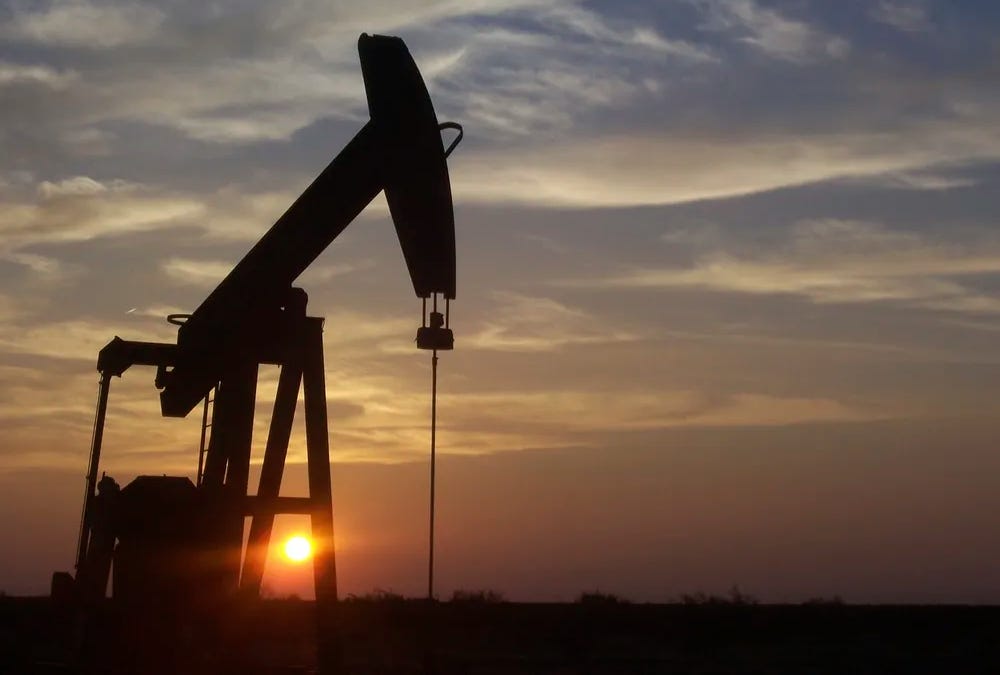
They have finally done it: The ruling class in the United States has seized a significant share of Venezuela’s oil. At least, if one is to believe their errand boy in the Oval Office. “Trump says US to take control of 65bn barrels of Venezuelan oil,” the Financial Times reported late Friday evening. The theft could amount to several trillion US dollars in revenue over the coming years and decades.
According to the Financial Times, the plan involves exploiting 17 to 21 oil fields, primarily in the Orinoco Belt south of Venezuela’s coastal region. A private joint venture is to be established for this purpose which, based on the reserves under its control, would instantly become the second-largest oil company in the world, behind giant Saudi Aramco. The “deal” was struck with Venezuelan President Delcy Rodríguez, who took over the presidency on an interim basis following the US abduction of President Nicolás Maduro in early January. As interim president of an “illegitimate interim government,” Rodríguez has “no legitimacy to strike this unconstitutional deal,” on anything approaching this historic scale, according to former Venezuelan planning minister and current Harvard professor Ricardo Hausmann.
Article 12 of the Venezuelan Constitution explicitly stipulates that all hydrocarbon deposits “are the property of the Republic, are of public domain, and therefore inalienable and not transferable.” The cannibalistic, predatory capitalism of the self-proclaimed ‘rules-based’ West is, needless to say, not about to be deterred by sentimental nonsense such as the binding constitutions of sovereign states.
A pet project
Venezuela has by far the largest oil reserves in the world and has therefore long been under the greedy gaze of the US Empire. In 2002, a CIA-backed coup attempt against socialist President Hugo Chávez failed. The mass protests in Caracas from 2017 onward received vigorous support from the United States, and under Washington’s barbaric sanctions regime, 40,000 people were killed in the first year alone after sanctions were imposed in August 2017. One does not need to invade a country with tanks and missiles to murder its population on a massive scale.
Washington’s attempt to install the far-right Juan Guaidó as its new puppet in Caracas did not quite work out. Not even then German Foreign Minister Heiko Maas (SPD) himself recognizing him as president—a move criticized by the German parliament’s Scientific Services as “a questionable position”—could change that. US sanctions escalated Venezuela’s economic crisis into a devastating hunger crisis: four out of five households suffered from food insecurity in 2017. Needless to say, the Western economic war against the increasingly impoverished country continued under Democrat Joe Biden. After all, starving the populations of governments deemed disobedient by Washington is a bipartisan pet project in the United States.
Yet the vast US oil reserves remained, unfortunately, beneath Venezuelan soil. And so, at the beginning of this year, the US government carried out a Hollywood-style covert operation. Backed by the destructive power of 150 fighter jets and bombers, US Special Forces abducted Maduro and his wife, Cilia Flores, during the night of January 3 and transported both of them to the US. Just two months earlier, Maduro had offered the US access to Venezuela’s oil and gold markets for US corporations. But the good predator capitalist does not want to talk—he wants to take.
In European capitals and their gazettes, the abduction of a president was met with reactions ranging from open delight to more restrained approval. There were deductions for style points, yes, but in the end, one of the bad guys had been taken out. The extensive bombing of Caracas and the roughly 100 people killed, including civilians, were generally written off as neocolonial collateral damage. Freedom, democracy and human rights, as we all know, can only be secured at the cost of blood.
German Foreign Minister Johann Wadephul (CDU) recently compared Maduro’s abduction to a speeding ticket: “It’s basically the same thing,” according to the lawyer holding a doctorate.
The depravity of the German government is truly breathtaking.
The stumbling giant
The now apparently formalized seizure of Venezuelan oil is historic in scale. The Financial Times,Associated Press and Politico have all quoted an anonymous US official—a strategically placed leak from the White House, in other words—according to whom the US will secure 55 percent of the “effective output” from the 65 billion barrels. At current crude oil prices of $80 to $90 per barrel, these volumes would represent potential revenues of around $3 trillion. Should global oil prices rise significantly—perhaps as a result of late-imperial crises such as the current tensions surrounding the Strait of Hormuz—those revenues would rise accordingly. At around $110 per barrel, they would already amount to $4 trillion. On top of that, the United States secured rights to purchase crude at cost, which could easily generate additional benefits in the hundreds of billions of dollars.
The following thesis is therefore plausible: By securing control over a large chunk of Venezuelan oil, the United States is carrying out the largest single resource theft of the postcolonial era. Perhaps even in the entire history of capitalism.
Other concrete acts of plunder do not come close to these figures. Following the CIA- and MI6-orchestrated coup in Iran in 1953 (Operation Ajax), Western oil companies certainly filled their pockets to the brim with petrodollars, but over the decades leading up to the 1979 revolution, the amounts involved reached at most the hundreds of billions. The 2003 invasion of Iraq was also partly about oil, but less about direct profits than the geopolitics behind it: an ambitious wannabe regional hegemon like Saddam Hussein was to be permanently neutralized. Control over oil was a means to a larger end—and to this day serves as a means of controlling the Iraqi state.
Other examples in which militaries served as an extended arm of national capital in the pursuit of resources—such as the decades of the US Banana Wars beginning in 1898 or Belgium’s barbarity in the Congo from 1960 onward—pale in comparison to the scale of the Venezuelan oil grab now being engineered. The US Empire has long entered the phase of imperial overstretch and late-Roman decadence. It has passed its peak and is behaving as empires past their peak tend to behave: petulant, blind, obstinate with age, and ossified with rage. The stumbling giant refuses to acknowledge its own decline. And while a historic act of plunder may perhaps push that decline back by two or three pages in the history books, Beijing is sitting in its armchair, watching and learning.
You can find this piece in German on etos.media.