Racism did not create slavery. Slavery, a system built to extract free labor, created racism to justify itself. When the 13th Amendment abolished slavery, it left an exception for punishment of a crime, so naturally Southern states went looking for crimes: vagrancy laws that made it an offense to be out of work or without a home, feeding convict leasing, a system that rented prisoners, most of them Black, out to plantations and industrial employers, and so on. A century later, Nixon’s 1970 D.C. Crime Bill, sold as part of a war on crime, brought preventive detention and no-knock searches to a majority-Black city, a testing ground for the police state the administration wanted nationwide. By 1972, the D.C. Jail was holding about twice the 550 people it was built for, with some men locked in six by eight foot cells nearly around the clock, no recreation time, and juveniles held alongside adult inmates. These squalid conditions had already led inmates to riot in 1968, and lawyers were already suing over cruel and unusual punishment.
Four years later, a staged seizure kicked off a takeover. When guards came to check on an inmate in Cellblock 1, his cellmate drew a loaded .38 pistol, and the prisoners seized the block and several guards as hostages. The revolt in the D.C. prison was just a year after state police killed 39 prisoners and 10 hostages at Attica Correctional Facility in New York. The prisoners asked for Washington Post reporter William Claiborne by name, and when he arrived with corrections director Kenneth Hardy, an inmate told him through a peephole, “This is not a riot, it’s a revolution.” Hardy was taken inside and held hostage too. Their demand was release, and one put it plainly: “We’re treated like animals, and we want out.” The standoff ran through the day and drew a major media spotlight.
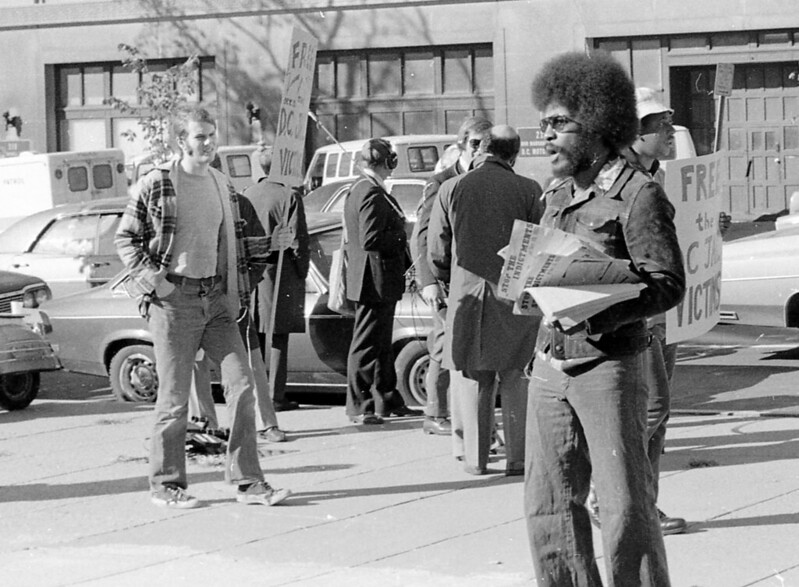
By afternoon, Rep. Shirley Chisholm was leading the hostage negotiations, with Delegate Walter Fauntroy and Marion Barry, and she talked the inmates down from demanding release to bargaining over their conditions in the prison. In return for the hostages, the inmates won a hearing before a federal judge that night and a written pledge that no one would be punished. The hostages went free shortly after midnight, 22 hours into the affair. A year later, despite the pledge, prosecutors indicted men over the uprising, further degrading whatever sliver of trust the prison institution could still claim. Nine were convicted, some on charges of trying to escape, and the courts ruled Hardy’s pledge void because it was signed under threat. There was public outcry to the double cross and demonstrations led to support the backstabbed inmates, but in the end, a promise made by a state official was never binding on the state to actually uphold.
The conditions did not change. A new jail opened in 1976, and it mostly carried the old problems into a new building. Nearly fifty years later, in 2021 the U.S. Marshals Service pulled hundreds of its detainees out after an inspection found officer abuse and the stench of human waste, and roughly nine in ten people in the city’s corrections system are Black, in a city that is 45 percent Black. Nationally, even after falling about 25 percent from its 2009 peak, the prison population in 2021 was nearly six times its size 50 years earlier. Imprisonment is concentrated among the poor, and Black Americans were imprisoned at five times the rate of white Americans, a pattern author Michelle Alexander has called the New Jim Crow. Furthermore, due to today’s climate crisis, heat is now part of the punishment. In Texas, where only about a third of state prisons have air conditioning, a federal judge has recently ordered air conditioning in every state prison by the end of 2029, after finding the heat “plainly unconstitutional.” Marx wrote that capital is “reckless of the health or length of life of the labourer” unless society compels it otherwise, and we must be the outcry.
This is profit over people. The people inside are also a source of revenue, and because policy keeps replenishing the supply, they are treated as expendable. Private prisons hold only about 7 percent of prisoners, but the public system is the machine, and private money attaches to it through food, healthcare, and whatever else it can get its fangs into. Angola, the Louisiana State Penitentiary, sits on a former plantation once owned by slave trader Isaac Franklin, and its farm is run by a state agency that sells the harvest on the open market. Farm Line workers, most of them Black, are paid anywhere from nothing to four cents an hour. AP reporting tied prison labor, America’s most vulnerable workers, to hundreds of food brands, and state prison industries brought in more than $2 billion in 2021. Additionally, most ICE detainees are held in private prisons, where GEO Group and CoreCivic, two of the largest operators, were each projected to bring in over a billion dollars in 2025, and the industry gave roughly $500,000 to Republicans now in Congress and $57,000 to Democrats between 2021 and 2025. The state pays the contracts and the contractors pay the campaigns. Marx and Engels wrote that the executive of the modern state is “a committee for managing the common affairs of the whole bourgeoisie,” and this is what that looks like. A police state that profits from punishment has little incentive to stop punishing.