Tuesday, October 6, saw vibrant mass demonstrations in dozens of French towns, as five of the nation’s six main trade union confederations mobilized in support of the escalating school student movement. Entering its third week, the historic uprising against years of cuts in school budgets continues to gain momentum in the face of brutal police violence and state panic.
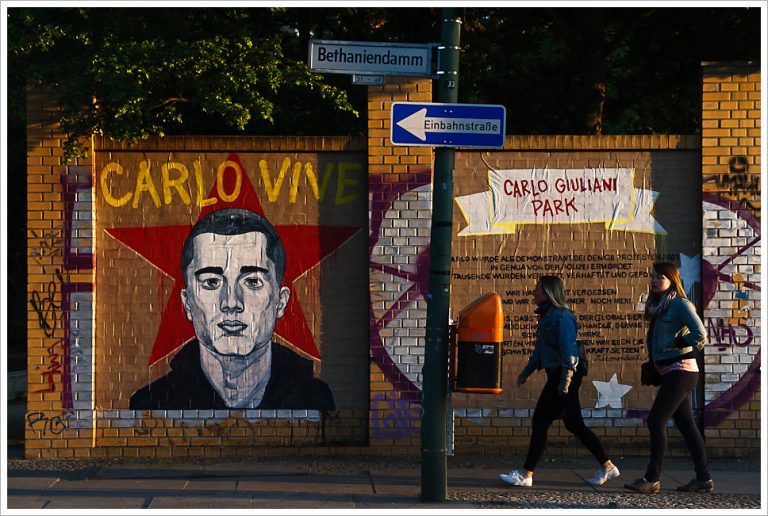
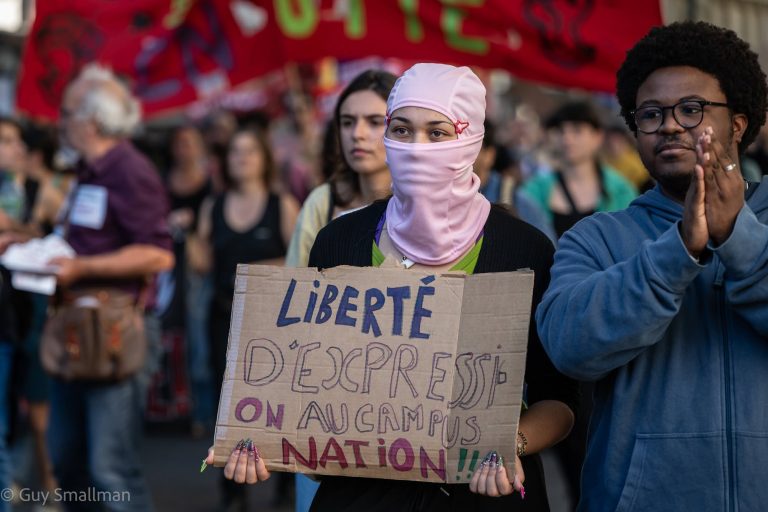
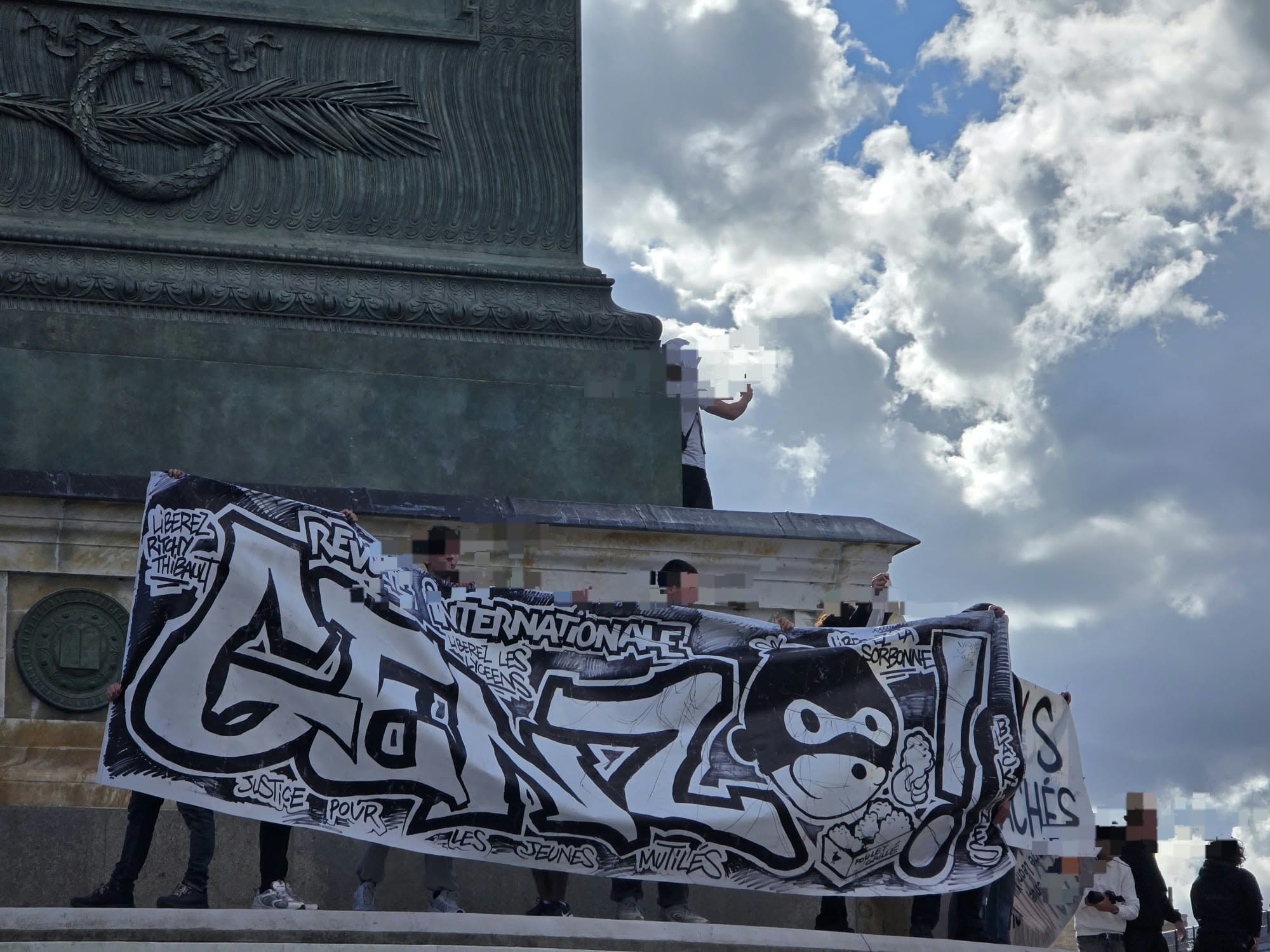
The movement has involved far more high schools than the last comparable movement eight years back. Over a thousand high schools (for 15 to 18 year olds) and over a hundred middle schools (for 11 to 15 year olds) have been blockaded. Thirty universities have joined the movement in the last few days. In every establishment, daily mass meetings decide on the day’s actions. At the demonstrations, you can see thousands of homemade placards with imaginative slogans which go from quoting the 1793 Declaration of the Rights of Man (on the duty of insurrection) to quoting popular rap artists, from “Generation X, generation Z, one struggle!” to “The six-seven generation is aiming at ’68”.
Desperate to extinguish the flames of revolt, authorities resorted to mass lockouts, preemptively closing hundreds of schools and several university campuses this week.
Macron’s minority government, eager to pass its austerity budget before the end of the year, has reacted in three ways.
Firstly, with violence and intimidation. In the hope of scaring away as many young protestors as possible, they ensured that the police repression was extreme. A couple hundred teenagers have been injured by cops, and some of the examples are heartbreaking. In the Paris region, an officer fired a tear gas canister point-blank into the face of a 14-year-old boy, shattering his jaw in two places and knocking out all his teeth; his family is now suing for attempted murder. In Tours, a 16-year-old lost an eye to a rubber bullet fired directly at him—on video, police can be heard boasting about blinding protesters. Elsewhere, multiple students suffered severe eye injuries. A viral video captured an officer pinning a young girl in a violent chokehold, while in Lens, a bystander schoolchild lost a hand to an exploding crowd-dispersal grenade (he did not “pick it up” as the media have claimed).
In a further attempt to intimidate, over 5000 young people have been arrested; only 1800 were subsequently even charged with an offence. And even now, the government refuses to rein in the police thugs. The Interior Minister Laurent Nuñez spoke on Tuesday of “supposed excesses” in police action, while former minister Bruno Retailleau demanded loudly that the age of criminal responsibility be lowered.
Secondly, the government has offered tiny concessions, which are only cosmetic. Proposals to hike some higher education tuition fees were abruptly shelved, and school student union leaders have been invited to talks with the Education Minister. The regime has also launched a token online portal for grievances, and they have scheduled managed “consultation sessions” in all schools for the end of the week.
Finally, a propaganda offensive is trying to paint the young people as manipulated by the radical left organization la France Insoumise (France in Revolt). The old lie of “outside agitators” is being mobilized, because the FI is playing an excellent role in the movement. Even previously sceptical far-left commentators have written that the young protestors consider the FI to be their party. Its leader, Jean-Luc Mélenchon, insisted that FI Members of Parliament and local elected councillors should interpose themselves between the police and students to help protect them. All of them were present and vocal in denouncing police violence.
In parliament, Prime Minister Sébastien Lecornu said one could not speak of “police violence” and complained that the France Insoumise “were implying that the police forces of the Republic … were racist”!
School student leaders are not fooled by the cosmetic concessions, and they are showing their confidence by announcing a new day of action, only two days after the previous one. Trade union leaders could learn from the youngsters but are preferring to drag their feet and suggest a strike in November.
The established media are working hard at slandering the movement and twisting the truth. The media watchdog Acrimed measured the time spent on peak-time national news of the main public TV channel, France 2, early this week, speaking of different aspects of present events. 75% of the time was used to speak of damage or alleged damage caused by the protesters, 8% concerned the movement’s demands, and 12% government accusations of manipulation by the France Insoumise!
This uprising is taking place against a backdrop of severe political polarization in France ahead of next May’s presidential election. Polls show the fascist candidate leading the field, with radical-left La France Insoumise candidate Jean-Luc Mélenchon running second. The prominent presence of antifascist placards and banners across student marches reflects the fact that young people recognize that their struggle against austerity and police violence is directly linked to the broader fight against the far right.
Opinion polls show clearly that a majority of the population (around 62%, according to the latest measure) support the school students’ movement. The next week will show whether much needed escalation will come.
Update, 9th October
The above text was written on 7th October. Here is an update
The uprising in France continues, and it’s changing by the hour.
There is something uniquely explosive about a school student movement, as opposed to a university student movement. Parents and grandparents feel concerned immediately. Even people who would never call themselves left-wing react differently to seeing a 14-year-old badly injured by police than to seeing a 20-year-old treated the same way. The government knows that the risk of a mass workers’ revolt in support is real.
Three things worth noting about the uprising
This is an offensive movement, not a defensive one. Most movements we’ve seen in France, from the 2006 fight against the CPE youth labour contract onwards, started as a reaction to a vicious legal attack. This one didn’t. Nobody pushed these young people into the streets with a vicious new law. They are demanding more.
It didn’t grow out of a university movement. Often the lycéens follow behind the university students. This time the high schools moved on their own. Now the universities are following, with magnificent scenes of enthusiastic mass meetings. Universities with no tradition of radicalism, such as Paris Assas and the Catholic Institute of Paris, are joining in. A whole series of mass meetings in Paris region universities are calling for a March on Matignon (the Prime Minister’s Offices) next Tuesday, October 13.
It started in the poor suburbs. The schools in the working-class banlieues lit the fuse. What is striking is how many schools in better-off parts of town have come out in solidarity, angry at the unequal treatment between schools, an inequality that runs straight along class lines.
The state’s response: small concessions but continued repression
Last night, the Prime Minister went on live television to respond to the escalating movement. Earlier in the day it had already been announced that police would suspend the use of crowd-dispersal grenades, the type that blew the hand off a school student who wasn’t even part of the demonstration a few days ago. The PM looked scared.
The Prime Minister seems to have understood that this revolt could spread much further. His speech was a package of small measures aimed at some of people’s most immediate problems. He announced increased financial aid for workers who have to travel a lot for their jobs and are being squeezed by petrol prices, and he ordered the release of the state’s diesel reserves to help limit price rises. He then promised that electricity prices won’t be allowed to rise this winter, but announced that proposals responding to the school students’ demands would only come at the end of October.
But, only a few hours later, as the day of action was clearly going to be huge, the Education Minister announced an emergency plan to improve the replacement of teachers who are absent through sickness. He promised to hire 3000 new teachers at once (before next Tuesday!). A concession on one of the most hated daily failures of the school system, made within hours of the PM’s speech, shows how rattled they are.
At the same time, police repression continues. Water cannon and baton charges were used in Paris this afternoon to clear demonstrators. Though disciplinary enquiries have been set up concerning a few of the worst filmed examples of police brutality, many examples, of course, were not filmed.
Today’s second day of action was then very successful, especially in Paris. Student protestors organized blockading of imposed online classes in some universities, signing on in their hundreds and disrupting the lectures. The radical left continued playing an excellent role. The France Insoumise mayor of Saint Denis, Bally Bagayoko, was welcomed on today’s demo like a hero after having intervened to calm police attacks.
Another day of action has been called for next Tuesday, and the school student leaders are demanding to meet the Prime Minister in person next week.
Small concessions made under pressure are an invitation to push for more. Trade union leaders must organize strikes to coincide with the next day of action.