In The Last Word, you’re invited to step into the role of an accused person and navigate a judicial trial, from your notification letter to your right to have the last word in a hearing. The Last Word is on view at Galerie Nord in Moabit until 16 October, with a closing event starting at 18:30.
Can you start by telling us a bit about yourselves?
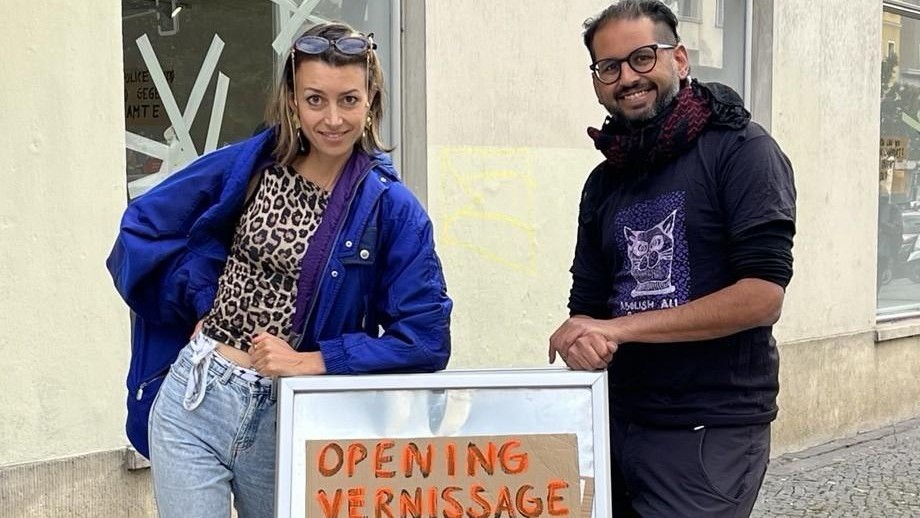
Miriam: My name is Miriam. I’m a theatre maker. I like to work at the crossroads of arts and activism. I recently graduated from a five-year law programme, which changed my perspective on why art is important—I think I had some doubts about whether anything meaningful can be done with art, but the law studies reminded me that it can be very important to use artistic spaces to think about how society could be different. So I’m a theatre maker trying to use artistic spaces for rethinking what we want to change in the world.
Momo: My name is Mohit Thatte, but people know me as Momo. I struggle with using labels—I don’t like saying I’m an XYZ; I’d rather think of it as “these are the things I’ve been doing.” So I have been working in the world of software, which I left last year. I’m now going back to university. I want to learn how to do research, but the goal is, ultimately, better activism. The art project that I was a part of recently is something that I’m entirely thankful to Miriam for, because I never imagined myself as an artist. But Miriam allowed me to experiment and to do what we call “learn by doing.” I’m in the process of learning how we can do political art, and how art can be a spark that brings people together, that can raise important questions and challenge the discourse.
Can you tell us more about your exhibition, The Last Word?
Miriam: The title of the exhibition refers to the fact that in German law, the accused person is given the “right of the last word.” This means that the person can speak up at the end of the trial, before the sentence. The project came together because there was an open call, asking artists to respond to a trial of Rosa Luxemburg from 1914, where she was accused of insulting the army, and connecting it to our times today. For us, the question of the “speech” moment in the trial became the centre of our research, and consequently, the exhibition.
Momo: We wanted the exhibition to be interactive—it’s not just a bunch of information you’re staring at, but it’s putting you in the role of an activist on trial, going through the labyrinth that is the court, answering questions and taking decisions; and seeing how you feel as you go through it. One of the things we consciously wanted to do was to point out that you are not alone and that there’s a community and a movement behind you, which is an aspect we also tried to bring in. We thought of it in three acts: in Act 1 you are being put on trial, Act 2 is reaching out for help, and Act 3 is where you find your voice and make a speech. This is a process of growth we all go through, especially as political activists.
What do you think happens when you ask visitors to be in the place of someone who is on trial, rather than an outsider looking in?
Momo: One of the “aha moments” for me was court watching. Going to see a trial and seeing what actually happens in court was almost a pedagogical experience, because when we talk about the law, we talk about it in a very abstract way—it’s just theory, a lot of books with lots of paragraphs and sections and this and that. But when you get the yellow letter, it becomes very personal, very real and very intimidating—to know the whole state is against you with all its resources. A big part of why we wanted to do it in this way is also to remind people that it could be you; it’s just a matter of what you decide to stand up for and what you consider worth fighting for, but it could be you. We also talked about the court as a black box: everyone knows that the court exists, everyone knows that XYZ should be tried in front of the court (like we say in the demos, “Netanyahu vor Gericht!”), but we don’t know what happens in the court. So we thought it would be interesting to put people through this experience.
Miriam: In terms of what actually happens to people in the exhibition, this is a mystery that we will never know. As a theatre maker, I have to train myself not to think I can predict the reactions of the audience; it’s impossible; they’re not one monolithic block. We should think about everything we do as an invitation. In the end, if you enter the game or not, it’s your decision. It’s an encounter between what we offer and what people make of it. But I would never think that just because we put a sign like “you are accused of XYZ,” that automatically works—this is not how art can interact with society. We are also giving workshops where people can not only learn about important political speeches and speeches in court, but also can write their own speech for a real or imagined trial. It’s interesting to see how many people struggle with imagining themselves in a trial context. It can be that they are in a bad mood, that they don’t feel creative, that they don’t have the right to imagine that, as if they’re not “activists enough.” All we can do is try to remind people to leave their old skin behind for a moment and try to imagine something else. I don’t like art that drags people into it, and I would never force people—it’s more about “here’s a possibility for you to have a different perspective; do you want to do something with it or not?”
Why did you choose this method? Why did you decide to approach this subject through art as the main format, rather than through a documentary or a political discussion?
Miriam: None of us had done an exhibition before, so it’s very new. I found the open call convincing, because the gallery is really close to the court, but also because the collective curating the gallery is planning a whole series about the court and the prison. I like it when people are consistent about bringing art and politics together. Current politics make institutions look for unpoliticised art, but the fact that this collective is putting up a whole series about that made it attractive as a space. We also saw the gallery space and how much it is connected to the street—in front of the gallery, there are a lot of benches where people sit and interact; it feels like a vibrant space. I always fear that cultural institutions are like ivory towers that don’t interact with people, and I was really relieved that we had this feeling of this place wanting to interact with people. They are interested in having conversations and inviting people to do something together.
Momo: In terms of why we chose to work with cardboard and simple paint: we wanted to invite the community in. We didn’t want it to be a fancy artwork that nobody understands, but rather something so simple that anyone can walk in and engage with it. At the same time, you don’t have to sit and watch something for two hours; it’s more about walking through and seeing how that feels. Both of us felt like it had to be inviting, and that has led to the shape that it has taken. Also, the fact that neither of us had a lot of experience with exhibitions was again us learning by doing, and that’s what we are most committed to, ultimately.
Beyond the open call, what was it about the court hearings that made you decide this was your topic? How did it all come together around this specific subject?
Momo: I really like the Bee Gees song that says “words are all I have.” We started reading about Rosa Luxemburg—going back more than a hundred years—and she was really amazing at connecting with people, using simple language and making simple arguments about big political issues. She managed to gain a lot of influence by going around the country giving speeches. Just imagine, there is no internet, just Rosa Luxemburg using all her energy going around the country, giving speeches. When her trial happened, she put out a call for witnesses, and 100 people showed up—professional soldiers who came to talk about their conditions. This goes to show that the speech is a very powerful technique for organising. In a sense, it is even more powerful than the printed word, because it can really connect emotionally with people in a way that the printed word cannot. So our inspiration was Rosa’s trial, and then Miriam had the idea to use the right to the last word, and we tried to narrow it down to not only political speeches, but speeches made in court.
Miriam: Another inspiration was the publication of the student speeches that stood up for Palestine. There was a presentation at Jockel Biergarten about the report of repression, which touched me a lot. They talked about the speeches as moments of resistance inside the court process, and how a lot of the time, the judges were annoyed by that and cut the students off, telling them what the right way to speak is, which language they should use, and so on. The students were not naive; they knew they would be cut off, that they wouldn’t be taken seriously, but they insisted. And I think this insisting on your own perspective, on your own words, can be so powerful and touching, and using the court as a stage that you can also “misuse” from the perspective of a judge—I was very inspired by that.
One thing is how you think of the exhibition, another is how you put it together, and then something else happens once people are there. Is there anything you want to highlight from the reactions you had so far to the exhibition?
Momo: This is a difficult question, because we don’t get to meet the people who walk into the exhibition every day. But what we’ve been hearing from the collective is that people are very curious—the gallery has glass walls, so people look inside, see the cardboards, feel invited, so they’re coming in. One comment from the opening day was from someone who said that they were a software engineer and they found the exhibition to be like a flowchart. And they enjoyed it, but they also felt like it wasn’t being pretentious or overly simplistic. We are also hearing that a lot of young people are showing up to see it; it seems to be attracting a younger crowd. Someone also said there is a pedagogical aspect to it, because people are learning about the courts and activism, but also about organisations that are active in the scene to support people who are on trial.
Miriam: A friend wrote me that the exhibition triggered a lot of conversations for her, and that she sees it as one of these moments where we are reflecting our times, capturing this particular moment where Germany is. I’m not sure what will remain after these five weeks. We don’t know if it will travel somewhere else, but I think it’s interesting to think of it as an archive of a specific moment. There were two law professors visiting, and they were amazed by how we changed the language—these things about trials are usually complicated to explain. This was interesting, because we thought a lot about finding the right language; we worked on finding the wording much more than I would have expected. Since it’s in two languages, we had to find the relationship between English as the main language and then German as a translation. We also had to find the right tone and how to speak to people. But it should also have some humour, so somehow it became a lot of text work.
You are working on other things in parallel, like workshops, including the one you did at Unframe festival. What can people expect from you next?
Momo: We would like to develop the workshops further. In the spirit of learning by doing, every time we do a workshop, we also learn from the people attending. It might be worthwhile doing this practice with organised groups instead of in a third space. So working with a group and offering them a chance to practice with us, to imagine you are going to be on trial one year from today but start preparing for it now. It’s a good way of dealing with it and being prepared for the reality that’s going to get you. I would love to continue this workshop series, but more focused on some sort of practical outcomes.
Miriam: I agree. In the future, I wish we could also find more space towards seeing what the body brings to this. I do kung-fu and give self-defence classes, and there too, we have more demand. There is a desire to feel resilient. A lot of people want not only to calm down, but beyond finding their own voice, they want to find their own body. In the moment of speaking up, it’s not only about the words; there’s also the tone of voice and the posture. At one of the workshops, we had two people who didn’t read what they had written, but they performed it. There is so much strength in speaking through the whole body. I wish that we can come closer to this in the workshops—what does it mean to think of your body, voice and words as something to connect and bring people together?
Momo: The current format that we have still focuses on the individual, and on finding your voice, but I also want to focus on finding your people, or keeping your people together, because too many times I’ve seen organisations that grow to a certain size and then they split because of conflict that doesn’t feel like it should lead to a split. So I am interested in exploring further conflict resolution as a practice, and decision-making as a practice. How can we use artistic practices to get people to talk to each other in a way that leads to resolution, rather than an avoidant way, or in a non-resolution way? Hopefully we can come up with some ideas in that direction too.
Is there anything you want to say that I did not ask you?
Momo: We are always happy to get feedback. If someone wants to collaborate or talk with us, you can use the email thelastword@tuta.io. We are always looking for the answer you mentioned earlier: what do people feel when they go through the exhibition? We would love to hear from people. What emotional landscape do they go through? I’m curious if it’s inspiring people to go experiment a little and put themselves out there.