Hi Dani. Thanks for talking to us. Can we start by you introducing yourself?
Sure. I’m DaniMo, and I’m a social artist, an activist, performer, provocateur. I do a number of different things. But it’s all about creative experiences that stimulate some form of social change, and getting people to think more deeply about a topic.
You are about to offer a series of workshops in Berlin on Brechtian theatre techniques. Could you start by explaining a little about Brechtian theatre?
Absolutely. The workshop series is called Radical Performance Making, and we’ll be doing a lot of Brechtian techniques, but also some other exercises. Brecht was a German playwright and theatre practitioner in the 1920s here in Berlin, and he’s actually buried here.
He developed a whole series and theory of practice about how theatre can be a tool for social change. There is this famous quote, which may be wrongly attributed to him, that art is not just a mirror to hold up to society; it is a hammer with which to break it.
Brecht was a Marxist, and as he was developing his most well-known theatrical approach , the one I love and teach, fascism was rising in Germany, eventually leading to Hitler coming to power. So his work was responding to the political conditions of the time, but also to the naturalistic style of theatre that had dominated much of theatre until then.
. The main thing he wanted to do in his practice was to show that theatre is not real. When people go into a theatre, they should not be lost in the emotion of the piece and relax. He didn’t want you to sit back and feel, but to sit up and think.
He developed the umbrella term of the Verfremdungseffekt—the alienation effect, which meant that everything within a play and the way it’s put on stage should wake you up through this alienation, or making the familiar strange. This makes you think about the play more critically.
Brecht used a lot of different devices, like breaking the fourth wall and directly addressing the audience. This was different to the effects used by Stanlislavski, which were about pretending you’re in the room. He used other tools like people playing different roles, to make you more aware of questions and critical content. He would also play a lot with contradictions within characters. Brechtian characters are never just good or evil. There would always be something between that.
He developed another thing called gestus, which is more than just a gesture. It’s more about how a body movement or pose can convey a whole social hierarchy.
The other aspect of Brecht’s theatre that I want to mention is unresolved endings. Brecht loved unresolved endings. For example, a film about a child being taken away from its mother. In a film in which the ending is all resolved, and they’re reunited, people leave thinking: “I saw a nice film. It ended up well in the end.” But if you end with an unresolved ending, where they don’t get reunited, the audience leaves asking questions about how it applies to their own life.
To summarise: You’ve got Stanislavski, who also affected a lot of method acting in Hollywood. His theatre is about the actor becoming the character and the audience being delivered a satisfying ending, so that everything is resolved. Whereas Brechtian theatre is about asking questions and disturbing the audience.
Yes, although the satisfying ending isn’t necessarily part of Stanislavski’s approach to acting, that’s more about conventional storytelling. Brecht wanted to disrupt those conventions and make the audience question what they were watching.
How does that work in practice? How do you unsettle an audience?
It’s all about making the audience feel a bit uncomfortable. There are a number of devices we can use to do that. Humour can wake people up and shock them so that they feel uncomfortable at why they’re laughing. You can have a reveal moment where new information arises and you were just laughing at something which was actually quite devastating. And then you ask yourself: Why am I laughing at this? This is disturbing.
Or you are reminded that this isn’t real. You are put in your thinking space and not your feeling space. Brecht was not into a cathartic form of performance.
Could you give a concrete example of what Brechtian theatre looks like? Some of the things you have talked about, like breaking the fourth wall, are now very common in TV drama.
Breaking the fourth wall is powerful because you can disrupt the flow of a scene when the audience is engrossed emotionally in something and invested in what’s going to happen. You then break this moment by talking about something else that could happen.
You can have visible signs that comment on what is happening. This has also become a common practice—third-person narration, or stepping out of your perspective. An actor can step out of their role to comment on their role as an actor.
Another device is the use of music. Brecht wrote Mack the Knife, which is now known as a famous jazz tune. It’s actually about a murderer who is a shady grey character. The song combines happy music with deeper, darker lyrics. That makes you take a while to figure out your reaction.
The aim is not just to disturb the audience, but also to make them think and convince them of a political position. Brecht was an activist.
Definitely it was to make the audience think. Brecht certainly had his own political position,but he also wanted people to question things and come to their own conclusions. There was a lot of commentary about social class and status in his work. And that’s something we’re exploring in the workshop too, using performance to question power and the way things are.
So you’d say that Brechtian theatre doesn’t necessarily have to follow a particular political line.
No, I don’t think you have to share Brecht’s politics to use his techniques. They’re tools that can be applied to all sorts of different questions and contexts. I mean, could you make a right-wing piece using Brechtian techniques? I suppose you could. But would we really call it Brechtian theatre? I’m not so sure. I think there has to be something about questioning power, social injustice and the systems we live in, and showing that things don’t have to be the way they are. I think that’s quite central to Brechtian theatre. But maybe that could also be co-opted?
Who is the workshop for?
It’s for a variety of people. For example, activists who want to bring their questions or their causes to the workshop to try and explore techniques for making a performance. But it’s also for performers who want to try a different approach to theatre-making. It could also be for curious people who want to try out something new.
You don’t have to be an activist or have any previous performance experience.
If someone goes to the workshops, what will they be able to do when it’s over? Is this primarily for people who want to act?
By the end, we’ll have developed some scenes from the participants’ own ideas or things that they would like to explore. That could be applied on the street, or at a workshop or wherever. Last time I did this series, one participant was a storyteller, and it influenced the way she was telling stories. So it’s not necessarily about making a finished show, but exploring techniques people can take into their own work and passions.
Let’s go back to the workshop. How long does each workshop last, and what happens in a typical workshop?
Each workshop lasts 2 1/2 hours on a Wednesday evening. Usually people arrive, and we get to know each other to feel more comfortable. Some people haven’t performed at all. Others are much more experienced. We try to be aware of that and help people feel comfortable to play.
Then I’ll do a little bit of input. This time I’m going to do a presentation because people respond well to this. Then we’ll go into exercises, looking at a few different tools of the techniques. Once we get about halfway through, we’ll start looking into stimulus, then do a bit of homework and come up with a starting point from which we can develop some scenes.
I’m sure there are some people who are interested in theory but very reluctant to perform themselves. Is there room for them at the workshop, or is it more for people who want to make a show of themselves?
Last time, we had people who didn’t feel as comfortable performing, and that’s fine. We accommodate that. Certainly people don’t have to do anything after the workshop. Ideally, it would be people who’ll be up for experimenting, although it doesn’t have to push them beyond their boundaries. But it would be great if people are up for at least giving something a go.
You are also involved with the Grieving Doves, who organise demonstrations for Palestine, and appear on other demonstrations dressed as doves. How does this fit with your idea about Brechtian theatre?
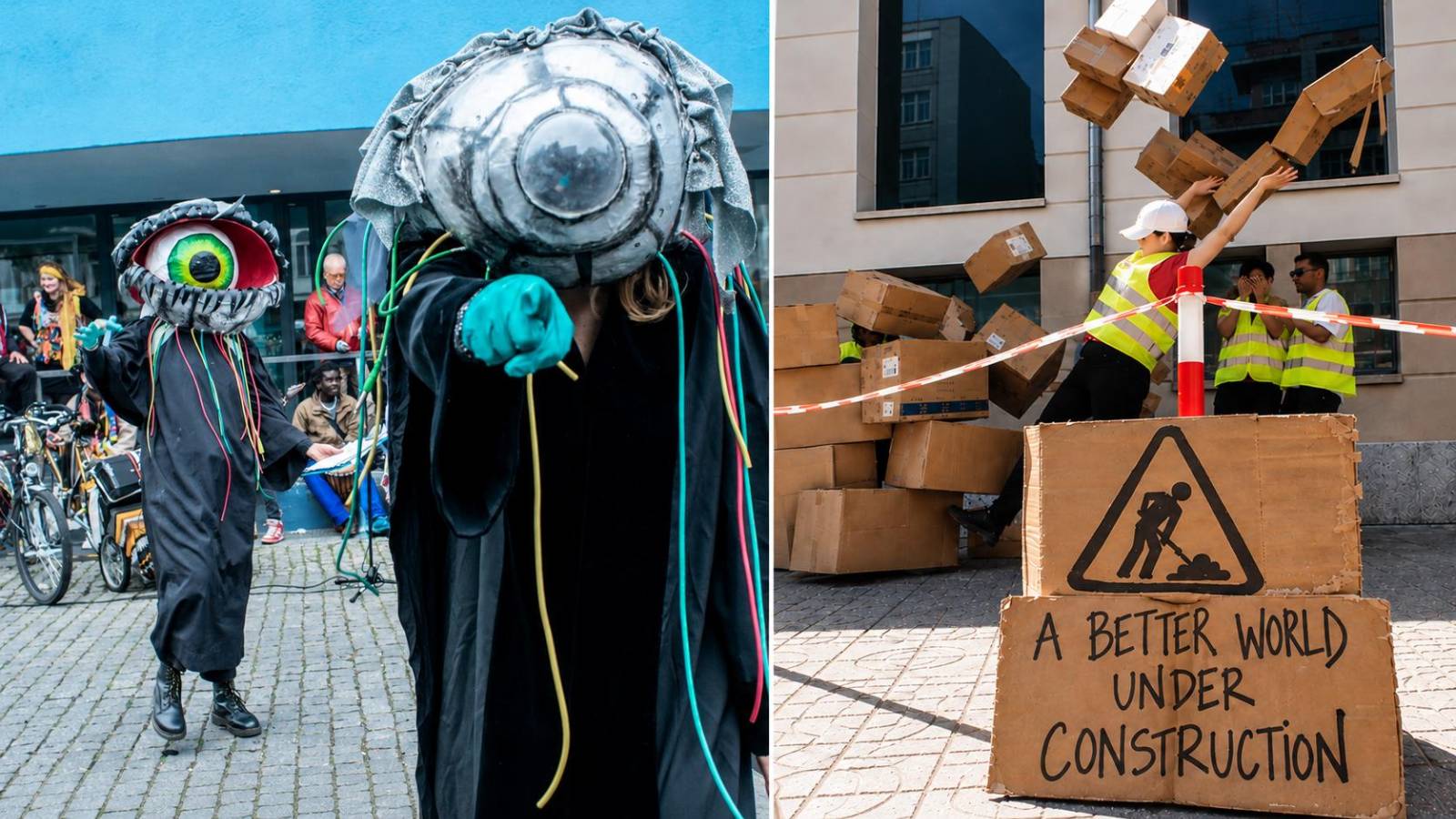
The Grieving Doves’ actions are a disruption of the public space. People walking solemnly all dressed in white, with big dove wings made from pieces of fabric with the handwritten names and ages of Palestinians killed in Gaza.We can reclaim a public space that maybe a demonstration could not. People aren’t expecting to encounter something like this, so they might stop and ask, “What is this?” and look closer..
When you first see the image of these white wings it looks quite beautiful, but then you come closer and see all these names, all these lives and realise the tragedy behind it. I think that contrast, and the way something unexpected can make people stop and question what they’re seeing, is quite a Brechtian element. Not to mention the juxtaposition of the dove as a symbol of peace with the violence and grief represented by all those names on its wings.
The workshop takes place in 90mil. Maybe you can say something about 90mil as a space.
90 mil is a community-run space. They have it until it’s going to be made into a block of flats. We’ve turned it into a bunch of studios, a theatre space, an event space, a movement space and even co-working. . They run an art school, where they try to do a whole range of more affordable courses for the community. There’s a really great program this season.
We need more places like 90 mil in Berlin that are not dependent on institutions and have the infrastructure to do their own programming. We have a few such spaces, but we need more.
Talking about affordability, courses like yours take a lot of money and work to organise. This means that people have got to pay to take part. If someone would love to be there but just doesn’t have the money, are there ways in which they can get involved?
Absolutely, I have some solidarity places, and likewise, if the fee is a barrier, just reach out and we can figure something out. I would like to encourage people to be able to take part.
Do you think there’s a direct relation between art and political activism, or is it more indirect?
I think there’s a direct link. Some direct action is more creative and artistic and has a stronger impact. I don’t think it can change material conditions directly, but I think it can certainly impact the methods in which we are trying to do that.
There’s a danger that we end up only working in our own echo chambers with culture. There are some exhibitions where we can say, “Oh yes, I agree with all of this.” Maybe that’s also okay. It can also be a form of catharsis for us, which I think we need sometimes in certain movements we’re working in.
Sometimes we need a day off as well.
Exactly. But I also think we need more community art or public art in public spaces. Galleries and the more insular art world have their place, of course, but there’s also a lot of money floating around in parts of the art world, and that plays a role in what art is seen as valuable and who gets to decide that. And there’s often quite a boundary around who actually gets to encounter art. I’m less interested in art that only speaks to people already inside the room, depending on who’s inside the room, of course! I want more art that has something to say and reaches people beyond those walls.
Culture should belong to us as well?
Yes. Culture belongs to all of us. It shouldn’t only belong to institutions, galleries or people who already know how to access those spaces.
Is there anything we haven’t covered which you’d like to mention?
I’ve seen some funny memes recently about how art can’t really change the world. I do think that artists should not be too self-righteous about what they’re doing, and be aware that we also need concrete steps to change the world we’re living in.
At the same time, I do really believe in the power of a creative experience to stimulate someone to go home and think differently about something. We don’t know what journey people have already been on, what injustices they’ve encountered or engaged with, what they’ve already questioned, or what they haven’t yet had the opportunity to think about. That might be Palestine, or any number of other struggles and injustices happening in the world.
I like to think of it as a puzzle piece. I don’t know which pieces everybody already has. When I create a performance or workshop, I like to include lots of different content so that people can deep dive into the area they’re most interested in. It’s not about dictating one message.
But I also like to lead with questions. If people go home with questions after engaging in a deeper look into a topic they hadn’t thought much about before, it can stimulate some kind of change. Whether or not they then take practical steps is another matter.
Dani’s workshop Radical Performance Making: Devising Performance for Social Change is running on Wednesdays from 21st October until 11 November. You can contact Dani directly via her linktree