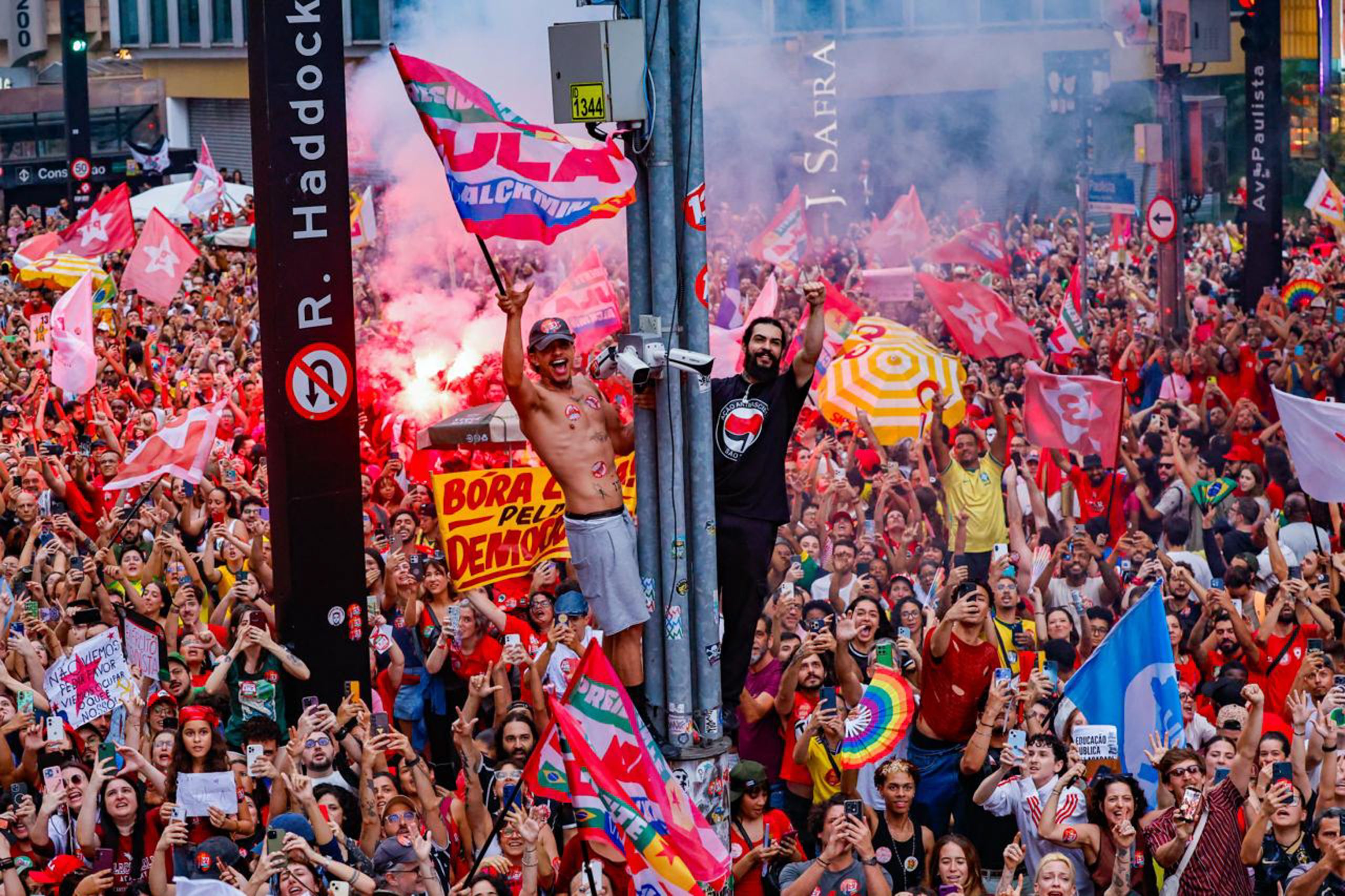
There’s no other way to frame this: Luiz Inácio Lula da Silva’s fourth electoral victory as president of Brazil is nothing short of historic. For the first time in the country’s democratic history, a presidential candidate has won the runoff after coming in second in the first round. Once all the votes were tallied, Lula had 51.8% to Flávio Bolsonaro’s 48.2%. In total, there were 4.8 million more votes compared to the first round (coming from abstentions and blank and null votes), plus 9.3 million from the other candidates. Lula managed to win around 10 million votes compared to the first round. As the Financial Times put it, “In an era when incumbents have been regularly swept aside, Lula’s victory will be closely watched around the world.”
How Lula pulled it off
There are many factors that contributed to Lula’s remarkable comeback. The fact that Flávio Bolsonaro came ahead in the first round shocked many Brazilians. Suddenly, the memory of the father’s government—the petty criminality, the lack of decorum, the mismanagement of the pandemic, the untold number of deaths, the fires in the Amazon, the coup attempt—jolted many people into action, including those who disliked Lulismo or the Workers’ Party (PT). The first campaign act in the second round, in fact, was spontaneously held by university students in Niterói, just outside Rio de Janeiro, who took to the streets right after the first-round results were announced, soon being joined by many other people. Similar spontaneous, grassroots mobilizations were seen across the country.
The Lula campaign went through a reshuffle after the first-round upset—he said that “This was the least organized campaign I’ve participated in since 1989, and you reap what you sow”—and improved significantly as a result, to the extent of being described as “the perfect campaign” in the second round. On top of that, the Lula government stepped up the delivery of policies that materially improved the lives of many Brazilians. Less than two weeks ahead of the runoff, Lula unveiled a series of economic benefits, including tax exemptions for those earning up to R$5,000 per month, debt renegotiations, housing financing initiatives, credit for workers and companies, tax reductions on fuels, and the expansion of social programs, adding up to R$248.7 billion. Four days before the second round, Lula sent a project to provide free public transport on weekends to Congress. In the same period, Congress approved a constitutional amendment, cutting the work week from 44 to 40 hours and giving employees two days off per week without reducing their pay, in a change that represents “the biggest overhaul to workers’ rights since Brazil’s return to democracy in 1988.”
Aside from an improvement in the quality of the official TV ads, a journalistic series called Revelando (Unveiling), launched in September by independent media outlets, featured exposés on the Bolsonaro family related to issues such as religious intolerance, financial interests linked to religious institutions, police violence, beach privatization, and women’s reproductive rights. The videos have surpassed tens of millions of views across multiple platforms. The teaser for “República dos Laranjas” (Republic of Scams) alone was viewed over 28 million times; a clip from the “Pátria Submissa” (Submissive Homeland) episode, hosted by actor Wagner Moura, reached 50 million views on Instagram. This series was arguably more important than any other digital initiative.
And then there was André Janones, at this point world-famous (it’s hard not to find an article about him). The lawmaker created the “Lula’s Army” WhatsApp channel, which went from 50,000 members in the first round to nearly 11 million followers by the end of the election, to guide and inspire Lula’s supporters. It’s difficult to measure, but the channel’s role in Lula’s digital campaign cannot be overstated. Whatever it was, he has been held up as a model by leftists in France, Spain and Argentina.
In sum, Lula’s campaign did what had to be done—but also what should have been done much sooner. It’s important that we understand that what worked was, of course, a combination of factors, and it’s hard to isolate one over the others. But clearly, offering material benefits to the population—not means-tested neoliberal schemes, but concrete, indisputable gains—played a major role. As did mobilizing the population to bypass bourgeois media institutions. It is the combination of these that allowed perceptions to change.
It is important not to lose sight of the fact that the conditions that brought Bolsonarismo as a political movement into being remain there, and that Bolsonarismo dominates both chambers of Congress as well as a majority of state assemblies and governorships. If we are to have any hope that this win was not just a postponement of the return of the extreme right, we have to learn from these past three weeks.
Flávio got too cocky
Flávio Bolsonaro and his camp fared much better in the first round than expected, and it seems like this unexpected lead went to their heads. Everything seemed to be going their way. As philosopher Rodrigo Nunes put it:
“Because it continues and accelerates existing social and political trends, the far right possesses various structural advantages over the left. Its message matches the narrowed political horizons, dominant moral framework of individualism, and the lived experience of many. From an organisational standpoint, it is more deeply embedded in Brazil’s social fabric and finds in digital platforms a more favorable terrain. Despite its anti-establishment rhetoric, its practices are perfectly aligned with the interests of global and domestic elites, who are expediting wealth concentration at the expense of democracy, the environment, and the wellbeing of the world’s population.”
In the days following the first round, the Bolsonaro campaign showed clear signs that they were overly confident, acting high and mighty. As one political analyst noted, while the first-round vote had been about the continuity of the Lula government, “The Bolsonarista victory had changed the focus of the contest.” In the second round, “Brazilians began deciding on the consequences of handing power over to Bolsonarismo.” And they didn’t like what they saw.
Flávio promised that his father would hand him the presidential sash, rather than his apparent predecessor, Lula. In the first presidential debate (since there had not been any before the first round), he displayed an aggressive attitude, with personal attacks against Lula. He and his allies were openly discussing the distribution of ministerial posts.
Almost daily, there were news reports involving Flávio or people close to him in dodgy, suspicious schemes or investigations. He is under investigation for corruption, money laundering, and tax evasion in two cases before the Supreme Court.
Finally, whenever the public conversation leaned towards policy, it turned out that his liberal program was not very popular—this led him to flip-flop on key policy debates, such as the workweek reduction, austerity measures or the Bolsa Família money transfer program. His plan for massive budget cuts within six months, to the tune of R$200 billion, also spooked many voters.
The Financial Times reported that a Brazilian executive who was with members of the Bolsonaro campaign on 25 October was quoted as saying: “As soon as the result was announced, the conversation immediately went to whether Flávio would be arrested. It was like flicking a switch.”
The following days would be taken over by Flávio’s dramatic escape to self-exile in Miami, alleging political persecution. Slowly, as bits and pieces of this cinematographic escape emerged, it became clear that Argentina, the U.S. government, and even a former Mossad agent (as reported by CNN Brasil) played key roles in exfiltrating the far-right senator and former presidential candidate from the country, in a clear effort to evade justice.
The Supreme factor
The Supreme Court as a political factor would require an article of its own. It has played an increasingly major role in Brazilian politics over the recent years. During this past electoral cycle, it ramped up yet another notch.
For a couple of weeks in the course of the first round, the Supreme Court was in the media spotlight. Alexandre de Moraes, a controversial justice who was not appointed by Lula but is perceived as aligned with him because he presided over the coup attempt case that ended with Bolsonaro senior’s 27-year prison sentence, became embroiled in Brazil’s largest banking fraud, the Banco Master corruption scandal. A police investigation found that Moraes’s wife’s law firm had a contract worth about US$20 million with the bank’s founder, Daniel Vorcaro. Moraes denied the accusations and claimed that Justice André Mendonça, nominated by former president Jair Bolsonaro, was using the case to benefit Flávio Bolsonaro’s campaign.
For several days in the final legs of the first round, the news cycle was dominated by the Supreme Court, with Moraes at its center. The Guardian’s correspondent wrote at the time that “Lula believes [this] may have helped Flávio Bolsonaro overtake him to emerge as the frontrunner,” adding that “The justice once hailed as democracy’s ‘saviour’ for containing Jair Bolsonaro may now have helped pave the way for the family’s return to power.”
Mendonça, in fact, is also suspected of involvement in the Banco Master scandal. The other Justice nominated by Bolsonaro, Kássio Nunes Marques, is likewise under investigation in the same sprawling affair. There’s still a fourth justice allegedly involved in the investigation, José Antonio Dias Toffoli, nominated by Lula at the tail end of his second term.
On the day of the second-round runoff, the Supreme Court extended the end of the voting time by two hours, following demands from both campaigns—Lula’s because of suspended public transportation in key sympathetic urban centers and Bolsonaro’s due to heavy rains in regions that tend to vote more for the right. Moraes approved the Federal Police’s request to seize Flávio’s passport just seven minutes after the final results were officially announced—kick-starting the saga that would dominate the news in Brazil in the next few days and involve two, possibly three, foreign governments.
The Reactionary International
Lula’s comeback win put the brakes on a rightward shift that had been underway across Latin America. It was a clear rebuke to U.S. President Donald Trump, who had publicly stated his preference for Bolsonaro. In fact, some view the Trump administration’s support of Bolsonaro’s escape as a tool to use to pressure Brazil in future negotiations.
That may well be the case, but the argument is weakened by the fact that basically all governments in the region have congratulated Lula on his reelection win, with the exception of Trump and Argentina’s Javier Milei (incidentally, the two countries that actively helped in Bolsonaro’s escape). The fact that the U.S. and Argentina governments played active roles in this escape should be a warning to Brazil that the far right, similarly to how they act domestically, doesn’t particularly care about diplomatic norms.
Lessons learned?
Ultimately, Lula won because he delivered concrete material gains to the population. If anything, the lesson here is that what is required is more ambition in the realm of political economy—to think outside of the rigid bounds of orthodox neoliberal tenets. The pressure against such an approach will be strong. Immediately after Lula’s unexpected turnaround win, the markets sent a clear message of what they thought about it. Whereas, after the first round of the election in early October, the stock market hit a record high, it now crashed by around 14% to 17%, even triggering a 30-minute circuit breaker. The Brazilian currency fell by 12% against the US dollar.
That is unfair to Lula, who has never posed a threat to the capitalist class. Lula has governed Brazil within the strict bounds of neoliberalism. The New Fiscal Framework, approved in 2023, capped real government expenditure growth. Lula’s finance minister, Fernando Haddad, consistently defended the goal of eliminating the primary deficit and moving toward a primary surplus cycle, and maintained Brazil’s continuous 3% inflation target. What made Lula’s neoliberalism progressive was that Haddad’s strategy to achieve a balanced budget relied not only on austerity, but also on increasing state revenues, closing tax loopholes, and introducing new regulations, while keeping welfare programs and some public investment. Haddad also spearheaded a landmark indirect tax reform, which focused on system modernization and progressive taxation.
Apparently, even that modicum of social justice is too much. The markets and their spokespeople will pressure the Lula government to continue business as usual, or even deepen it. The Economist warned that Lula’s “golden victory will turn to ashes” if he “believes that now is the time to double down on the policies that won him re-election.” Unfortunately for the British publication, in his victory speech, Lula said that these elections “taught him many lessons” and, as a result, he will “change the way we govern the country” so that “we will make it so that the people will participate more in our decision-making.” He went on to defend more investment in public health, education, climate policy, and public safety.
Already, the left is making sure Lula will follow through with these promises rather than yield to pressure from the financial sector. The day after the unexpected win, leftist firebrand Jones Manoel, newly elected to Congress with the Socialism and Freedom Party (PSOL), posted a video saying, “Today, as expected, the ‘market’ is pressing for fiscal adjustment, attacks on constitutional spending floors for health and education, and cuts to social benefits. President Lula, please never forget your words in this second round.” The Minister of the General Secretariat of the Presidency, Guilherme Boulos (PSOL), said in an interview that he sees market blackmail in the debate on fiscal adjustment. “Now, Lula himself gave the signal. Governance will involve Congress and the Judiciary, but it will also have another component. We will need to govern with the streets and the networks.” Progressive scholars and activists released an open letter advocating for tax justice and lower interest rates rather than austerity as a way to deal with the fiscal situation, stating that “The voters have spoken. The market cannot hold a third round.”
In a recent article, Anton Jäger reminded us of a lecture over 10 years ago in which the German sociologist Wolfgang Streeck, talking about what he called “the delayed crisis of democratic capitalism,” made the case that European governments “were caught between the barricade and the bond market, with no effective remedy in sight.” This will be Lula’s challenge in his fourth and final term.
The left must offer an alternative framework. A great example of that is an episode of the Revelando journalistic series, in which the host, singer MC Cabelinho, goes through senator Flávio Bolsonaro’s career and contrasts it with the presidential candidate’s austerity program and meritocratic rhetoric. At one point, MC Cabelinho states, “Flavinho was born with a silver spoon in his mouth, lived off his daddy, and now wants to convince you that the problem in your life is the government.” The episode didactically connects many of the workers’ benefits to public policies. It was released just a few days before the runoff.
This educational work should have been going on much earlier, more systematically, and organized by left parties and social movements. A striking example of how smart cultural and political messaging works in tandem with policies that improve people’s material conditions was when, a few days after Lula’s reelection, João Galassi (head of ABRAS, representing supermarket owners) stated that the ban on online betting actually increased household consumption, as people diverted money away from gambling and toward supermarkets.
In fact, by expanding the people’s understanding of the economic system that oppresses them, the government forges the very conditions that make possible the broadening of the horizon beyond neoliberal orthodoxy. The question remains: what will be the lessons drawn by the Brazilian left, both the institutional left and the grassroots? What Brazilian society did in the three weeks of the second round needs to be adapted and sustained on a permanent basis. It would be necessary that the fourth Lula government relies less on Congressional deal-making and mobilizes society to go beyond.
Lulismo had from the get-go preferred to do business as usual politics—that worked for a while, until it didn’t. The reaction of the past weeks was only possible precisely because Lulismo was forced to act against its own instincts. If we want to avoid running the risk of finding ourselves in the same situation four years from now, these lessons need to be internalized. As for the global left, the lesson is clear: it must deliver material benefits to the population and communicate better, both in form and substance, without relying on bourgeois media.