The youth are on the move all over the whole world and have reached a boiling point in several countries, including India, Italy, Spain, Germany, Ireland, Belgium, Albania, etc.,. They are our future. This article focuses on France. In 1968 students in Paris exploded against the ossified French ruling class. Crucially, they were joined by massive working class support. Why, then, did Paris 1968 not result in any fundamental class change in French society? What can we learn to apply to today’s movement? The anger of today’s French youth—and increasingly workers—is rightly directed at the government and a blithe abuse of educational funding.
Between 1968-2026, many other student and youth led rebellions occurred. However, only short-term victories were won. Protests led to the fall of Prime Minister (PM) Pierre Mauroy in 1984. In 1986 huge protests and the police murder of non-protesting student Malik Oussekine forced PM Jacques Chirac to withdraw “reforms” involving charging fees for university and other restrictions. In 2005, after 15 and 17 year olds Zyed Benna and Bouna Traoré from Clichy-sous-Bois (a banlieue of Paris) were electrocuted while chased by police, the youth exploded onto the streets. In 3 weeks 9000 cars were torched. The same year, student youth resisted attempts of employers to hire and fire youth on a temporary basis. Crucially, trade unions joined and Chirac withdrew his law. We are now at a similar point.
To summarise, this repetitive pattern of protests without a fundamental revolutionary change in French capitalism is concerning for Marxists. What can we learn from the failure of the biggest rebellion: 1968?
Paris 1968
May 1968 is on the minds of the French people today. Thus far, the scale of 2026 has not matched that of 1968. Importantly in 1968, the student revolt was rapidly joined by about 10 million workers.
When General Charles De Gaulle (1890–1970) came to presidential power in 1946, his main goal was to stop the Communist Party of France (PCF). He succeeded. Thereafter the PCF rapidly became a ‘left’ front for the capitalist class as seen in 1968.
In 1961, French white colonists (colons or pied-noir) in Algeria detonated a coup to prevent French decolonisation in Algeria. But de Gaulle used it to gain extraordinary Presidential powers. Under his rule an elitist and hierarchical modern capitalist state emerged. The peasantry was transformed into an urban middle class and technicians which required higher education. As Encyclopaedia Britannica puts it, a troubled student population was in an “autocratic, hierarchical, and tradition-bound” France where “French youth […] assumed that they were living under a quasi-benign political dictatorship.” Students were increasingly alienated.
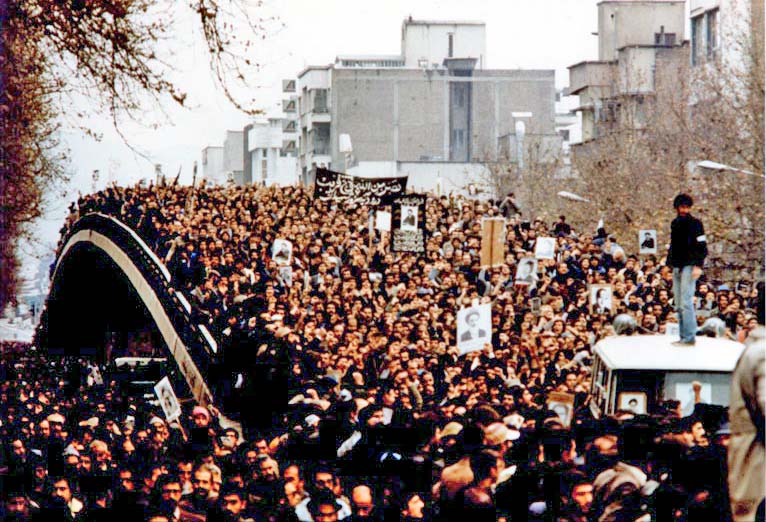
The 1968 movement was sparked by an issue regarding the cohabitation of sexes at Nanterre University dormitories. The student leader Daniel Cohn-Bendit accused François Missoffe, France’s Minister of Youth and Sports, of being part of a “fascist regime.” Student protests spread into central Paris at the Sorbonne campus. A subsequent escalation was marked by a vicious police attack on the “Night of the Barricades May 10 – 11, 1968.” This ignited into a student-worker alliance. Working people were incensed by police brutality. Millions of workers erupted into a massive wildcat national general strike. Several factories were occupied by workers. On the 13th May, the PCF and their trade union (the CGT) raised the slogan of “Ten Since he was years are enough!” and mobilized between 500,000 and 700,000 individuals.
Now the ruling class panicked and developed a two path strategy. The first strategy was the usual threat of military response. Since he was concerned with maintaining secrecy, de Gaulle conferred with the army outside France in Germany. He asked General Jacques Massu, commander of French occupation, for the army’s loyalty to the ruling class. Satisfied, de Gaulle returned. The previous police brutality extended to a threat of naked army brutality. Visibly armed tanks manoeuvred with clear warning. Political groups of the left, including Marxist and Maoist parties, were outlawed.
The second strategy was to disarm the organised workers by using a fifth column: the PCF. By now the PCF was openly revisionist. As they decayed, they precipitated a revulsion in many. Countering the PCF were now those such as Jean-Paul Sartre, André Gorz and others. They promulgated a philosophy of “self-management” or “autogestion“. Cohn-Bendit dismissed many as ‘mentors’ to the students, but acknowledged Sartre: “None of us have read Marcuse. Some read Marx, of course, perhaps Bakunin, and of the moderns, Althusser, Mao, Guevara, Lefebvre. Nearly all of the militants of the March 22nd movement have read Sartre…” 1 Rejection of “standard” Marxism was accompanied by attraction to Maoism and “autogestion.” These strands were unable to withstand the force of the French state.
The refusal of the PCF to continue to support the movement was the final straw. It effectively stopped the 1968 movement when it was close to a sweeping societal change, especially because the army cadre were ‘wobbling.’ The bosses met with the trade unions, and were supported by Prime Minister George Pompidou who in 1967 faced down a miners’ strike. On May 25, an agreement was made by the PCF trade union (CGT), to exchange some wage benefits for getting the workers back to work. The PCF sent CGT leaders including Georges Séguy to negotiate with 25,000 strikers at an occupied Renault factory. But unanimously, the workers refused them. Many other factories followed suit. However, the workers lost support of the CGT.
By 30 May, Pompidou managed to get de Gaulle to dissolve the National Assembly. This allowed for new elections on 23 June. Tanks were visible again. The state initiated a wave of old-fashioned French nationalism where “800,000 supporters marched through the Champs-Élysées waving the national flag.” Workers were threatened by a “state of emergency” to go back to work. In the election that followed, the Gaullists had a near clean sweep.
What is happening in France 2026?
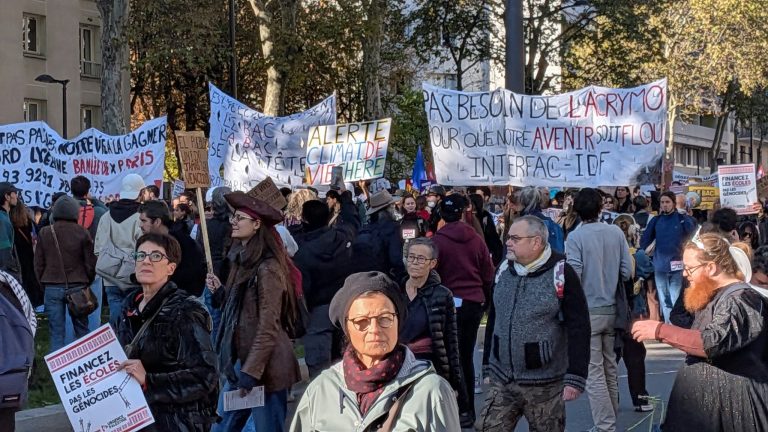
A chronic lack of facilities and funding for schools spurred spontaneous massive school protests. They began in a working-class suburban district of Paris, in the ‘banlieues‘ of Servan, St Denis. Generally banlieues are areas of working-class, high-rise flats, often with a high density of immigrants. Here the tradition of fighting for rights is of long standing. Sevran’s Lycée Blaise-Cendrars, has 1,000 pupils and in 2024, “students and teachers made a viral video about the state of classrooms.”
The main underlying grievance is that “Education is a right“. While the poorest and most working-class districts of France are especially hit, the themes have resonated across the whole country. Namely a poor quality of education with about 10 per cent of classroom hours being untaught “because absent teachers are not replaced”. All this shows up in severe drops in French maths and literacy scores in the OECD’s transnational Pisa study.
The amount of state spending on education is ranked at number 9th across the OECD countries, which falls to 15th place after teacher pensions are adjusted out.
Terrible conditions in schools sparked outrage. Teachers joined students to protest but also to tried to protect them from the police. The French prime minister, Sébastien Lecornu, was forced to state students had “legitimate” concerns—as students’ showed pictures of “broken classroom chairs, holes in walls, holes in ceilings, mould, buckets to catch leaks, faulty lights. […] toilets broken, … no toilet paper or soap. Video projectors and science equipment were lacking.”
Up until 2026, in recent years policing before any street events remained brutal. In the 2018-2019 gilets jaunes (yellow vests) demonstrations, allegations arose that people had lost eyes and had hands and feet mutilated.
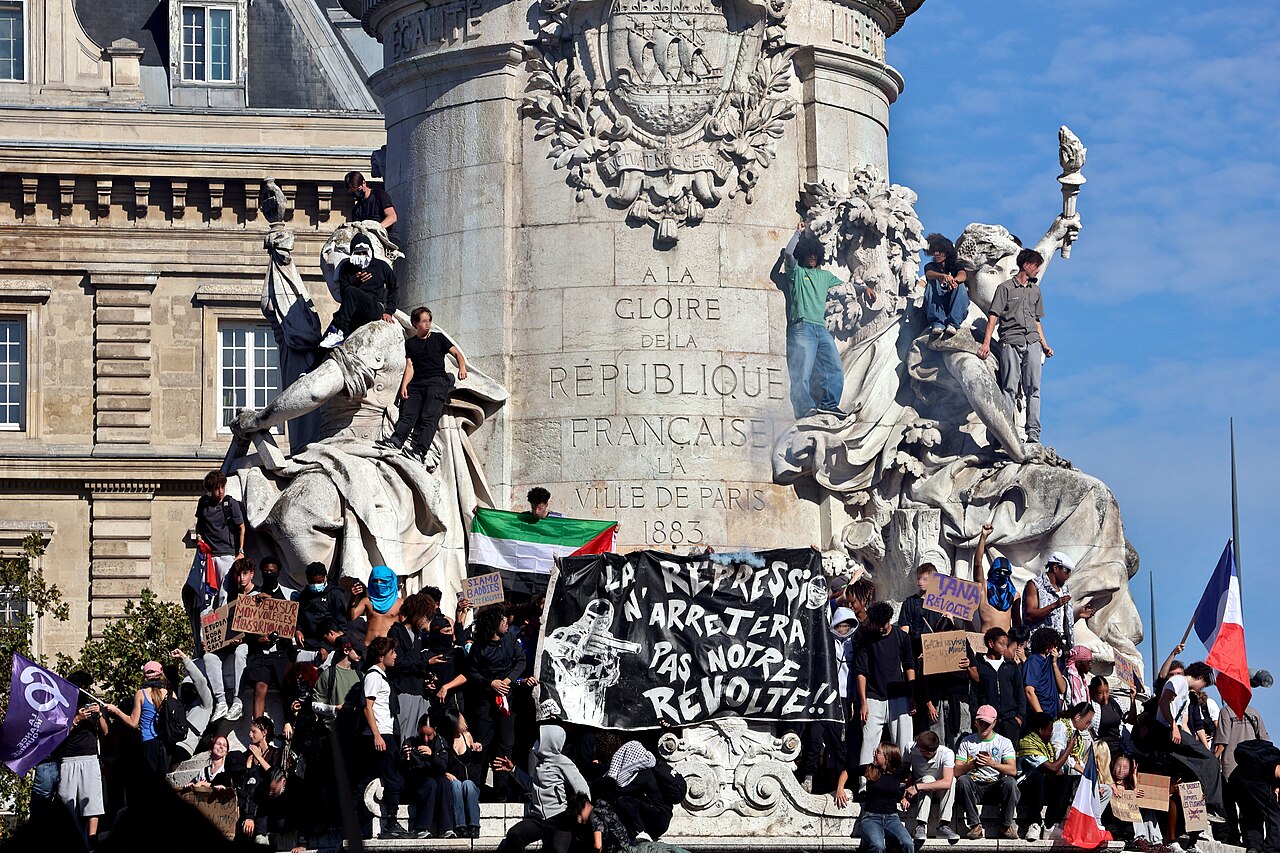
Already 2026 has seen waves of arrests—with a total of a total of 6,773 under-18s only in September—and brutal attacks on children and young people. Already at least one hand and one eye has been ‘lost.’
The Gaullists of the “Fifth Republic” in 1968 imposed censorship over radio and television. Today cellphones and messaging expose the government and its brutal police force. Eden, 14 years old, was shot by a grenade from 1.5 metres with serious wounds. His lawyer calls it all “the equivalent of war weaponry.”
Trade unions—including the CGT led by Sophie Binet—have now joined with the students, as have university students. But just how many workers join the struggle will depend on how similar 2026 is to 1968.
In the meantime matters may become derailed by acts of extreme vandalism, which, whether by design or not, will almost certainly precipitate reaction. Whatever the origin of such events as the burning down of a town hall, the likelihood is high that they will bring down State repression on the working class. Thus the state appeared to have swung from an initial ‘over-policing’ to one of a deliberate ‘under-policing’ on 17 October 2026. That inspired a round of looting, which as commentators put it, make “the most obvious immediate winner Le Pen’s Rassemblement National (National Rally RN).”
Marine Le-Pen and the fascism of her RN party are poised for an electoral victory on the backs of a “order” campaign. This will further repress the working class and students. The timing is important to note. In six months elections for presidency occur with a huge budget deficit, and a vaingloriously outgoing President Macron.
As well there is a social democratic force in movement. In fact, left-wing party La France Insoumise (LFI), led by Jean-Luc Mélenchon, is being conveniently blamed for the episodes of vandalism. He rightly throws the charges back, pointing to the police brutality. Although both he and his programme are not Marxist, the LFI are an obstacle to Le Pen.
But the worry is that in the absence of a large and organised Marxist-Leninist party, current developments are likely to parallel the ultimately failed 1968. An understandable anger—but chaotically undirected—will lead only to repression. The underlying issues of how to organise in the absence of a disciplined central Marxist-Leninist force are universal. As heartfelt as the theories of ‘autogestion’ are, they cannot guide the movement. French Marxist-Leninists must work in and with the forces of LFI—but they cannot rest there.
A fuller version of this was first published at MLRG.online 17 October, 2026
- Arthur Hirsh; 1982 ↩︎