Maricarmen Abascal became a symbol of Spain’s housing crisis after being forcibly evicted from the house where she had lived for more than 70 years in Madrid. Her highly publicised case, followed by her tragic death, sparked a wave of protests across the country. The movement soon expanded across the border into the neighbouring Portugal, which has faced its own housing crisis for years.
The Portuguese government insists the situation is nothing like in Spain or France. In early October, in response to demonstrations planned in Porto, Prime Minister Luís Montenegro declared his hopes for political parties and grassroots movements to not “import climates of instability and protest into Portugal that do not actually have support in Portuguese society”, calling protesters “selfish.” The numbers, however, contradict him: a 2026 study by Tradingpedia ranks Lisbon as Europe’s least affordable rental market, with the average rent consuming over 99% of the net salary of its inhabitants. In Porto, tenants spend over 85% of their salary on rent. Additionally, prices are rising much faster than incomes: according to Eurostat, between 2015 and 2025, Portugal’s house price-to-income ratio grew by 60.8%, the largest increase within the European Union.
The Portuguese housing crisis is not a new issue, and its factors are varied and well studied: lack of public housing, a boom in tourism and short-term rentals (such as Airbnb), no rent caps, and the “golden visa” scheme, which since 2012 has granted residence in exchange for property investment, pushing prices up and kicking families out of city centres.
Demonstrations and actions against the rising housing costs and the overall cost of living have been taking place for many years. However, the recent Spanish protests, alongside the new tenancy law discussed in the Portuguese Parliament in September—which left-wing parties call the “eviction law”—triggered a new wave of protests. The law would allow landlords to terminate a contract after three months of unpaid rent, to demand three months’ rent in advance instead of two, and to end the 2% limit for rent increases in new contracts.
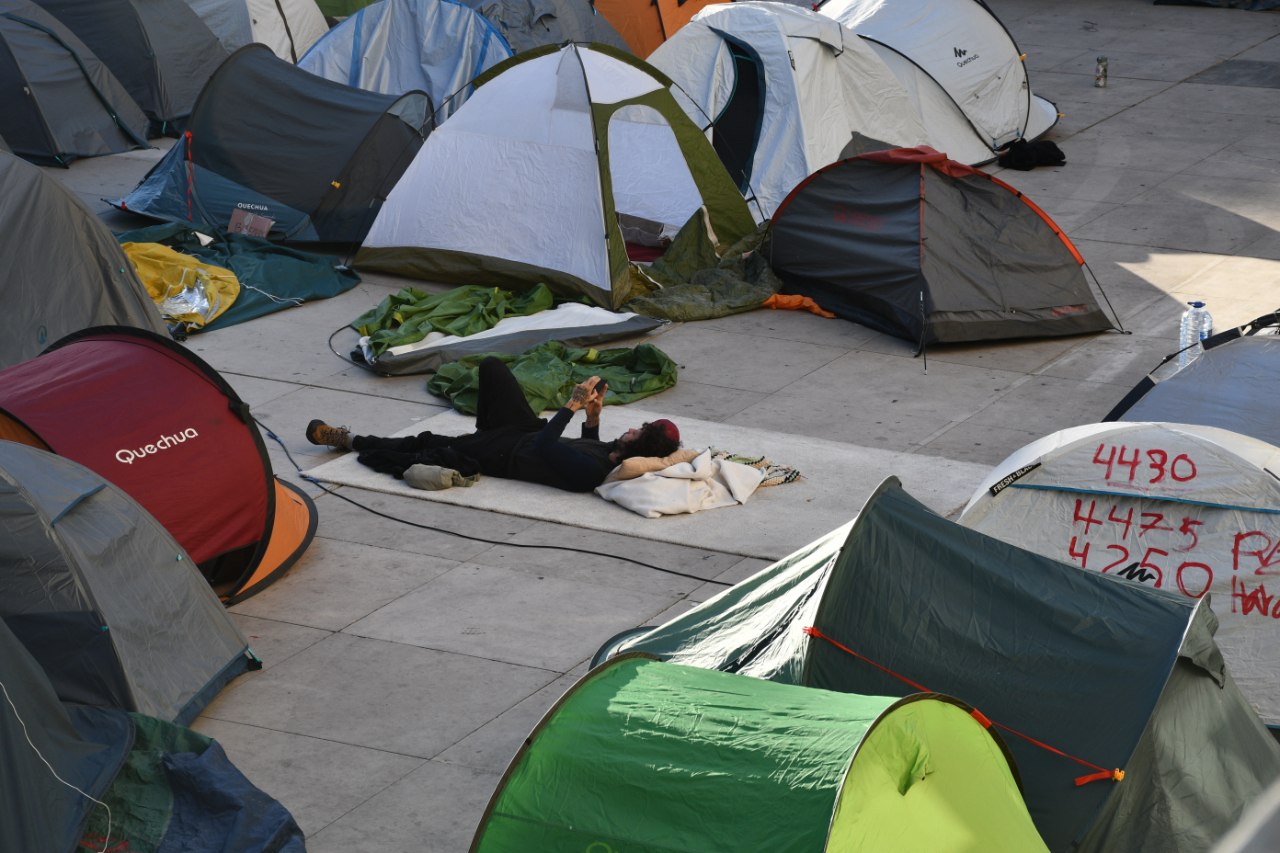
In response, a series of demonstrations were coordinated across the country. In Porto and Lisbon, encampments were also set up since 10th of October, under the slogan “Can’t afford the rent? Set up a tent!” Beyond repealing the new tenancy law, the demands from the movement include an end to evictions without alternative housing, a brake on the purchase of homes by property funds, an increase in public housing, bringing vacant properties back into use for housing purposes, and rent caps.
Since then, we’ve witnessed an arm-wrestling match between the housing movement and the police, as the Portuguese government resorted to violence several times to disperse the peaceful protesters. On 15th of October, police cleared the Porto camp, injuring 37 people. Amnesty International said it was concerned that the force used was excessive and unlawful. On 20th of October, police arrested 55 people in Lisbon; and then again on 25th of October, 25 more people where arrested in Lisbon and six more in Porto, when the riot police, some with dogs, charged the camps and fired rubber bullets. On 1st of November, another violent police advance resulted in 13 people arrested and more than 30 injured; but Minister of the Interior Luís Neves considered the authorities’ use of force proportionate. Protesters describe it very differently: Afonso, a Lisbon demonstrator, told us: “People were singing Grândola Vila Morena and other protest chants (…) no objects were being thrown. I witnessed it and can testify firsthand that the use of force was not proportionate, especially since we on the protesters’ side did not resort to violence in our resistance. The police began to approach us and started grabbing people. There was no verbal communication that we were being detained”.
Another demonstrator from Porto, Leyla, also denounced sexist police violence as a means of intimidation: “The riot police said some really horrible things to me while they were forcing me to the ground and my hands behind my back, tasing me. They said some really horrible things to me (…) Horrible things, things a rapist would say. Psychological terror is real too, and it’s also intentional and calculated.” Now, alongside the demands for housing, people are denouncing police violence and defending their right to protest. Ricardo Sá Fernandes, one of the lawyers representing the Lisbon campers, called 1st of November “a dark night in the history of Portuguese democracy” and said he would file a criminal complaint against the minister of the interior and the national police chief for abuse of power.
The good news is that in Porto’s Praça D. João I, the encampment is still standing and resisting. In Lisbon, the decision was made yesterday to leave Praça do Rossio and decentralise the struggle against housing speculation and for the right to housing, occupying space in the neighbourhoods, streets, and places in the city in general. A central approach of the movement has been a commitment to non-violence. This commitment played out when far-right demonstrators carrying knives attempted to infiltrate the protests and provoke chaos on 15th of October. They were met with calm and unity and perhaps this choice explains the movement’s popular support in a country that prides itself on having had a peaceful revolution.
Lacking the legitimate tools and arguments to dismantle the encampments—with court rulings siding with the demonstrators—the government has used every opportunity to push the narrative away from housing. Officials have sought to portray the protesters in the media as violent actors occupying public space, provoking the police and disturbing public order, leaving the police no option but to arrest them violently. The Minister of Defence, Nuno Melo, went as far as describing the demonstrators as “Trotskyists” who “want to end the State” and turn the streets “into the Bastille in Paris.”
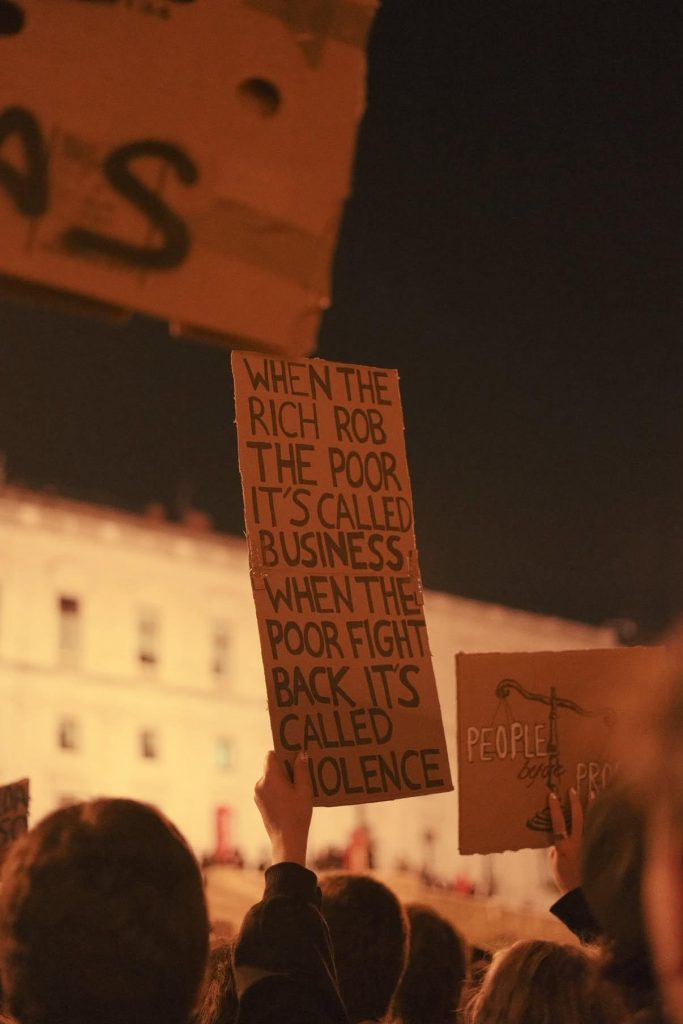
Photo: Daniela @yellowishsociety, Lisbon
Yet the movement’s answer has been to ignore the distractions and to cultivate a utopian praxis with a tangible here and now: they show up every day, make decisions collectively in horizontal People’s Assemblies, and keep up a full programme with concerts, choirs, activities for kids, workshops and popular canteens, obeying only the will of those who participate in their construction. This movement reminds us that it’s the state that holds the monopoly on violence. To protest is not violent, nor is asking for the fulfilment of constitutional rights; violence is having more days in the month than in your salary. Violence is being evicted from your home. Violence is not having a house.
This week, new housing demonstrations are scheduled for 14th of November all across the country. They are mobilised by the Casa para Viver (House to Live) platform. On 10th and 11th of November, the Portuguese diaspora calls for demonstrations in Berlin, London, The Hague, Rotterdam, Brussels, Paris, and Dublin, in solidarity with the encampments, and because “there aren’t more of us on the streets because many have left the country.” Join us in Berlin on Wednesday, 11th of November, at 18:00, at the Brandenburg Gate.
For more information: https://www.instagram.com/acampadaber/