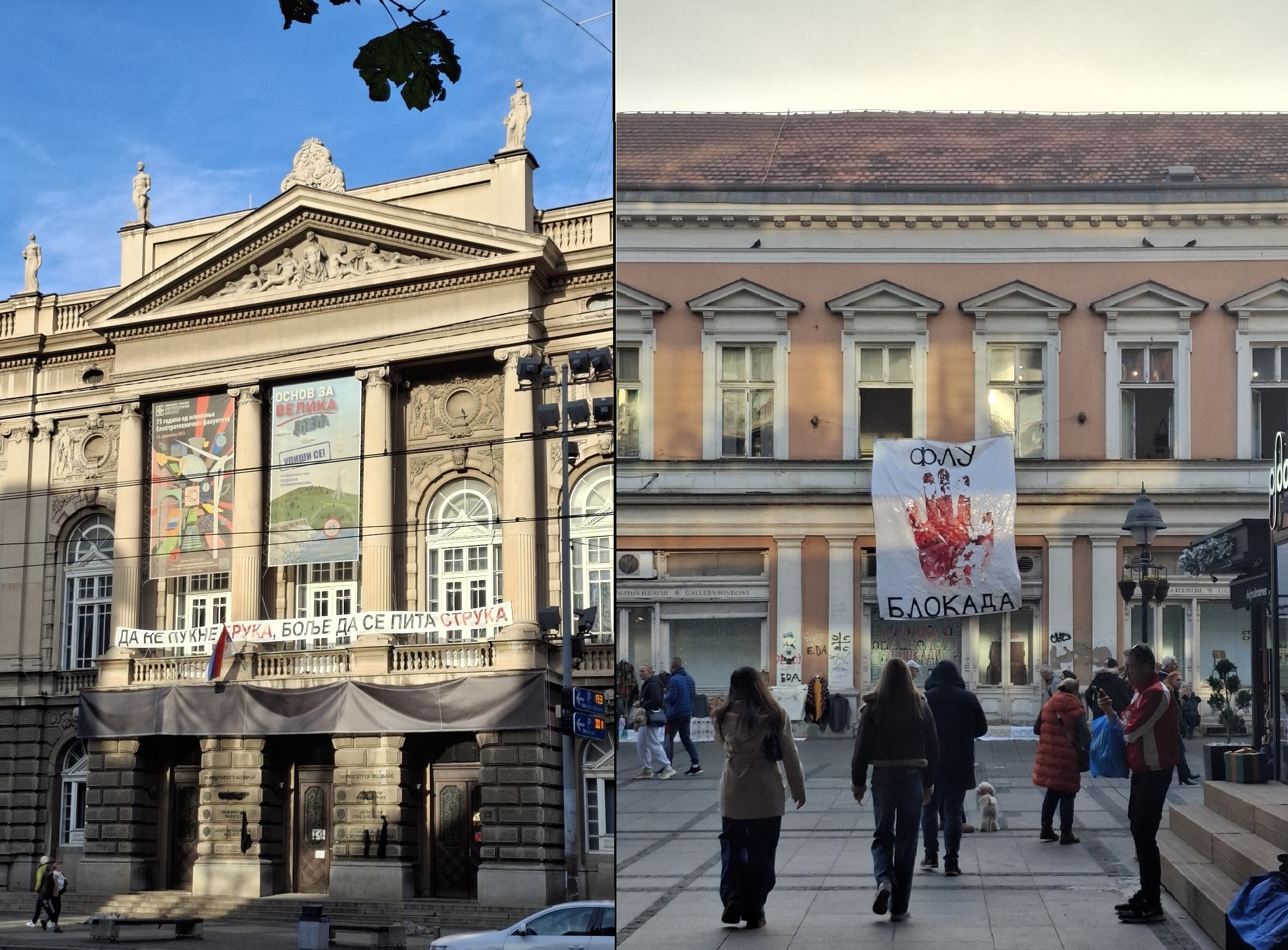
The student movement (which would ultimately become the victorious Student List, listed as number 3 on the ballot in the recently held parliamentary elections in the Republic of Serbia) emerged spontaneously, almost instinctively.
On November 1st, 2024, at 11:52 a.m., the concrete canopy of the recently renovated railway station building in Novi Sad, a city in northern Serbia, collapsed, killing sixteen people who happened to be there at the time.
The modernist building of Novi Sad railway station was originally constructed around sixty years ago. It was renovated from 2021 to mid-2024 as part of the wider reconstruction project of the Belgrade–Budapest railway line, itself embedded in China’s much broader global initiative known as the Belt and Road Initiative.
In the immediate aftermath of the tragedy, and following the unwillingness of state institutions—including the principal state media outlets—to respond to it, citizens in Novi Sad, and subsequently in other cities, initiated commemorative actions in honour of those who had lost their lives. These took the form of fourteen-minute periods of silence: groups of people would stand peacefully at street intersections, bringing traffic to a halt. The actions began as a fourteen-minute period of silence and subsequently extended to fifteen and then sixteen minutes, as two more people who had been hospitalised after the canopy collapse later died. These acts of “silence” took place weekly, every Friday at 11:52 a.m.
On 22 November 2024, students and professors from the Faculty of Dramatic Arts (FDU) in Belgrade were physically attacked outside their faculty during one such act of commemoration. Some of the assailants were later identified as municipal councillors from the ruling party. The FDU attack triggered a response that, three days later, would lead to student occupations and blockades of faculties across Serbia.
During their first weeks, the faculty blockades remained almost invisible beyond the academic community. From the winter of 2024 onwards, however, through actions staged in public spaces, they became a catalyst for a broader social movement. During the following months, public actions by students and citizens gathered in the streets were repeatedly a target of attacks by individuals involving verbal and severe physical violence, at some points, going above what was initially imaginable.
The faculty blockades continued until the spring of 2025, when the students formally announced that they saw the calling of early parliamentary elections as the means of resolving what had by then become a profound social crisis.
The public actions conceived and organised by students through complex processes of collective decision-making were never aimed at constructing a cult of personality or promoting individuals. Rather, they functioned as collective and corrective rituals: all those gathered experienced themselves as equal participants, rather than as an audience, in actions whose defining characteristic was decentralisation. Students and citizens gathered at public protests acted as a single organism. This was perhaps most striking in moments of absolute silence, collectively produced at certain events by more than 100,000 people. Over the past two years, the collective body of a society in revolt has assumed, alongside its social and political struggle, the role of the most significant artistic form on the local scene. The tools and formats of these public actions evoked major moments in the historical avant-gardes—such as artistic events in post-October 1917 Russia—as well as canonical examples of performance art.
At the same time, through frequent dismissals, replacements, programme cancellations and the cancellation of guest appearances, representatives of state and local cultural institutions were effectively dismantling the local institutional art scene. However devastating the consequences of these actions were for the actual lives and livelihoods of cultural workers, they also contributed to the creation of an atmosphere of resistance and solidarity across society.
Ideological Framework
“I agreed, I’ll be whatever they want me to be
La-la-la-la, la-la, la-la, la-la”
— Excerpt from the lyrics of Pristao sam biću sve što hoće [I Agreed, I’ll Be Whatever They Want], by Bijelo dugme, from the album Doživjeti stotu (Jugoton, 1980); lyrics by Duško Trifunović.
During the student actions in public space, we witnessed a broad spectrum of signifiers: banners, flags and images printed on T-shirts, ranging from the radical left to the far right, appearing alternately, side by side, and in every possible position in between. The refusal to adopt a fixed ideological position within the social and political divisions—once interpreted as a personal or collective weakness—has, in a post-historical context, become an effective mode of struggle, a tool that has produced unexpectedly powerful results in this particular situation.
The precariousness into which we have collectively been driven—except in small, protected environments such as state faculties and research institutes—has, in turn, produced a crisis in the cult of individuality, imposed on western culture during the Enlightenment and subsequently through modernism. The aim of modern man is to fulfil himself as an individual, is it not? In today’s world, individualism and individuality increasingly appear to be privileges of the wealthy.
Young people enrol at universities believing in their own capacities, in the qualifications they will acquire through their studies, and in the stability of a social system that will welcome them as educated individuals. The reality of the labour market presents a different picture: jobs may exist, but most people are expected to set aside their individual aspirations, and adapt themselves, their abilities and their capacities to working conditions that are increasingly far from ideal.
Perhaps this also partly explains the readiness of so many young people in Serbia—members of a generation labelled “superficial” and “antisocial”—to act collectively, setting their individualism aside in the name of a common goal. They have taken what was directed against them—the deprivation of their right to individuality—and transformed it into their greatest strength.
Moreover, from the very beginning, the problem was not located in ideological frameworks, but rather in deep-seated systemic corruption. The system attempted to conceal this corruption precisely by invoking the supposed ideological background of the protests, attributing them to one or another form of foreign influence. The polyphony of the protests proved an effective shield against attempts by the state leadership to point the finger at imaginary ideological enemies, since such accusations would immediately be drowned out by the presence of other, opposing voices.
The initial reactions to the broadcast of the Student List’s electoral victory on Serbia’s mainstream television channels revealed that the ruling system was still processing events through the conventional media formats of pre-election communication: billboards, television advertisements and formulaic campaigns organised by party activists. Some commentators made statements such as: “The Student List won even though there was no campaign.” From the outset, the student movement had relied on social media and, more interestingly, had allowed people to add to and alter slogans and memes themselves through their interactions. Since the emergence of social media, the reality in which we live has become so deeply interwoven with the digital one, that it has long been impossible to divide or separate these two domains.
“Be like water,” Bruce Lee said.
A Leaderless Revolution
“Students in Blockade have the right to discover a new way of practising freedom, and I believe this is a good starting point.”
— Unnamed student, SKC Paper, no. 1, 25 February 2025.
From the very beginning, the student protest took the form of a front, emphatically anti-individualist in character. All student decisions were made through plenary assemblies. The assemblies of individual faculties were connected through a collective decision-making body that coordinated the decisions of all plenums via selected delegates, who were replaced at each subsequent meeting. The frequent rotation of delegates was intended precisely to prevent any form of individualisation within the system of communication.
This arrangement had two advantages. Internally, it protected the student movement’s decision-making system from the risk of any form of personality cult. Externally, it largely disabled the repressive apparatus of the state and of the ruling party at the time. Of course, the repressive system continued to operate: during the blockades, dozens of attacks on students, unlawful detentions, and allegations of illegal surveillance and wiretapping were documented.
The anti-individualist character of the student protest initially caused confusion within the local art community, and responses among its participants varied. Institutional programmes—such as scheduled exhibitions in museums and galleries or the regular repertoires of theatres—continued under increasing pressure from the ruling structures, seemingly indifferent to the social upheaval. Yet spaces in which resistance could take place also emerged within these institutions. At the end of performances, actors from certain theatres would raise their student ID booklets—indeksi—in a gesture of support for the student struggle. An administrative document had thus become one of the symbols of the protest. Beyond the major state institutions, performances, concerts, happenings and exhibitions openly supporting the student struggle took place during the blockades. The only dividing line among those involved was the extent to which their creative engagement was devoted to strengthening the protest, as opposed to using the protest, in some cases, as a platform for self-promotion.
One particularly persistent and impressive example was the initiative bearing the somewhat bureaucratic name “Archive of Public Gatherings”. The “Archive” was launched in 2023 by a small group comprising journalists and activists Aleksandar Gubaš and Dušan Čavić, together with visual artist Vladimir Nikolić, Serbia’s representative at the 2022 Venice Biennale. Nikolić, himself an active participant in the student protests of the 1990s against the regime of Slobodan Milošević, is described as the group’s “author of a methodology for measuring public gatherings, based on orthogonal aerial imagery, photogrammetry, georeferencing and the manual marking of participants”. “The Archive of Public Gatherings is an independent research group that establishes how many people actually attend outdoor public gatherings,” its website explains. The “Archive” has become a kind of creative platform whose outcomes go beyond the mere counting of participants. It emerged in response to the crude manipulation of attendance figures and other information on official news channels during the student protests.
Individualism, already discussed as an inherited ideal of “modern man” and largely promoted as the foundation of artistic creation in European discourse, was overcome during the protests by collective action.
In February 2025, a group of students and activists entered the premises of the Student Cultural Centre (SKC) in central Belgrade and declared it liberated. At the same time, and predictably, the ruling structures used their media outlets to describe the SKC as “occupied”. Until then, the centre had been under bureaucratic administration, which had reduced it to a mere shell; in practical terms, the SKC had ceased for decades to be a significant spot on the artistic map of Belgrade or Serbia.
From its very beginnings, however, the Student Cultural Centre in Belgrade had been closely connected to student protests. The building it occupies dates from the late nineteenth century. Until the student protests of 1968, it belonged to the military and served as an officers’ club. Following the protests of 1968, the building was allocated to students. Since 1971, it has hosted some of the most significant events in the contemporary art scene: performances by Marina Abramović, a visit by Joseph Beuys, and exhibitions by Daniel Buren, Braco Dimitrijević, Jannis Kounellis and others.
During the six months of its activity, from February to July 2025, the liberated SKC was, quite literally, a space of continuous activity, day and night. In that brief period, even the forgotten “Radio SKC” was reactivated, broadcasting on its FM frequency of 107.9 MHz. Immediately after the students entered the SKC building, the people were invited to take part in a “participatory performance”: a forty-eight-hour event that offered people the opportunity to intervene freely in the gallery space through a process described as “direct democracy”. “There is no single author of the exhibition; each visitor participates in the collective creation and presentation of content. The framework itself is set by the programme working group, which is also a fluid structure, without permanent members, and is therefore not subject to the logic of authorship,” stated the first issue of “SKC Paper”, dated 25 February 2025.
On 22 July 2025, the previous management entered the Student Cultural Centre accompanied by the police and expelled the students. The liberated SKC then ceased its activities.
The energy generated by the protest movement was ultimately channelled, through the parliamentary elections, into existing institutional structures. The initial demand of the Students in Blockade, that “institutions should simply do their job”, ultimately led, through a non-violent transformation and the collective act of casting ballots at polling stations, to a situation in which society as a whole now faces a long and arduous process of restoring order, including within the art scene.
The moments of boundless freedom experienced during the blockades have ultimately been embedded in the foundations of what we hope will become a new society in the making. Of course, this raises questions about the ways in which absolute freedom and institutional frameworks can meet and accommodate one another.
During a conversation at the liberated SKC in the spring of 2025, a friend said to me: “This is it, this is the moment. This is what we fought for. There is no afterwards.”
The article was first published in the CC_Critical Communication Newsletter