The recent “cockroach protests” in India have seen reporting from all quarters. Following a series of uprisings across South Asia, these too have been seen as a fairly optimistic sign of democratic victory, in a country that has been growing increasingly authoritarian while also facing economic stagnation. How can we better understand the dynamics of these protests?
Historically, the incredible lack of economic opportunities in India has meant that one amongst not very many avenues for class mobility has been to sit through ruthlessly competitive exams, and to try and study engineering or medicine. While alternative avenues did briefly exist during the economic boom of the 2000s, stagnation over the past decade has once again made such exams assume critical importance. The exam that precipitated the current crisis, the NEET, has gatekept access to medical schools across the country since 2016. In 2025, 2.29 million candidates sat the NEET, competing for access to a measly 130k places, more than half at unaffordable private universities. At a minimum, around ten students die by suicide every year due to this exam, with women being overrepresented amongst suicides. This is, therefore, far from the first controversy these exams have sparked: in 2017, a year after the NEET was introduced, a Dalit student in the southern Indian state of Tamil Nadu took her own life after the Tamil Nadu government failed to get an exemption from the NEET. She had scored 98% in her school-leaving exams: had admissions been based on these exams, she would have likely have been a doctor by now.
Fast-forward to the present. The results of the exam, held on 3 May this year, were annulled on 12 May, after a chemistry teacher reported a strong overlap between a published set of sample questions and the actual exam questions. A later investigation revealed an elaborate chain of leaks, where model questions were being sold to students for €15,000. The government consequently decided that the results would no longer count, and that students would have to retake the exam, leading to much outrage and another spate of suicides. On 15 May—in an unrelated context—the Chief Justice of India, in a rant that is quite consistent with global right-wing discourse today, called unemployed students “cockroaches” and “parasites” who end up joining the fake news media or becoming lifelong activists.
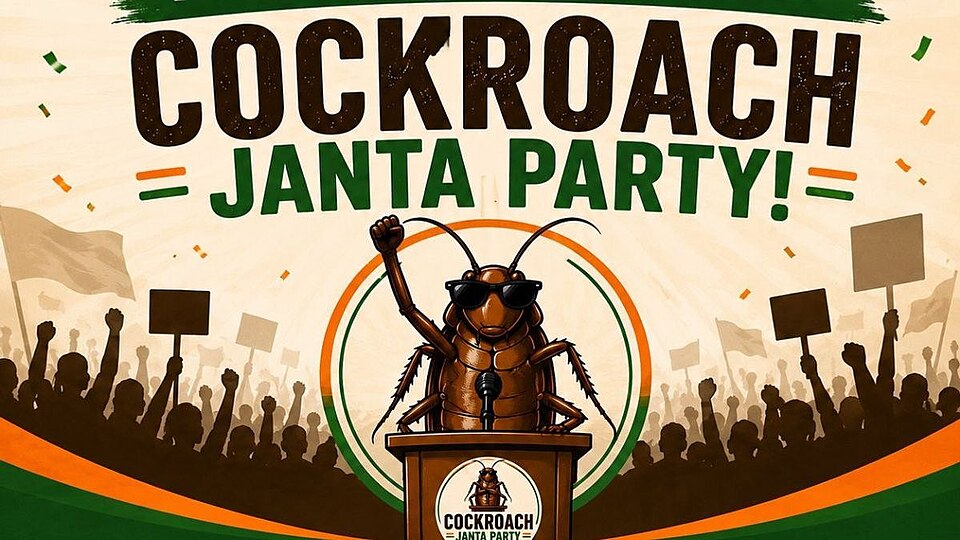
In response, an Indian student living in the United States created an Instagram page for the satirical CJP (Cockroach Janata Party/Cockroach People’s Party): a play on the acronym “BJP” (Bharatiya Janata Party/Indian People’s Party). By the end of the week, the page was already more popular than the BJP’s own Instagram account. And by June, momentum had picked up to the point that the group began calling for protests at Jantar Mantar in Delhi, a site that has long been ground zero for protests against governments past and present.
The protests snowballed; while numbers are hard to glean, estimates claim close to 50,000 protestors in New Delhi alone. The goals were the resignation of the Minister for Education, financial compensation to the families of the students who died by suicide, and assurances that nobody would be tried for participating in the demonstrations. As far as these main demands were concerned, the protests were successful: on 24 July, after massive escalations, gratuitous police violence, and mass-arrests across the country, the education minister resigned. And after assurances from the government that the other demands would be honoured, the CJP called off all demonstrations, declaring the whole thing a success.
Several observations can be made here. The positives, first: the visuals emerging from the protests mark a clear shift in public sentiment. While videos of teenagers setting fire to images of the Prime Minister would not raise eyebrows in functional democracies, any critique of Modi has been shut out of public life over the past decade. This has been effected through state authoritarianism, but also through the legitimisation of a mass fascist movement, the fear of which has played a powerful role in silencing people. The students joining these protests have simply never experienced an India outside of the BJP; to see them even challenging the status quo, acknowledging that it is not normal, is a positive sign. Yet we cannot remain mired in optimism for the sake of optimism, but rather should take a clear, level-headed look at the tensions that these protests highlight.
The first such tension is the role of the CJP itself. Unlike the more horizontal demonstrations in Bangladesh and Nepal for instance, the CJP has had its fair share of “leaders”, who have found themselves playing interlocutors between the genuine rage across the country—not just over the exams, but over a generally collapsing economy, where prices seem to increase with no end in sight and living standards gradually collapse—and the state. Amongst sceptics on the left, they have been seen as a minor pressure-release valve at best; at worst, they have been called controlled opposition. These seem like harsh claims, yet it is simultaneously also true that the CJP’s leadership has repeatedly thrown protestors under the bus: they have relentlessly played the good protestor/bad protestor dichotomy in an effort to gain legitimacy; they have attempted to control precisely what gets said at demos, banning slogans calling for azadi (freedom), likely because of the associations of the expression with calls for freedom in Kashmir; they have stooped to explicitly describing the more radical of the protestors as “infiltrators” or “outsiders”. CJP leaders have also repeatedly met with government officials, negotiated, bartered, and participated in photo-ops, in a consistent effort to “manage” a movement that risked growing larger than the CJP itself. And following the education minister’s resignation, they have actively called for protests to end, and asked people to go home.
The second tension is the demographics of sections of the protestors themselves. These protests are likely the first to feature any meaningful representation of the otherwise apathetic middle-classes, since the anti-corruption protests around 2012 that allowed the BJP to ride into government in the first place. “The situation is so bad”, a common genre of Instagram post goes, “that even the [insert middle-class identity] are protesting”. This is perhaps unsurprising: the present dismal state of the Indian economy and the entire exam fiasco are intense enough that they have started to affect many who were once sheltered from its brutality. This is also why there has been fairly sizable diasporic participation in the protests, compared to the relatively muted turnout when the Indian state engages in its frequent, widespread human rights violations. And in principle, this is also not a terrible thing, given the potential for the politicisation of a class who have been the prime beneficiaries of neoliberalism with Indian characteristics.
Ultimately, a combination of these two tensions has culminated in a situation where only some sections of protestors face brutal repression, either from organised mobs of Hindu nationalists, or the police. This particularly affects those who are not upper-caste Hindu men. Women, for instance, have faced persistent doxxing and harassment: a 15-year old child and her single mother have been forced into hiding after multiple threats from Hindu mobs. And as is tradition in India at this point, it is predominantly Muslims who have faced the full brutality of the state. Some of these stories are poignant in their sheer cruelty: such as that of Muhammad Junaid, a working-class Muslim who went viral on Instagram for distributing food to protestors in Delhi. Junaid was arrested together with his father and with his sister’s family, a form of collective punishment that the Indian brand of fascism is particularly fond of. Recently-passed legislation in the once-communist stronghold of West Bengal—where the BJP won their first elections this year, after the mass-disefranchisement of close to 6 million Muslims—allows the government to detain “gangsters” without a trial for up to a year, and to confiscate and auction their property. In the past week, 10 Muslims have been charged under this new law. In Bihar, the poorest state in the country, 400 people have been arrested for participating in the demonstrations. In India-occupied Kashmir, 2,500 people have been arrested following the alleged killing of a policeman by militants. And in Bangalore, a woman has been charged for carrying a sign calling for solidarity with Umar Khalid and Sharjeel Imam, two Muslim students who have been in prison without a trial for more than six years now — charged under the Unlawful Activities (Prevention) Act, a piece of legislation that allows the state to detain potential “terrorists” without a trial.
Indeed, it would be remiss to talk about the protests today without comparing them to the protests Khalid and Imam were arrested for—the 2019 protests against the Citizenship Amendment Act (CAA), an act that made it explicitly impossible for Muslims to seek refuge in India. Together with the simultaneously-launched National Register of Citizens (NRC), which required obscene amounts of documentation to “prove” citizenship, the government’s goal was to effectively render Indian Muslims stateless, or in perpetual fear of statelessness; the extrapolation of a model that has long been used in the north-eastern state of Assam, to the entire country. Unsurprisingly, the protests against these laws were massive, particularly in Delhi. Given the substantially different demographics of the protestors, these protests also featured the use of colossal state violence, with more than 60 casualties reported. The protests ended in the Delhi riots of 2020, where an additional 50 people died; shortly after, all demonstrations ended due to the pandemic. Many of the sharpest voices from that era remain political prisoners today.
The fundamental issue with the protests today is that they have ultimately remained fundamentally apolitical, making the idea of connecting solidarities absolute anathema to many of the involved parties. The core rationality underlying this, practically a neoliberal new-public-management cliché, is the view of nation-states as firms in need of good “management”. This framing is not unique to India: all over the world, this view has birthed a number of protests that have attempted to resolve crisis by replacing individual bad managers with good managers, while actively working to foreclose substantial systemic transformations. Deeply nationalist verbiage has thus also been very acceptable within these protests, both within India and amongst the diaspora: national flags are a mainstay, as are attempts to reclaim nationalist slogans from the right. Downright reactionary movements have also emerged in the wake of the protests, from sections of the protestors themselves: such as an Instagram campaign calling for the abolition of affirmative action in education.
Ultimately, the leadership of these protests has failed to address the mass fascisation of Indian society over the past decade, or to even begin to connect solidarities. Indeed, it is largely the government’s mismanagement of this crisis that led to things snowballing to the extent that they did: had they simply asked the minister to temporarily step down until the storm had blown over, they may well have had been successful in taking the wind out of the movement’s sails.
The now former education minister has been replaced by someone who is likely to be even worse, a lifelong member of the RSS, the ideological paramilitary group that drives Hindu fascism. Many protestors have gone home; those that are left continue to face the wrath of the state; and little has been said to address the fact that it is specifically Muslims that will face long-term consequences for protesting, or even being seen around protests. Ultimately, a weakness of the Indian left has been a particularly obstinate focus on the material, which leaves them particularly blind to the fact that the material and the ideological are deeply contested within the Hindu right. The BJP do indeed appreciate ruthless industrial capitalism: the cause of mass dispossessions of indigenous people, of the brutal suppression of labour movements, and so on. Yet it is important to understand that this ultra-capitalism is contested by their ideological wing, by the RSS: like true national socialists, many within the organisation find the new bourgeoisie to be destructive to their aims. Many, that is, would be very happy to see more social welfare for Hindus; what motivates them is not the accumulation of capital, but the construction of a state with an unambiguously upper-caste Hindu Leitkultur, built by the petty bourgeoisie, and complete with the erasure of Muslims from every aspect of public life.
Where we go from here is unclear. The BJP will undoubtedly regroup, attempt to diagnose precisely what went wrong, and ensure it never happens again; this will likely spell increased repression, and increasing control over social media. The main positive here is that some spell appears to have been broken: Modi’s name is no longer sacred, and shall see more frequent sullying in the years to come. More radical sections of protestors continue to turn up to the streets, despite escalating state violence and a “leadership” that has betrayed everyone but its most passive, conformist elements. This is where hope lies: in the discontent that refuses to be quelled, in the masses that continue to turn up, and in the seeds of politicisation that have been sown amongst those who have grown up within an India painstakingly curated by Hindu nationalism, their imaginaries of the future severely curtailed by its sheer hegemonic power. Whether the left can take advantage of the situation without reflexively validating the worst instincts of the thus-far apolitical masses remains to be seen. What is clear is that the project ahead of us is immense; and however imperfect, crises like these represent the temporary breaks in subjectivities upon which we must act, if only to create the conditions for the possibility for future battles.