
In the first and second parts of this series, we reviewed perspectives from migrant labor organizers in Berlin which highlighted the role of Germany’s trade unions and works councils, respectively. However, not all organizing efforts are pushed through formal institutions—some of the most innovative and creative ideas exist on the periphery of “official” efforts. One example is the concept of the “worker center,” an approach to organizing aimed at the community-level which seeks to work in tandem with formal labor organizations such as trade unions.
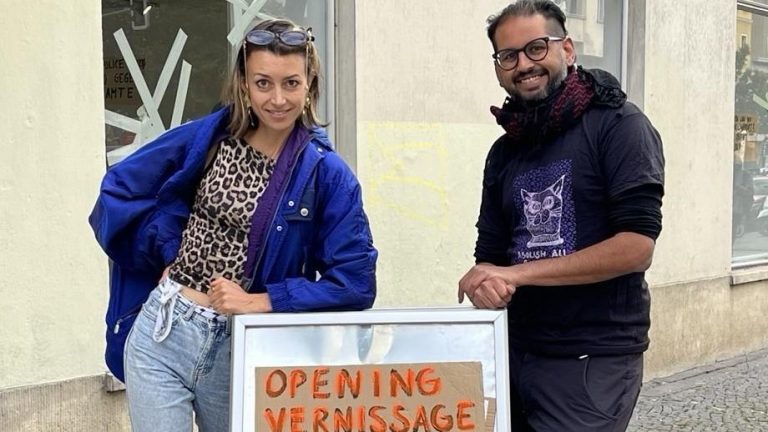
Gabriel Berlovitz has been living in Berlin for 7 years and was previously active as a union organizer with the Service Employees International Union (SEIU) in the United States. Having accumulated several years of experience as an effective union organizer, he has been working in Berlin as a researcher and labor activist. His focus has been on organizing the migrant community by developing a worker center to facilitate a deeper sense of community and a greater capacity to act collectively. Gabriel began his union activism in Berlin by assisting a number of Betriebsrat (works council) initiatives, was involved with the creation of the Monthly Membership Meetings program hosted by members of Ver.di, (see part one of this series), and has expanded his activities to broader organizing at the community level.
Worker centers
One of Gabriel’s primary efforts is the development of a worker center in Berlin to address the needs of the migrant community. Unlike trade unions or works councils, worker centers are grassroots community-level initiatives which function independently or in coordination with formal labor organizations. “It’s typically a city-level initiative to organize a very specific migrant community, typically within several key connected industries,” says Gabriel. As an example, Gabriel points to areas where worker centers developed in his hometown: “Think about Uber and Lyft drivers in Minneapolis—it’s mostly Somali workers, East African workers.”
In other words, the worker center pulls together groups of people at the community-level, facilitating cooperation between workers in distinct but similar industries. “It is just organizing at the end of the day,” says Gabriel, “but you’re trying to find intermediary steps for informalized workers to build a certain level of associational power that can be used to win changes outside of a more formalized system.”
In Berlin, Gabriel obtained funding to kickstart an organization called MigLab, through which he has hosted several events around the city to start a conversation on worker centers. “My strategy was to find an active campaign that was adjacent to low-wage, precarious, informalized workers that could serve as a place to build a base around,” says Gabriel. He soon got in contact with the Lieferando Workers Collective, which has been working hard to organize Berlin’s delivery drivers, the majority of whom are members of the city’s South Asian community. One of the goals is to bridge different levels of worker organizing, to “give people an idea about what organizing in the community and organizing in the workplace looks like,” Gabriel adds.
Things began to accelerate when Lieferando workers received the news that the company was planning to get rid of its workforce and rehire all delivery personnel through subcontractors—stripping them of their already limited rights and making their lives ever more precarious. Gabriel gathered together activists he had recruited from unions, protests, and many of the events he had hosted through initiatives like MigLab. This community was able to come together and organize a phone-banking campaign to ensure as many Lieferando workers as possible knew about the situation and that their colleagues were ready to support them.
“We’re gonna try and build a base for these people at Lieferando and then also use that to try and build bases at Wolt and Uber Eats,” he says, noting that other companies in the service industry operate with the same subcontracting agencies. By focusing on the community-level, a worker center ensures that even if workers are laid off from their job, their efforts to organize can continue in a structured way within the industry. “When they go into the next workplace, we’ll have a structure—we’ll have a community built. This is sort of the fundamental process behind a worker center.” Executed properly, this strategy can build resilience in the labor movement, helping to mitigate crises while facilitating widespread cooperation among workers which is not limited by contracts or specific workplaces.
Facilitating union work
So how do worker centers fit alongside more institutionalized forms of organizing, like trade unions? Gabriel makes it a special point to note that these community-level initiatives are in no way designed to replace the role of trade unions. He insists on the importance of working in harmony rather than in competition with other kinds of organizing. “These movements could very well collaborate with trade unions, should be supported by trade unions, and should support the trade unions as well…” he says.
To exemplify the benefits of a harmonious approach, Gabriel turns to his past experiences in Minneapolis. “Typically trade unions fund worker centers; in Minneapolis they funded three. Those worker centers have organized Amazon workers, they’ve organized Uber and Lyft drivers, they’ve organized subcontracted cleaners into unions—actual functioning unions. They’ve won minimum wage laws for Uber and Lyft drivers […] these are all funded in part by progressive unions.” Unions have a tremendous amount of resources at their disposal as a result of membership dues, though there are limitations to the scope of their work and outreach campaigns. Worker centers only possess the limited resources that the community can gather together voluntarily, but can be very effective at building organizing networks that transcend the boundaries of specific companies, contracts, or collective bargaining agreements.
The benefits of cooperation are obvious, and the emphasis of worker centers on informal organizing is particularly beneficial to migrant workers who are unable to benefit sufficiently from Germany’s labor laws and trade unions. So what are the prospects for such cooperation in contemporary Germany? Gabriel points to his experience collaborating with various components of Ver.di as an example of union tendencies: “There are thousands of committees […] and what ends up happening is a lot of the union is run by staff,” he says, distinguishing between organizing approaches that are directly run by the rank-and-file rather than full-time union officials. “[The committees] all have their own different cultures, so there’s not a lot of consistency, and there’s not a lot of trust in anything outside the union from what I understand—otherwise, I think you would have seen these initiatives already popping up.”
Gabriel also isn’t convinced that organizing work by Germany’s unions sufficiently supports migrant organizing, though he sees things as moving in a positive direction. As examples of progress, he names Daniel Gutiérrez’s work at Ver.di, the Vivantes-Töchter strike, and various strike movements by IG Metall. Nonetheless, he believes there is a lot of work to be done before migrant workers and the issues specific to them are sufficiently represented in major labor campaigns in Germany. Gabriel notes that one of the major differences he sees in Berlin, as compared to the organizing culture he was raised in in Minneapolis, is the lack of a long-term strategy by the unions to use their structures and resources to rally support from more secure, domestic workers to assist the efforts of more precarious, migrant workers.
Gabriel recalls that while organizing with SEIU, it was common for the union to rally workers of one demographic or location to assist workers elsewhere through phone banking and direct actions. If a certain community of workers were struggling, worker centers would facilitate support by requesting members to reach out to their respective unions to rally support—churning out a greater number of activists than would otherwise be possible while simultaneously building bridges across various communities. This kind of work, Gabriel insists, was considered to be on “the very minimal level” of what organizers were expected to do.
Moving forward, Gabriel insists that unions and labor organizers need to better analyze those core sectors of the economy where workers can most effectively fight back. “What are the sectors of the future that are going to be the most disruptive? [Unions] need to strategically organize a couple of really key bargaining units, such as tech, such as cleaners, such as delivery, that can then bring more migrants into the internal organizing of the unit,” he says, noting that migrant workers play a major role in these key sectors. Worker centers could greatly benefit the goals of trade unions in this regard.
Obstacles to migrant labor organizing in Germany
On the subject of rising anti-immigrant sentiments and policies in German society, Gabriel notes that migrant workers and the problems which affect them are often invisibilized. He recalls a scandal involving Wolt’s efforts to manipulate its drivers through a subcontracting scheme, describing how many of his German colleagues expressed disbelief that anyone in Germany could have their labor rights denied in such ways. Gabriel remarked that Germany’s Arbeitsrecht (labor law) has meaning only insofar as it can be enforced. By denying migrant workers secure or formal work contracts employers can effectively exclude them from Germany’s legal protections. The only solution, then, is to organize.
During a campaign at Hello Fresh, Gabriel explains how one union secretary instructed workers to defer to the court system to enforce their demands, a process which was estimated to take between six and eight months. However, even if a decision were reached in favor of the workers at the end of that timeframe, the company would simply be able to appeal it and delay things for a further year. This case exemplifies a tendency in Germany for officials to take existing rules, laws, and guarantees for granted without reflecting on the social dynamics that prevent “outsiders” from benefitting from them. “Functionally this is a worthless strategy,” Gabriel says. “All of these people might be right legally, the system might work in two years,” though by that time “half of [the workers] are gonna be gone or fired.”
It is worth reiterating that German work visas are often tied to employment at a specific business—for the migrant worker, “gone or fired” can mean deportation. Relocating oneself back and forth across borders is a challenge even in the best circumstances. As hostility toward migrants continues to gain traction in German politics the ability for migrants of various backgrounds to enter or reenter Germany is increasingly difficult. One is then forced to ask: what good is being proven legally “right” after it is far too late to alleviate the damage that has been done? The courts may be a necessary tool, but they will never be a sufficient one. Arbeitsrecht can aid workers in very important ways, but it will never replace the need to organize.
Failure to acknowledge the role of migrant workers and the unique challenges with which they are presented plays directly into the hands of the increasingly influential far-right movements in German politics. Moreover, it suppresses the capacity for migrant workers to organize “which is, I’m sure, what the Merz government wants,” says Gabriel. “I’m sure it’s what the AfD wants. Just intimidate [migrants] as much as possible to make sure that they do the job, that they pay their Rentenversicherung, and that they make sure Germans can retire”, effectively subsidizing the German welfare state through the work of migrants who will never be granted equal access to such benefits.
Yet for many migrant workers, the personal gain from the work they contribute is unjustly limited. “You hear [migrant workers] telling you about how they are forced to pay a shady guy they met on a WhatsApp group a couple hundred Euros for a job that may only last two months—maybe your net gain from this job is like 400 euros in the end”, says Gabriel. Such shady deals are simply the only opportunities available to many migrants, and the far-right continues to instrumentalize their exploitation for the benefit of the already-wealthy. “It’s an adoption of the capitalist mindset of the zero sum game that someone else’s gain is my loss, and ‘these people are coming to take my lunch’, and that’s just not true,” says Gabriel.
Conclusion
I end my conversation with Gabriel by asking about his motivation to dedicate his time and skills to labor organizing. He presents me with a story, reflecting on his experiences growing up surrounded by overt inequality. “My high school is modeled after a prison,” Gabriel tells me. “We only have windows on the top floor—they added the third floor with the windows like 20 years after it was built.” He continues: “Just growing up working-class in the city you see massive inequality, and I think the high school experience really put it into a very clear lens for me—all the middle class, wealthier kids get to go to school on the top floor with the windows, all the black and brown people on the bottom two floors without the windows”.
The blatant inequality Gabriel witnessed in his formative years caused him to reflect on how unequal conditions rob people of their own potential—denying even sunlight to many of them along racial and class lines. “We didn’t have money for books or things that everyone got in other schools, and it’s around the time of the Iraq War and Afghanistan, and I was like, ‘okay, so we have all this money for war, we’re putting people in a prison, our teachers are getting furloughed, they’re about to go on strike— what the hell is this?’”
Seizing on Gabriel’s tendency to misbehave as a student during his high school years, one of his teachers replaced punishment with education. “One of my teachers was this kind of curmudgeonly Marxist guy,” Gabriel explains, “he’d be like, ‘all right, your punishment is you have to come with me to the political club and discuss things with us.’” These discussions motivated Gabriel to seek ways to change what he saw around him. Meanwhile, the global economy was reeling from the Great Recession, leaving Gabriel’s father without a job. “We’re just working class,” Gabriel recalls thinking, “we’re just at the winds with all these insane forces that have no practical benefit to anyone at all, and we’re just expected to live with that.”
The state of affairs disillusioned him, and while the presidency of Barack Obama in the United States offered a glimmer of “hope and change,” this quickly proved superficial when President Obama decided to bail out the banks responsible for the Global Financial Crisis. Gabriel’s intolerance of the inequality he found all around him, combined with his disillusionment in purely electoral solutions, inspired him to get involved in union organizing. “If we try and build collective power to address all of the things that are holding people’s potential back, that’s a viable model to change things,” he says. “Fundamentally, what motivates me is: I’ve seen victory, I’ve seen what can be done with collective power, and I refuse to believe that that’s not possible—because I know it’s possible.”