You started Disruption in 2014. What was the impetus, and how have things evolved since?
I founded the Disruption Network Lab in April 2014 after I had spent three years working as a curator at the transmediale festival in Berlin. I moved from Rome to Berlin in 2003 and have been working ever since to connect grassroots communities in the fields of art, activism and technology, in Italy, Germany and internationally. I wanted to create something different from a festival, something that was more of an ongoing programme connecting people throughout the year. I had already put this into practice at transmediale, but the organisation decided to discontinue “reSource transmedial culture Berlin,” which was their year-round events programme.
I wanted to continue this work, drawing on the network of people and project spaces I had connected since then. At the time in Berlin, I was also involved in the network of whistleblowing advocacy, which came out after Chelsea Manning’s leaks and Edward Snowden’s disclosures. Many people active in the context of this debate had moved to Berlin, and I wanted to create a space to continue working on themes surrounding art as evidence—a concept that I developed with Laura Poitras and others—and to connect whistleblowers, investigative journalists, artists, activists, and tech communities.
In 2015, we launched our own series of events, with our first conference—”DRONES: Eyes From A Distance“—featuring our first keynote speaker, Brandon Bryant, a former U.S. Air Force drone sensor operator and whistleblower. The conference also included other experts on drone warfare, such as Asmaa Al-Ghul, a Palestinian feminist journalist from Gaza. Asmaa was supposed to attend the conference, but was not permitted to leave the country, and therefore prepared a video contribution that remains highly relevant to today’s debates. It was our first event, but also something that gave already a clear direction for our future programme. Since then, we have organised 38 conferences and several community events, exploring topics that are important to address, to inform the public, and to raise awareness.
DNL first popped up on my radar with your Kill Cloud event in 2024. Back then, it was still quite difficult to talk about Gaza in Germany and in Berlin. Did you face any form of attempts at censorship?
We organised already an event under the title “The Kill Cloud” in March 2022. This was part of the series of conferences around the launch of our book “Whistleblowing for Change,” an anthology of 30 writers discussing the concept of whistleblowing as vital to the development of society. This book featured a chapter by U.S. drone programme whistleblowers Cian Westmoreland and Lisa Ling, The Kill Cloud: Real World Implications of Network Centric Warfare, which inspired us to follow this path of research. That was when we began to examine the concept and the ethical issues surrounding the use of AI and technology to execute targeted killings.
That was four and a half years ago, and we began working on it together with a community of experts, including the warfare whistleblowers that have been involved in our previous programme. When we organised the event you mentioned in November 2024, it marked the outcome of a process during which—over the course of more than a year—we had been investigating the Kill Cloud through four research fellows from our then newly-founded Disruption Network Institute. On of them was Lisa Ling, the same whistleblower who initially wrote about the Kill Cloud; others were Jack Poulson, Joana Moll and Naomi Colvin.
To come back to your question: although it was a very difficult time to discuss these topics in Germany, we decided to keep focusing on the consequences of wars on civilians, and on the collateral killings of people via unmanned aerial vehicles and AI—in Gaza, Ukraine and elsewhere. We have aimed to document and discuss these findings using evidence-based methodology, bringing together experts from various disciplines. Many of them were part of the systems that gave rise to these technologies of killing in the first place, and we saw it as our duty as citizens to inform others about it. We did not experience censorship: that would have been akin to preventing journalists from writing in newspapers, silencing whistleblowers, stopping artists from creating art in the context of human rights, and preventing civil society from raising its voice, all at once. Perhaps it’s this combination of factors that helped us to go on and keep doing our work.
You’ve built quite an interesting network of collaborators over the past years. How do you curate presenters for your events?
For me, the most important approach is to create contexts for interaction and exchange, and to give people the opportunity to shape these contexts according to their own ideas. I’ve been doing this work since the late ‘90s, both in digital communities and in physical cultural and activist spaces. In 2006, I wrote a book on the “art of networking,” at a time when people weren’t yet as active on social media. For me, that is the core of my work: building networks of trust. It is like conceptually connecting the dots by bringing people together so that they can develop their thinking collectively. It is also something truly wonderful, because when you create a framework for interaction, you never know what will happen or what will come out of it.
To me, this is very close to artistic practice, given that art is a process rather than an object. The most important aspect of my curatorial practice is creating unexpected synergies and associations, and this happens through people. By connecting whistleblowers, artists, investigative journalists, and activists, you create an unpredictable experience in which knowledge is developed together. Some of these people come to me spontaneously, others via other people within the network, others through my own research, or suggestions from team members: the method here is to shape a subject from a diversity of perspectives.
Very often, at least in Berlin, you tend to either find events that take the form of panels, or as artistic interventions—it’s very rare to see the two together. Could you tell us more about the idea behind this?
It’s not just about a diversity of perspectives, but also about a diversity of formats. For example, one might learn about AI and warfare from a whistleblower who shares personal stories or reveals highly detailed and complex documents; one might learn something through a journalist’s investigation, which also represents a specific way of transmitting knowledge; or one might experience the same topics through an artist, via their performances or artworks; or one might embody the issues directly by taking part in collective actions. This is a good method for gaining a better understanding of the systems of power that surround us; it leaves a very vivid impression, because it interconnects all these areas. Also, this approach connects to a very diverse public, too. So, at our events, you might meet people with backgrounds ranging from computer science to art, from human rights to advocacy, from whistleblowing to activism, from gender rights to journalism—all in the same place, to discuss the issues that we bring forward, and to expose systems of power and injustice.
Tech critique is far more popular today than it was a decade ago. The average person is quite worried about the direction tech firms are taking the world. Yet what we often struggle with is praxis—how do you think we can help the “average person” get there, from analysis to actual praxis?
Analysis becomes praxis the moment someone without technical expertise feels empowered. The most important aspect of our events is to produce understanding around technology and its effects on people and society. We don’t want to stop at just posing questions; we also want to share the very practical insiders’ stories that could offer inspiration, and produce evidence for documented facts. Many debates around technology today end in paralysis or fatalism—nothing I do matters, they are all too powerful, I cannot do anything—or absolute claims, like how AI will “kill us all”. I believe that vague conspiratorial framings feed into that paralysis, especially those that talk about an omnipotent “they”, rather than identifying individual and systemic responsibility behind certain actions.
A more scientific approach instead produces agency, especially when supported by concrete examples and experiences of people that have been operating within the subjects under scrutiny: whether because they actively worked on these topics, or because they themselves were part of the very systems under discussion. We need, first, to understand technological systems, and then to collectively discuss how to produce an alternative, or generate contexts of interaction where one might share skills and imagine actions. For example, in our programme we often run hands-on workshops—we call them “meetups”—and many of them encourage people to come together and learn new things.
Let’s talk about more recent things. You’ve been quite vocal about the U.S. government’s sanctions on Autistici/Inventati, and have organised events around it. Could you tell us more?
On 31 October, we organised a collective debate under the title “Sovereignty Shutdown – No Infrastructure is Safe: The US sanctions of Autistici / Inventati,” inviting people to discuss why the Autistici/Inventati case is so relevant, not just in Germany and Europe, but all over the world. For context: on 26 August, the United States designated the Italian hacktivist collective Autistici/Inventati as a terrorist organisation, alleging that it provided support to radical violent actions. This was an executive order that we need to put into the context of the current U.S. administration’s fight against antifascist groups. Autistici/Inventati were providing free digital infrastructure to a large part of the antifascist movement in Italy and worldwide, but also to many people that did not want to be tracked and monitored by corporations. They hosted around 20,000 email accounts, 10,000 blogs on the NoBlogs platform, 5,000 mailing lists, and 1,500 websites. Importantly, their services also respected the privacy and anonymity of their users, in stark contrast to other commercial services. The political, financial, and state repression of Autistici/Inventati, and the problem of possible secondary sanctions on people using their services, ultimately resulted in the closure of the association.
We are facing a serious problem with the erosion of digital, political, and legal sovereignty, as well as the disappearance of a history of 25 years of digital and grassroots culture. Although some NGOs and other civil society groups created letters of solidarity to support Autistici/Inventati, the international silence surrounding this case is incredible. I think people are afraid to be associated with the subject of terrorism, and they fear repercussions. But this case is serious, and this silence is dangerous. People need to read more about it, and there need be more debates on the problem of sanctions used as a political weapon—not to mention a rigorous political debate in Europe about this.
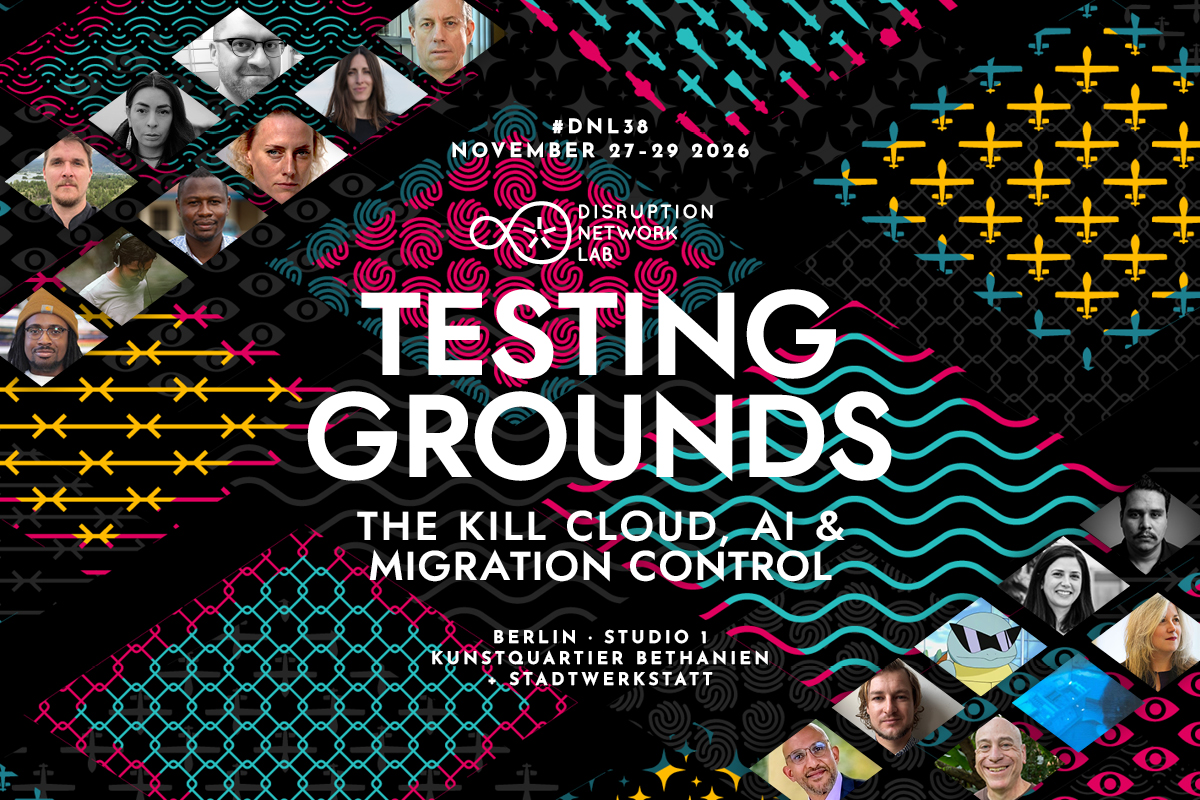
Your conference next week—”TESTING GROUNDS: The Kill Cloud, AI, and Migration Control” at Kunstquartier Bethanien—has an intriguing title, since all these three things are very related to one another yet distinct in their own way. How do you connect these?
The central topic of the conference TESTING GROUNDS (27–29 November) is the idea that AI, automated target recognition, and data extraction technologies are first deployed and tested in war zones and at borders, where the people affected have the fewest civil rights, and are then expanded into civil society at large. In this context, through the research of the Disruption Network Institute fellows, we also plan on showing precisely what the Kill Cloud is today—the shape it has taken in recent years (the wars on Ukraine, Gaza, and Iran), and how it is globally applied in an increasing number of contexts (such as Kenya). According to whistleblowers Lisa Ling and Cian Westmoreland, the Kill Cloud is a pervasive networked global warfare infrastructure, spanning sea, land, air, space and cyberspace. In this context, AI, satellites, telecoms and communication tools are combined to track, target and surveil people, as well as to advance warfare.
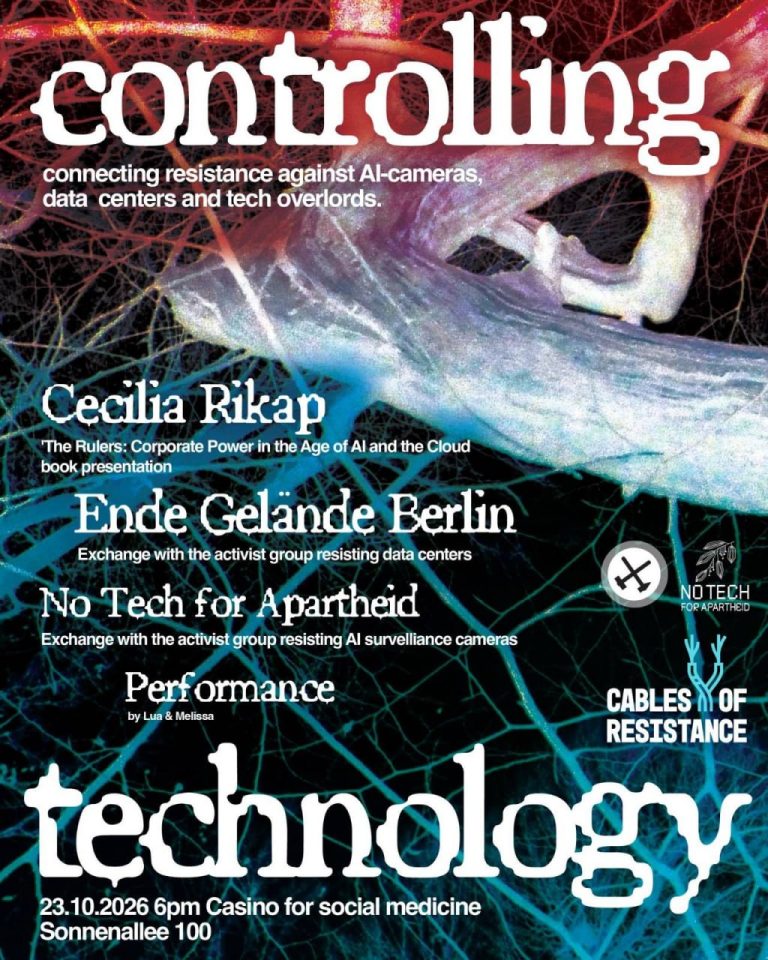
Migration control plays an important role here, if we see migration as a laboratory in which technologies are tested, produced, and commercialised. For example, Tiara Roxanne’s fellowship research looks at automated surveillance and extraction targeting Indigenous, Mestizaje and migrant communities at the US-Mexico border; Namir Shabibi will focus on telecoms, ubiquitous surveillance and state crime in Kenya; Mais Qandeel will speak about how AI systems are used in conflicts and militarised borders, with Big Tech’s role in Palestine as the main case study; Romain Lanneau from Statewatch, Dominik Winkler, and Néstor Espinosa Robledo’s video contribution, will be part of a panel connecting drone targeting, asylum processing, and data extraction and deportation — both in the context of ICE, and the construction of a new deportation prison at Berlin Airport. We also have two upcoming meetups on 29 November, with activists and campaigners from Purge Palantir and #teslatakedown, and activists and organisers from ORCA-Orca Resists Corporate Apartheid, where we collectively discuss all of this.
What are you hoping attendees take away from the event?
I hope that they learn that technology is not something to be afraid of, but something that should be understood and used wisely, and that it can also be a source of self-determination when it is not used solely for waging war or oppressing people; but we do need to learn how it is used in these contexts first. I want people to meet others that have a really deep knowledge of AI systems, surveillance and state oppression: it will be important to listen to their presentations, and to understand that we are not just dealing with “black boxes”, as many define AI systems, but with something that people have still the power to shape. Ultimately, I also hope—despite the political climate, which is very difficult and oppressive for many—that people will find a community where they can discuss, exchange ideas and feel welcome enough to share their personal stories and learn from others.
What plans for the future, if it’s not too early to ask?
We will continue to present burning topics that need to be discussed to our audiences, and we must do this together. Come to our events, follow us on our website and social channels, get in touch with us—and if you have the ability to do so, support us! We work independently, on difficult topics, and times are hard.