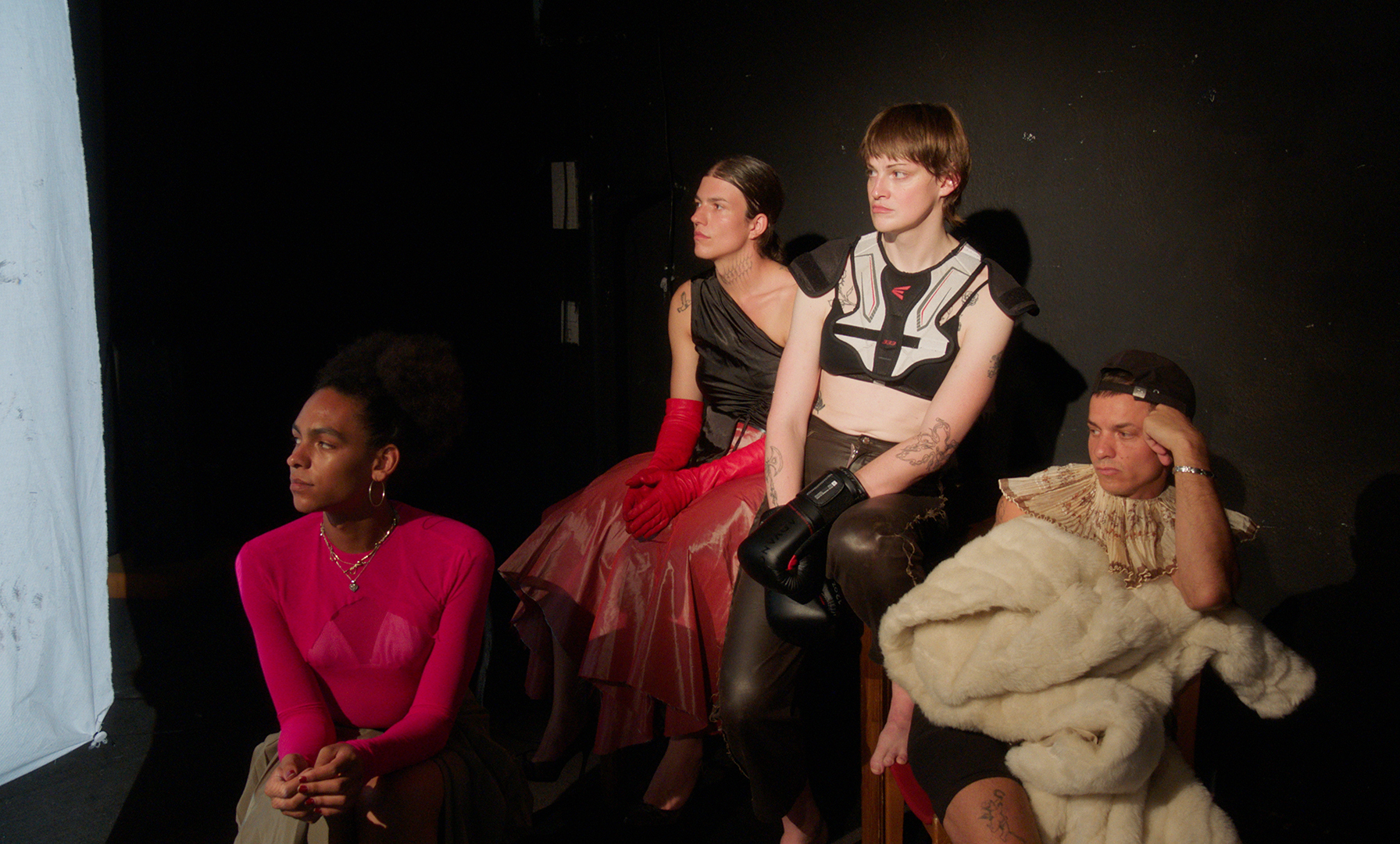
The film’s opening scene is unsettling and melodramatic: a person who appears to be injured is hurriedly carried away by medical staff in scrubs, amid agitated voices. It’s unclear where the scene is taking place. No sooner is this person lying in a hospital bed than she asks, “Are you recording already?” Then Leila, who has just been injured by the police during the occupation of Berlin’s main train station, proclaims: “Join the protest in Berlin and all over Europe for the great revolution. We want a different world and real freedom…” Her call to action is filmed on a cell phone by someone standing nearby. This is followed by a series of picturesque images of street fighting—as spectacularly beautiful and insidious as the images Bruce O’Connor once assembled from U.S. military footage of underground nuclear tests (“Crossroads,” 1976). What do images reveal, and what do they conceal? In the next scene: a white sheet, a symbol of the peace protests (such as those hung from Berlin windows after the first Iraq War). In the film, the sheet serves as a projection surface for text quotations and is part of the setting for a theater rehearsal. A group of young people is rehearsing in their loft a stage adaptation of “The Faggots and Their Friends Between Revolutions,” a queer-utopian fable by Larry Mitchell from 1977.
These opening scenes not only introduce the film thematically but also immediately signal a reflection on its medium. What traps do images set for the viewer? What do we believe them to be, what do they represent? How can a complex human-political situation be portrayed with equal complexity? “Between Revolutions” employs epic techniques of alienation, omission, and distancing, thereby creating impressive precision and intimacy—a fragmentary counter-narrative to the violence of images and of life.
Where are we now? More than three years have passed since an elite Hamas unit raided southern Israel, massacring and kidnapping hundreds of people. Gaza was then reduced to rubble by the IDF, and more than 75,000 Palestinians were murdered. The territory remains sealed off, and more than 60% of it now occupied by Israel. There is no solution in sight to the people’s plight or to the issue of Palestinian self-determination. Millions around the world continue to protest against the Israeli genocide and the settlement policy that violates international law—most recently, 200,000 demonstrators in Amsterdam this November. In Germany—which has been accused by the International Court of Justice in The Hague of complicity in genocide—“reasons of state” continue to prevail, along with the silencing of critical, pro-Palestinian voices. Moreover, these “reasons of state” have seamlessly transitioned into repressive national (cultural) policies. The social fabric of the country is marked by suspicion, mistrust, and punishment.
At the center of Ruben Desiere’s new film “Between Revolutions” is a group of queer Palestine activists in Berlin, whose daily experiences range from taking part in public resistance against the genocide and the complicity of the German state to dealing with threats of criminalization and even deportation. The activists go through phases of exhaustion and despair. The film combines this aspect of the group’s daily life—set within their specific social circles, which, despite everything, are marked by great tenderness toward one another—with another narrative level: the rehearsals for a play.
In 1977, the American author Larry Mitchell wrote “The Faggots & Their Friends Between Revolutions,” a queer manifesto of freedom—an allegorical fable about the non-assimilation of queer life in a patriarchal world and the anticipation of the next revolution. As the film’s title suggests, the theater rehearsals in the Kreuzberg loft epitomize this very everyday life “between revolutions,” between “ass-kicking” and the confidence of “winning.”
“I feel deeply connected to the spirit of the film: its narrative, its radical tenderness, its refusal to accept the world as it is. I’m genuinely happy to offer my moral and artistic support to this beautiful, crazy political constellation, unfolding at a time when the world seems to be in such profound chaos,” says Valentina Magaletti, who composed the film’s score, as quoted in the press materials. It is indeed a special film that explores the immense tension under which the resisters live—without “betraying” the political dimension aesthetically. Political here refers both to the collective activism—the protest against the annihilation and negation of Palestinian life and the German “reason of state”—and to their everyday, solidarity-based, and queer relational space. In the film, Ruben Desiere constructs a complex, intricately interwoven chamber drama: he does not reproduce images of the fighting in the Gaza Strip or of the Berlin protests. Instead, he stages fragile spaces of relationship: how does one live—together—a life of resistance in the face of genocide, violence, and mistrust? The theater rehearsals introduce an artificial layer into the quasi-documentary framework: Mitchell’s utopian text, the work on his play, its embodiment, the repeated rehearsals, and also the questionable nature of this dedication—the strength derived from distancing or transposition.
“We must do something. The situation is fast approaching the desperate…” The scene is repeated countless times during the theater rehearsal. But also: “The vanguard demands revolution. The faggots were never asked to join the revolution.” A few scenes later: two people are touching up the walls of the room; they’re talking: she doesn’t want to see any fake blood on her skin. He says: “Everything feels strange these days.” Five members of the group are threatened with deportation and police action on the grounds of “endangering public safety” as well as “anti-Semitic” and “terrorist” hate. “We all have a lot of work, then there’s the trial, financial stuff, and then the play…. Instead of reflecting on the whole situation, it’s all suffocating.” “Perhaps you need to take some distance from yourself….” That’s where art comes in: in the theatrical performance, but also during a visit to the painting gallery, where the activist uses her hands to mimic the gestures of the figures in the paintings before her. The activists’ tension and nervousness run through all 78 minutes of the film. But the documentary style is constantly counterbalanced by the director’s epic strategy—his staging of the various scenes. He inserts blue screens; all you hear is the sound of the demonstrations. Large banners hang from a building: “Long Live the Revolution”; at night, they sit by the lake next to an idyllic scene of swans. Everything is supposed to change. “We want a different world and real freedom …” The film succeeds in bringing together desire and resistance, tenderness and struggle. It offers no recipe for resilience, but rather a plea—as reflective as it is emphatic—to demand and live out solidarity.