Your film creates an incredibly dense snap shot of stress and resilience in a tense sociopolitical situation. Was that the starting point for “Between Revolutions”? How did the idea for the film develop?
The film gradually took the form it has today, not so much through preconceived ideas or a theoretical framework about a particular situation, resistance or the various themes it explores, but rather through the collaborations and the people I met along the way.
There was a whole process leading up to this. I visited land occupations and spoke with activists in France, Germany and Belgium. They were working on very different issues from the people I would later meet in Berlin. Still, these conversations prepared me to propose to a project Kasz Wlaszczyk and Nomi Sladko, two Berlin-based pro-Palestinian activists.
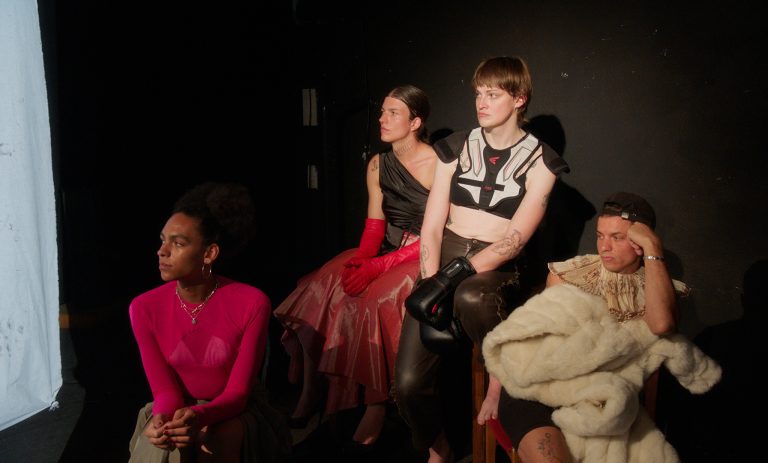
They decided to go along with the idea and took the risk of embarking on this project. At that point, nothing was predetermined and there were very few certainties. We shared an interest in politics, and they agreed not only to take part in the film as actors, playing the roles of Jack and Leila, but also to take on a production role. Through their networks, they helped find people who were active in the pro-Palestinian movement and felt a connection to the queer themes of the book.
It was this accumulation of conversations, encounters and ideas that eventually became the material we shaped into the film.
You interweave theater rehearsals by a group of activists with scenes from their individual and collective daily lives in Berlin. The play they’re performing—“The Faggots & Their Friends Between Revolutions” by Larry Mitchell—was written in 1977, at a time when the “personal” was already being lived out politically. What significance does this historical reference hold for you?
What first appealed to me in the book was its particular form. Larry Mitchell once remarked that he originally set out to write a children’s book, though it ended up becoming something else. Perhaps this is also where the particular simplicity and directness of the text come from, which I really like. It is made up of loose, self-contained chapters that don’t add up to a closed theoretical framework. I also really loved Ned Asta’s drawings in the book.
Another important aspect was that the book is a historical text, while the film is engaged with the current political situation. The book creates a connection between what is happening today and the political movements of the 1960s and 70s.
This moment of distancing is quite important in the structure of your film, that on one hand, you go very, very close to the skin of the people, to the everyday life. On the other hand, you have a lot of breaks, self-reflections, doubts, distancing. Is this something you worked on later or was it already a kind of, let’s say, strategy you wanted to use once?
I think what was clear to me from the start, and to Nomi and Kasz as well, was that we didn’t want to make an observational film.
Instead, I wanted to bring together different kinds of material: their experiences, things I had encountered with different resistance movements, things I had read and seen, and so on. Through this process of reworking and translating these experiences, I developed possible scenes for the film. I was very conscious of wanting to maintain a certain distance. The characters don’t simply play themselves. They reenact situations, drawing on their own experiences and on things they have witnessed or been directly confronted with. The distance between what they have lived and what you see in the film is sometimes quite large, sometimes much narrower, but the two never fully overlap.
There’s a scene in the film in which Jack is interviewed by a journalist about the order he received to leave German territory because of his involvement in the pro-Palestinian movement. The journalist is played by Edwin Nasr. If we had filmed a similar situation as it actually happened, with two cameras and a journalist from a real mainstream German news outlet, the effect would have been very different. What interested me was the structure underlying the interview. How does the journalist use certain tactics to discredit the person being interviewed? How can we make those tactics visible? The reenactment allows us to reveal the structure of the conversation, beyond its specific content. If we had filmed it as it happened, reality would probably have been too dense, making that underlying structure harder to see.
I’m interested in theatricality in most of my films, but in this particular case, it also creates a sense of transparency. It allows us to see more clearly how these mechanisms work.
The film has a high degree of self-reflexivity regarding its own means, or rather, its critical epic and aesthetic power. The relationship between politics and aesthetics is a contaminated field. Why did you, for example, introduce a museum space?
When thinking up the scene in the gallery, I was interested in the particular silence of the museum and the contrast it creates with the noise of the city.
In the scene, Pru, played by Prudence Dippah-Dina, walks very slowly through the museum, surrounded by old European paintings, some dating back as far as the thirteenth century. While we were shooting, we came across a seventeenth-century Dutch painting depicting a group of men signing official documents. This painting created a kind of rhyme with a passage from the book, in which Larry Mitchell writes: ‘The men love papers. They love to sign them, file them and move them around. They believe that certain papers are sacred and display them.’
At the same time, Pru is a character in the present. So, in a way, three different moments in time come together in this scene: the seventeenth century, the 1970s and today.
Within the context of the film, walking through the museum also brings to mind the various actions by climate activists who have glued themselves to paintings or thrown cans of soup at them. For me, the museum is a place that opens up many different associations and possibilities for imagination.
I thought there is also this moment of transmission from one to the other, from one physicality to another, when she is performing the gestures from the painting.
Yes, she is quite literally walking through a particular view of history. At the same time, it was important to me that the scene didn’t become symbolic. Both in the editing and in the sound design, we stay grounded in the concrete present. Pru is doing something very tangible: she looks at the historical gestures in the paintings and reproduces them in the present.
Alongside the characters’ stress, their doubts, and their exhaustion, there’s a layer of genuine trust and tenderness within the group; that’s why the film somehow feels like an intimate chamber drama amidst the larger conflicts. How did you manage to bring both levels together?
I think that is indeed very important. In resistance movements, a sense of community and care for one another are essential to maintaining resilience, especially in a situation that can feel quite hopeless. That sense of connection is also a form of resistance.
At the same time, this care was also genuinely present during the shoot. I think that had a lot to do with the network Kasz and Nomi brought together. Not everyone in the film knew each other beforehand, and even Kasz and Nomi didn’t know everyone they had invited. Yet a sense of intimacy developed very quickly. We only had ten days of shooting, but during that time people were very attentive to one another and open to the shared process of making a film. I think that genuine sense of connection also comes across in the film.
So there is something authentic in it. It’s not all reenacted or staged?
The situations were always staged, but within those setups the actors themselves decided how they sat together, how they looked at each other and how they carried out certain actions. I think their attentiveness towards one another also comes through in the fiction. What struck me during the shoot was how genuinely everyone listened to each other, even when they were speaking within a fictional situation.
So, although you are speaking about a fictional film, there is this real, documentary layer below everything?
When people watch a documentary, there is often an assumption that the people they see on screen are really as they are portrayed in the film. Here, it was important for us to make clear that what you see is a form of imagination. At the same time, all the people in the film are activists who have experienced repression because of their opposition to the genocide in Palestine. The film draws on these experiences, but reworks them through fiction. I hope the film can serve as a document of resistance today.