
Hi there David. Thanks for talking to us. Could you briefly introduce yourself ?
I’m David Rovics. I’m a singer-songwriter from Portland, Oregon. I’m basically fanning the flames of discontent with music in the tradition of the Wobblies, Joe Hill, Woody Guthrie, Pete Seeger, and a lot of other people over the ages from around the world who sing songs about what’s happening in an effort to educate and change things, to inspire people to do something about it.
I hate to do this, but could I ask you about Wim Wenders? At this year’s Berlinale, Wenders made a very confused speech in which he—inasmuch as it made sense at all—argued that Art is on a different sphere to politics. Which means that you shouldn’t be singing about politics. You should be singing about “important things”.
Yeah, it was such a bizarre thing. People often talk about how Art should be political, and I disagree with them, too, because I think Art can be anything. It’s just a tool like so many other things. It can be used for political purposes or escapist purposes. It can be right wing or left wing. It can be so many things.
It can encourage people to fight, or to empathize with each other and not fight. It’s a very powerful thing, but for Wenders to say that it’s not political or shouldn’t be political is just completely ridiculous. It has nothing to do with historical reality.
I don’t know who his funders are. I understand why, in Germany, he wants to just completely avoid the whole question of Palestine and Israel. I understand why he’d be annoyed with people who are trying to highlight that issue, because it’s so incredibly divisive, and he wants to host a film festival, not a big argument.
But still, this is the world we’re living in, where Israel is committing genocide and of course, film makers are going to respond to that, and they have done absolutely brilliantly. I would think that somebody like him would be commending the incredible film makers who have been risking their lives to cover what’s happening in Gaza, like the ones who just put out this film Palestine 36, which is brilliant.
You’re on tour in Europe at the moment. How’s that going so far?
Great. This is our third of three gigs in Germany, and we still have a month more of gigs around Scandinavia and England, Scotland, and it’s been just wonderful. All three gigs have been just fabulous.
You’ve always been explicit about your views on Palestine. Have you noticed any change in Germany this time around?
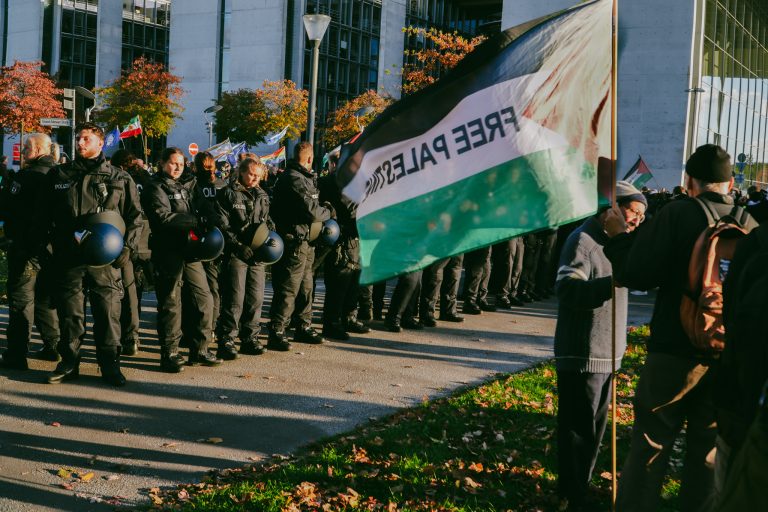
I haven’t, but I haven’t been here long enough to really say. I’ve been hearing so much about the scene in Germany. I hear a lot about protests that are happening here where the police are being violent. And, of course, I assume that there are protests happening where the police are not being violent, but I’m just seeing the ones where they are.
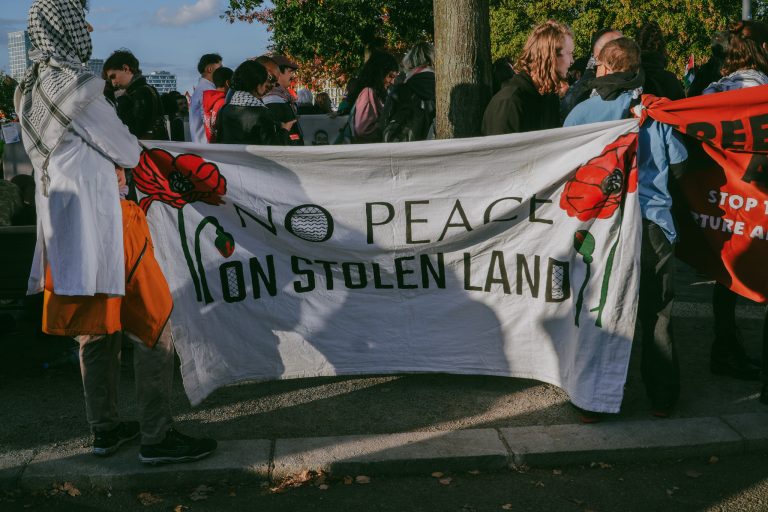
You see a lot of stuff on Instagram, every time somebody gets harassed for wearing a keffiyeh. You could develop the impression that this is happening all the time in Germany. We have been wearing keffiyehs all over the place, and we’ve gotten some maybe unhappy looks from some people, but we certainly haven’t been harassed by anyone.
Germany is always a complicated place when it comes to Palestine. It’s not new for it to be complicated. The first march I ever went on in Germany in support of the Palestinian struggle, there was one white German woman who was my girlfriend at the time, and it was me and one friend of hers. Otherwise, everybody in the crowd was Arab.
You are US-American. Let’s look at the States. Is Trump a qualitative shift in what’s happening there?
For anybody who’s alive in the US today, most people would say that it feels like a qualitative shift, because he just really seems to be just doing whatever he wants. He doesn’t seem to have a plan. There are other people who have all kinds of plans and want to influence him, but he himself seems to be just winging it.
That’s maybe new. He’s qualitatively different in that sense. But otherwise, in terms of the US pursuing Empire and invading countries all over the world for resources and on false pretences—that’s nothing new. It’s just that he’s so uniquely unable to even maintain a false pretence for more than five minutes.
He changes his tactics every half hour. So, it is new and scary for people in a way that most people haven’t felt that kind of fear of possible nuclear holocaust, because we haven’t had somebody who is so completely irrational.
George W Bush was pretty darn irrational, and all his advisors were making stuff up in order to go to war. So that’s really not much different, except that then it was a group of people working together to pull the wool over our eyes in a methodical way over the course of years in order to carry out their agenda. Whereas there doesn’t seem to be any real thought going on here.
I was thinking the other day that we haven’t had a US president who is so irrational. And then I thought: but we had George W Bush, and Reagan before him. We seem to be having the same discussion about uniquely mad US presidents once a generation.
Look at Reagan and George W. They all just seem so tame in comparison. Andrew Jackson maybe. With Reagan we thought that too. And Reagan was reasonable and equinimical. Maybe I made that word up.
What can our side do against the very real threat of Trump?
In the context of the US, it seems to me that the capability of the Left to organize is so degraded at this point, because of real, long-term systematic efforts on the part of the secret police to disorient the Left. They’ve been doing that for over 100 years. It’s been the main purpose of the FBI.
I think, in the wake of 9/11 and then with the rise of social media and everything that’s happened with the power of these algorithms to brainwash people, they’ve really succeeded in creating a situation where people don’t know how to organize without alienating everybody. The form of organizing that takes place is the kind that you organize a demo that nobody wants to ever go to a demo again. That’s not what we need.
The first thing we need is to remember how to organize again, and remember how to build a movement based on solidarity and bringing people together to fight for a common cause. We must understand the power of culture in that process, and use music and art to bring people together, which is something that has been systematically forgotten by the US Left in a way that has not been forgotten in most of the world.
There’s really basic stuff that needs to happen before any serious organizing is going to be able to happen. It’s a sad situation. I always want to be able to say something more hopeful, but it’s just a dismal, bleak situation on the Left in the US. You can have demos all over the country against Trump, and they hardly mention the fact that the US has just killed the entire leadership of Iran and is bombing bridges and schools.
What’s your view of the rise of the DSA, the Democratic Socialists of America?
I view it as a basically positive development that has attracted a lot of energy. A lot of people have gotten involved, and they’ve supported campaigns of people like Mamdani, Bernie Sanders, and AOC. All that is very positive, even if they don’t have power—because they’re such a small minority. Even if they’re running as Democrats, they don’t represent the mainstream of the Democratic Party.
But they can have some kind of a voice, and they can expose the rest of the party for being so warmongering. Every time Sanders puts out a bill saying, “Do you support sending arms to Israel?”—the Democrats have to vote Yes or No. That exposes who are the ones who support this genocide and who’s opposing it, but they always continue to send the arms.
It’s a positive development, but the DSA also faces the same kinds of problems as the rest of the US Left. It hasn’t figured out how to rise above sectarianism. There’s still this paranoia about associating with the wrong people who have the wrong opinions about something. The paranoia permeating the US Left also permeates the DSA.
Let’s go on to the role of culture. I don’t want to misquote you, but you said something like US culture has not managed to be as political as other cultures?
US culture historically has been profoundly political. Music and art and culture have been so central to the social movements like the Industrial Workers of the World in the 1930s, the civil rights movement, the anti-war movement. These were all tremendously musical movements that were incredibly impactful on society because of their emphasis on using music and art to organize and educate and inspire.
That’s not at all unique to the US. Music that came out of these movements spread around the world and impacted people in many other societies as well. But what has happened, especially in the past 20 years, has been a divorcing of culture from politics in the minds of so many Americans.
Most of the time in most of the country, when you have some kind of political rally, there is no live music, and there’s very little in the way of any artistic expression. It’s like people with signs. It looks like a protest from some TV series that’s making fun of protests for how boring they are.
The Left Berlin has a radio programme, and the people who do the music tease me for suggesting the music of old white men. For the anniversary of Kent State, I said why not play Neil Young’s Ohio? And they say there is all sorts of really interesting Latino music, hip-hop, rap that is still very political and still talking to poor people. I’m just too old to get it. Do you think that it’s possible that there is still this music going on, but it’s addressing a different audience?
Oh, definitely, yeah. In all kinds of genres. The thing about the whole rock phenomenon, people like Neil Young and everything that came out of the 50s, 60s, 70s, it’s not people’s fault that they happen to like all these musicians who are white men, because the industry itself is a totally racist industry.
Its definition of rock music was: it’s a white form of music. If you’re not white, then you’re playing rhythm and blues. It was also a white male phenomenon. All the singers of all the rock bands had to be white men. That was the arrangement. All the other members of the bands had to be white men.
The only exception to that rule was San Francisco, because nobody in San Francisco would cooperate with the industry. They allowed San Francisco to be an exception to the rule for a little while. So that’s where Janis Joplin came out, Jimi Hendrix.
Sly and the Family Stone
Yeah, and so many other bands that were not all-white or all-male. San Francisco was allowed to be the exception. But that was the industry. But when you don’t look at the industry, and you look at the music that’s coming out of the people all over the world, either overtly or metaphorically political music is everywhere. People like Silvio Rodriguez are performing political music in packed stadiums in many Latin American countries.
Those musicians are all over the place, including in forms of music that would be very familiar to people who are into rock and roll, like the folk punk phenomenon. Whether you’re into hip-hop, whether you speak Spanish or Arabic, you can name people from every part of the world. Just the names of these musicians will bring a tear to somebody’s eye, because they mean so much to them. This is profoundly political.
You mention Fairuz to somebody from the Arab world, or Victor Jara to Spanish speakers. These are profoundly important people.
We’re mainly talking here about the Global South. Do you think it’s possible to build a new political music scene with a mass audience like San Francisco in Europe or the US?
Yeah, It can totally be done. People need to realize that that’s what needs to be done. Especially in the US, and probably beyond, there’s this constant drum beat of division against the sixties generation. It’s astounding, because it’s more than 50 years since then.
But there’s still this constant drumbeat of derision from the mainstream about the sixties. They just have to make sure that everybody still remembers that playing music and having a good time, and free love, and puppets and guitars are all just terrible, terrible hippie stuff that nobody should be associating with.
People get the message enough and they think: maybe we don’t actually need more acoustic guitars in the world.
Today you were playing with Liadland. Liad is a soon to be former Israeli—she’s giving up her citizenship. She also plays electronic music. Is mixing with people of completely different genres and backgrounds the sort of thing you do often?
Oh, yeah, absolutely. That goes over well or not well, depending on the audience. It’s not that everybody into one form of political music likes other forms of political music. It doesn’t necessarily work that way. Different styles on the same bill can work well, or it cannot, but I do it a lot.
One thing it can do at least is introduce people to a sort of music that they would never have thought of listening to themselves.
Absolutely. It’s such a great chance to hear new stuff, and it’s the main way I hear new stuff too.
What future projects do you have planned?
We do have another tour planned if there’s enough jet fuel left in the world. That’s a big if at this point, right? We do have a tour in Canada, in British Columbia, in late June, early July.
Do you have a message of hope for the next generation?
I heard Jesse Welles say this. I don’t know if he’s ever heard of me before, but I’ve been saying the exact same thing for decades. He said, to paraphrase: If you don’t have hope, then there’s no hope. Hope is a requisite to anything else happening. For social movements to get off the ground, there needs to be hope.
A sense of optimism is absolutely essential, as is a real, serious embrace of cultural means of communication—building the movement and inspiring people, educating people, embracing music and art. But it all starts with having some kind of hope for the future, some kind of vision for what you’re going to do that’s going to change things. But it all starts with hope.
My main hope is that we can maybe keep things going long enough for the aliens to come from some other galaxy and rescue us. In Star Trek, one time they came to a planet, and they asked the computer some questions about the planet. The computer said: According to our calculations, things are so unequal on this planet that the civilization will collapse in 250 years. So maybe it’s a good idea to invite aliens.