On 22nd November, Ramsis Kilani’s expulsion from Die Linke was confirmed following a kangaroo court in Karl Liebknecht Haus. The following weekend, in the same building, the party’s BAG Palästinasolidarität (national working group for Palestine solidarity) was formed. There are few better examples of a dissonance between party leadership and base.
This is not the first time that our website has covered Die Linke and Palestine. I have written several articles on the subject, and we published an important statement by The Left Berlin in November 2024. More recently, both Nathaniel Flakin and Pepe T. each provided a list of the party’s many crimes and betrayals around the subject of basic rights for Palestinians.
Show a list like this to the people now organising for Palestine within Die Linke, and they’ll agree with you. They know better than most how the party has time and again betrayed Palestinians. ‘That’s not the point,’ they say, ‘Others have just interpreted Die Linke. The point is to change it.’ This article aims to look at why Die Linke has taken the positions it has, and how much change is actually possible.
The betrayal is still going on
In order to recognise the scale of the problem, it is worth looking at some of the more recent betrayals. Ramsis’s was not an isolated case. Four days before his hearing, Berlin Insoumise (BI) was due to have a meeting in Karl Liebknecht Haus with Member of European Parliament Emma Fourreau, who had been on the Gaza Flotilla. The room booking was cancelled by Die Linke just a few hours before the event was due to start. The cancellation came directly from Matthias Höhn, who was once an MP and national party chair.
Raul Zelik reported a similar experience in November. He wanted to organise a book presentation of Donny Gluckstein and Janey Stone’s The Radical Jewish Tradition. He was told that the room, which is partly owned by Die Linke, would only be made available if Donny and Janey signed a statement that they ‘do not question Israel’s right to exist, nor oppose a Two State Solution’—something that they were not prepared to do. Not for the first time, the German Left was denying Jews a space to talk.
And then there’s the expulsion that didn’t happen. Andreas Büttner supports withdrawing finances for UNRWA, and posted that: ‘The recognition of a Palestinian state would be the worst step that one could take.’ While the Berlin police were repeatedly using excessive violence against pro-Palestine demonstrators, Büttner tweeted: ‘I wish I were a policeman @polizeiberlin. Thanks to all colleagues for your deployment today in Berlin and everywhere in Germany.’
The party ignored calls by some party members for Büttner’s expulsion. The message was clear—active support for genocide is perfectly compatible with being a member of Die Linke. Defending the rights of Palestinians is not.
The last gasp of the old guard?
Many Die Linke activists are appalled by Ramsis’s expulsion. But, they say, things are changing. Encouraged by insurgent electoral campaigns, like that of Ferat Kocak in Neukölln, Die Linke doubled its membership in 2025. Many of the tens of thousands of new members are actively pro-Palestine and insist on their voice being heard.
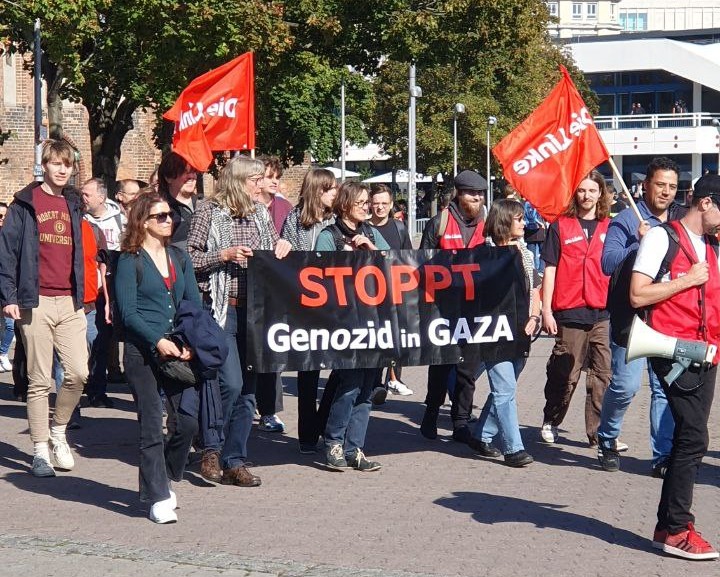
On 10th May, Die Linke’s national conference voted for a motion that rejected the notorious IHRA definition of antisemitism, which falsely equates criticism of Israel with antisemitism, and replaced it with the Jerusalem Declaration. On 21st June, when 30,000 demonstrated for Gaza in Berlin, there was the biggest Die Linke bloc I’d seen, not just on a Palestine demo but on pretty much any demo in the past few years.
In September, four Die Linke MPs were thrown out of the Bundestag for holding up a Palestine flag. Later that month, the party co-organised the largest demonstration for Palestine in German history. On that demo, party co-chair Ines Schwerdtner said: ‘We are standing here for the whole party when we say: we have been silent for too long. I have been silent for too long. It is a genocide! We must stop the delivery of weapons.’
Schwerdtner’s change of heart was the result of pressure from new members, who are serious about fighting for Palestine. They argue that party decisions are currently being made by older, more conservative members. This will change after the next set of internal elections. I fully support the newly formed BAG Palästinasolidarität, but here I believe that they are being naive. Forgive me for saying that I’ve heard it all before.
What is the point of Die Linke?
Much of Die Linke’s cowardice has been ascribed to its role as a reformist party—its raison d’être is to chase votes. Rather than try to convince people through principled arguments, it says what it thinks people want to hear. There is something in this, but vote chasing alone does not explain Ramsis’s expulsion. With a clear majority of Germans opposing weapon deliveries to Israel, expelling a well-known Palestinian activist could cost the party both votes and activists.
But Die Linke is not just chasing votes. It is also chasing respectability. Unless there is a major shift in election results, Die Linke will only get into government as the junior partner of a government led by the SPD or the Greens. And each of these neoliberal warmongering parties places clear conditions on who they deem to be an ‘acceptable’ coalition partner.
The main sticking block used to be NATO. Programmatically, Die Linke has always been against NATO, but whenever elections come closer, pragmatism takes over. I remember a rally shortly before the 2021 national elections, when party leader Janine Wissler—a former revolutionary socialist—insisted that NATO would be no barrier to the party joining a coalition. This was just one more principle that could be ditched for the right price.
German Staatsräson is the latest principle that the party leadership is prepared to throw overboard. For the last 3½ years, a majority of Die Linke leadership has been on the left wing of the party. Most of these leaders have been fairly good on Palestine, but they have been almost unanimous in their silence as the party has supported pro-Israel demos and expelled members like Ramsis.
Unity at all costs?
The new insurgents are clearly not the same as the old leadership, which loyally supports Israel. In contrast, the party’s left talks about a dual strategy of combining elections and social movements. Yet it has always ended up tolerating right-wing attacks in the name of party unity. Good activists who support Palestinian rights end up providing cover for those who don’t.
Around the time of Ramsis’s expulsion, I interviewed Kostis from Die Linke Berlin working group for Palestine solidarity. The group had approached The Left Berlin and asked to explain why they had withdrawn two motions at a party conference. One motion named what was happening in Gaza as a genocide, and the other supported the Boycott, Divestment, Sanctions (BDS) movement.
Kostis explained that withdrawing the motions in the name of party unity was ‘a strategic compromise … if we had not participated in these negotiations, the discussion would have been between the leadership and the right-wing factions of the party, meaning the document would have been even worse.’ In other words, by avoiding a difficult discussion, left-wing activists preserved party unity.
I recently spoke to Martha Kleedörfer, chair of Die Linke Berlin-Mitte and an old friend. I know that Martha is serious about supporting Palestinians. She too defended withdrawing the motions in order to reach people who are not yet convinced. It is not clear to me how avoiding a debate is able to convince anyone.
How do ideas change?
We can see a strategy here, which has elsewhere been described as the resolutionary road to socialism. It sees political argument as being an incremental fight. First you win over the people nearest you, without saying anything that might scare the horses. This strategy also sees the main place for such discussions as being in respectable political organisations like Die Linke.
But what can change Die Linke leadership is not reasoned argument, but pressure from below. In an interview that was supposed to promote the demo on the 27th September, Die Linke Party Secretary Janis Ehling explained why the party had finally come out in support for Palestinian rights: ‘What has changed is the mood in society. Public opinion about this war has massively shifted.’ In other words, Die Linke sees their job as not to form public opinion, but to follow it.
This explains Ines Schwerdtner’s mea culpa. She recognised a growing movement that she couldn’t control, and so tried to rush to its head. Under pressure from party activists to deliver something, she produced the minimum possible.
We saw this one month after her speech, when the party’s youth wing passed a resolution, ‘Never again be silent about a genocide’, which attacked ‘the colonial and racist character of the Israeli state project.’ Schwerdtner, and co-leader Jan van Aken issued their own statement, saying ‘a one-sided perspective of Israel and Palestine brings no-one in the region anything’, and: ‘in the party leadership, there is a very broad unity that the contents of the adopted resolution are not compatible with the positions of Die Linke.’ The only lessons that they had learned about Palestine were entirely opportunistic.
In September 2026, there will be elections in Berlin. Die Linke has a serious chance of providing Berlin’s mayor. Not just that, for the first time ever, the candidate, Elif Eralp, comes from the left of the party. Like all sensible people, I hope that Elif succeeds. But her campaign will be accompanied by a massive crackdown on talking about Palestine for the ‘sake of party unity’.
An International phenomenon
The German ruling class has invested money, armaments and its reputation on uncritical support for Israel. Breaking from this requires challenging this consensus, not accommodating to it. And yet recent history has shown an international Left that is more suited to trying to do a deal with capitalism.
Following the 2008 crisis, the Left enjoyed brief victories followed by ‘necessary compromises’. In 2015, Coalition of the Radical Left – Progressive Alliance (SYRIZA) won the Greek elections on the back of a mass movement. SYRIZA leader Alexis Tsipras ignored that movement and imposed the European Central Bank’s bailout programme. More radical SYRIZA members, like Stathis Kouvelakis proposed a strategy of ‘seizing power by elections, but combining this with social mobilisations,’ but following the elections, these mobilisations were limited.
A few years later, Podemos emerged from the radical 15M movement in Spain, promising a new type of politics. As 15M lost influence, Podemos brought in two social democrats to draft an economic programme based on ‘short-term pragmatic proposals’. By 2016, party leader Pablo Iglesias could say: ‘things are changed from within institutions… That idiocy that we used to say when we were on the extreme left, that things are changed in the street and not in the institutions, is a lie.’
And then there is the recent victory of Zohran Mamdani’s campaign to become New York mayor—a victory that was every bit as impressive as those of SYRIZA and Podemos, not least because Mamdani has held the line on Palestine. And yet, like Tsipras and Iglesias before him, Mamdani has seen the need to compromise—appointing Jessica Tisch, who the Wall Street Journal describes as a ‘law and order police chief’. It is true that Tisch must now report to the deputy mayor rather than the mayor, but Mamdani was under no obligation to keep her at all.
Faced with genuinely progressive party-based movements, the radical Left can make two mistakes. The first mistake would be to pretend that these movements are irrelevant. It is profoundly important that members of Die Linke are finally mobilising for Palestine and holding their leaders to account. I would urge all party members to get involved in the BAG Palästinasolidarität.
But the other mistake would be to expect a struggle to come from organisations that are institutionally committed to German Staatsräson. I agree with my comrades in Die Linke that we must organise to effect change, but unlike them, I believe that any fundamental change in their party first requires a change in German society, and that this change will come from outside.
It is great that Die Linke co-organised the demonstration on 27th September, but this was the result of pressure from below. As the Berlin elections come closer, party leaders will inevitably dismiss opposition to genocide as a luxury and a distraction. Together with comrades both inside and outside Die Linke, I look forward to fighting to ensure that we never stop speaking about Palestine.