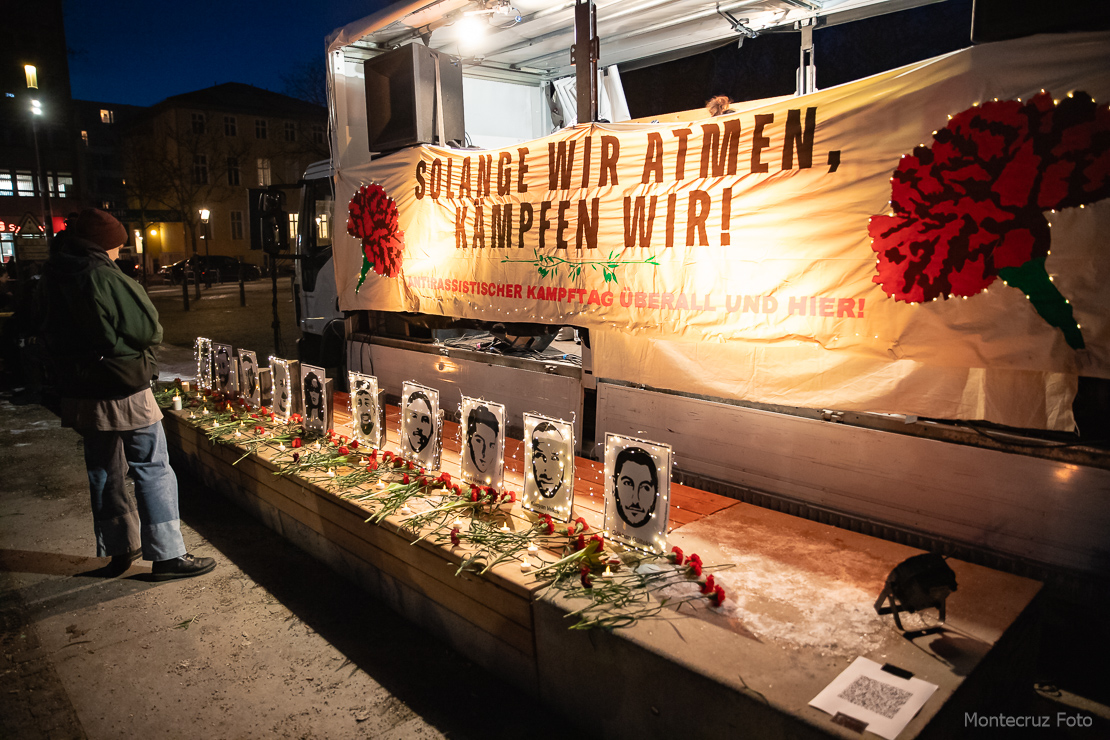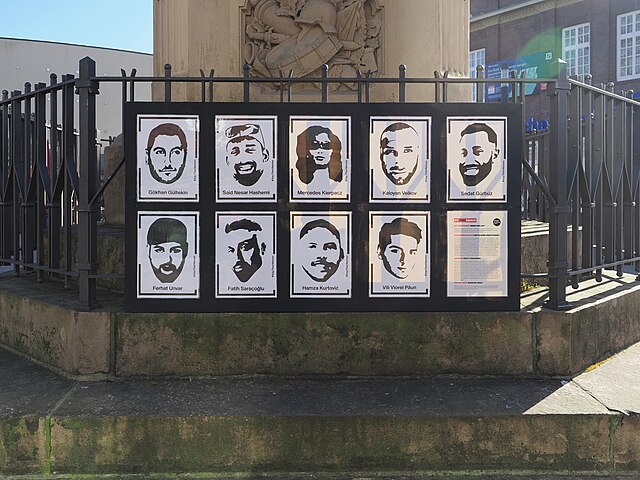
On 19th February 2020, neo-Nazi Tobias Rathjen killed 9 people and wounded 7 more at the Arena bar and Midnight Shisha bar in Hanau. Both locations were known as meeting points for individuals with migrant backgrounds. The names of the deceased are Gökhan Gültekin, Sedat Gürbüz, Said Nesar Hashemi, Mercedes Kierpacz, Hamza Kurtović, Vili Viorel Păun, Fatih Saraçoğlu, Ferhat Unvar, and Kaloyan Velkov. Remember their names.
Before killing them, Rathjen had been watching videos of AfD Thüringen leader Björn Höcke. In an online document released prior to the massacre, he called for the “complete extermination” of many “races or cultures in our midst.” He suggested that the “total destruction” of entire states might be justified in a future war, listing 25 countries. In a video detailing his motivations, he referenced various QAnon conspiracy theories and expressed deep-seated hatred for foreigners, women, Muslims, and Jews.
After identifying Rathjen as the perpetrator, it took police five hours to respond to his nearby home. When they finally arrived, Rathjen first shot his mother before taking his own life. Police later claimed they did not hear any gunshots. Despite being known to law enforcement, Rathjen was allowed to renew his firearms license as recently as 2019. It was later revealed that 13 police officers working in Hanau that evening were suspended for participating in racist, far-right group chats.
Sadly, families of the deceased were not promptly notified; some learned of the deaths from news reports. Family members presenting identification had to wait 18 hours before they could see their slain loved ones, and autopsies were conducted without consent. Emergency calls made that night went unanswered. Initially, the media attributed the violence to “clan violence,” suggesting that the victims were somehow responsible for their own deaths. As Seda Artal later recalled, “I think the first headline I read was ‘Shisha murders.’”
The Hanau shootings sparked two powerful chants that have become popular at subsequent demonstrations: “Hanau war kein Einzelfall” (Hanau was not an isolated case) and “Where were you in Hanau?” (directed at the police). These phrases symbolize a pervasive narrative in the media and among law enforcement, portraying attacks by non-white individuals as the work of Islamists, while white terrorists are framed as troubled individuals. Since reunification, over 200 people in Germany have lost their lives to right-wing violence. We should remember them all.