At the end of October 2025, a small group of activists from Dresden—members of Anarchist Black Cross, malobeo, FAU and Queer Pride—set out on a solidarity trip to Ukraine. We packed a van full of materials collected in Dresden and hit the road, not just to deliver supplies, but to connect with people and collectives who, in their own ways, are resisting the Russian full-scale invasion. Our goal was also to learn and to listen to those living through the war, to exchange stories and experiences, and to weave stronger networks of solidarity.
On a weekend, we left Kyiv at 6 a.m. in a convoy to head to the humanitarian trip we planned to support. It is organized by Oksana from Solidarity Collectives. She is responsible for the humanitarian work of the organization. She is nearly permanently on the road, establishing contacts to grassroot initiatives in the regions near the frontline or evacuating animals from abandoned villages and towns. The perfectly renovated motorway stops after some hours of driving, roads get bumpier, smaller. We drive through villages and towns with high apartment blocks, pass Dnipro to come to Pavlohrad, a town of about 100,000 inhabitants, shaped by its omnipresent mining sector. The trip takes about nine hours.
We arrive at a small house with an outdoor toilet and a few people standing around the yard—displaced families, some fleeing war for the second time, many of them coming from Dobropillia or other mining towns in Donetsk region. Olha, the woman who is organizing humanitarian aid here in town, opens her yard and garage for organizing support.
We unload the cars—duvets, pillows, mini ovens, microwaves, kettles, pet food, toys, power banks, kitchen utensils, electric heaters—things we gathered in Dresden or bought in Kyiv. People from the area come to help, and soon a human chain forms; everyone is willing to take part. Afterward, people line up to collect what they need while Olha and others organize the distribution. She kneels on the ground, dividing dog and cat food from large sacks into the small bags people have brought with them.
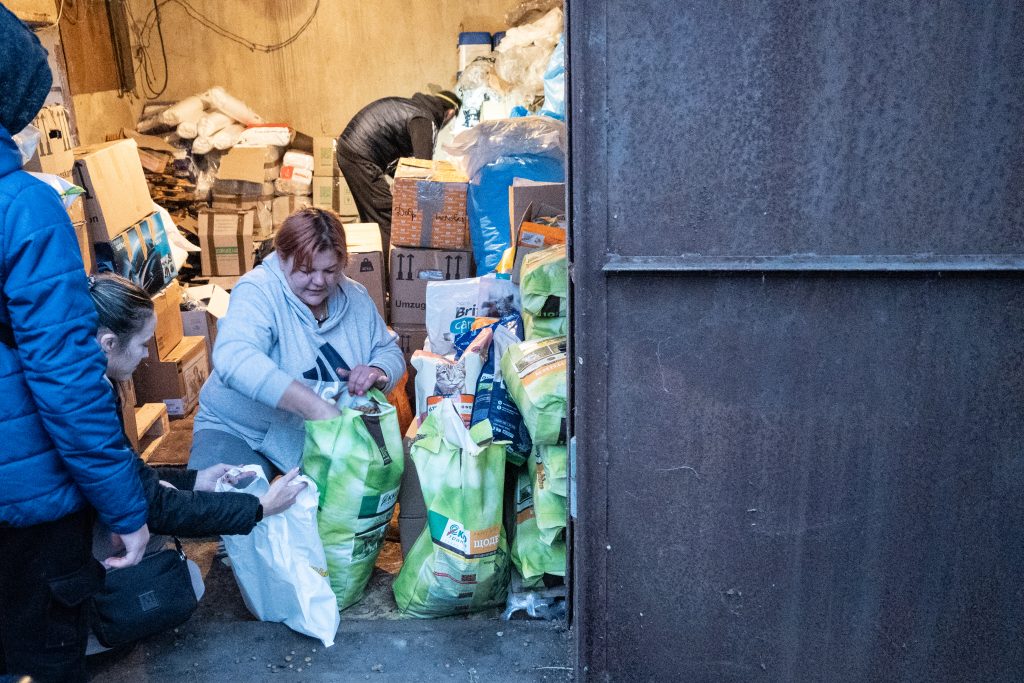
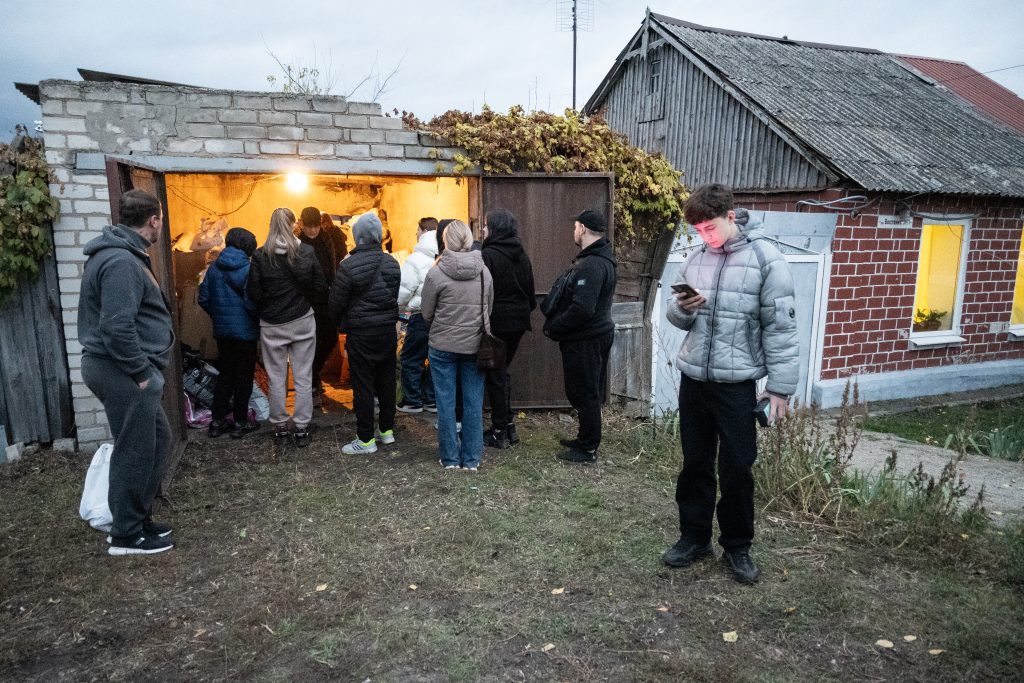
Olha has been volunteering since 2014, originally supporting soldiers on the front line. After the beginning of the full-scale invasion, her work shifted towards the support of refugees. In Dobropillia, she had an office and worked together with different initiatives, among them Solidarity Collectives. But as the Russian army started to heavily hit the town with guided bombs in August 2025, she had to flee herself. She took refuge in Pavlohrad where her husband got offered a job at the local mine. They rented and renovated a small house on their own cost, as she emphasizes, even though their only source of income is the husband’s salary. Meanwhile, she tries to adapt to the changed conditions and continue her voluntary work.
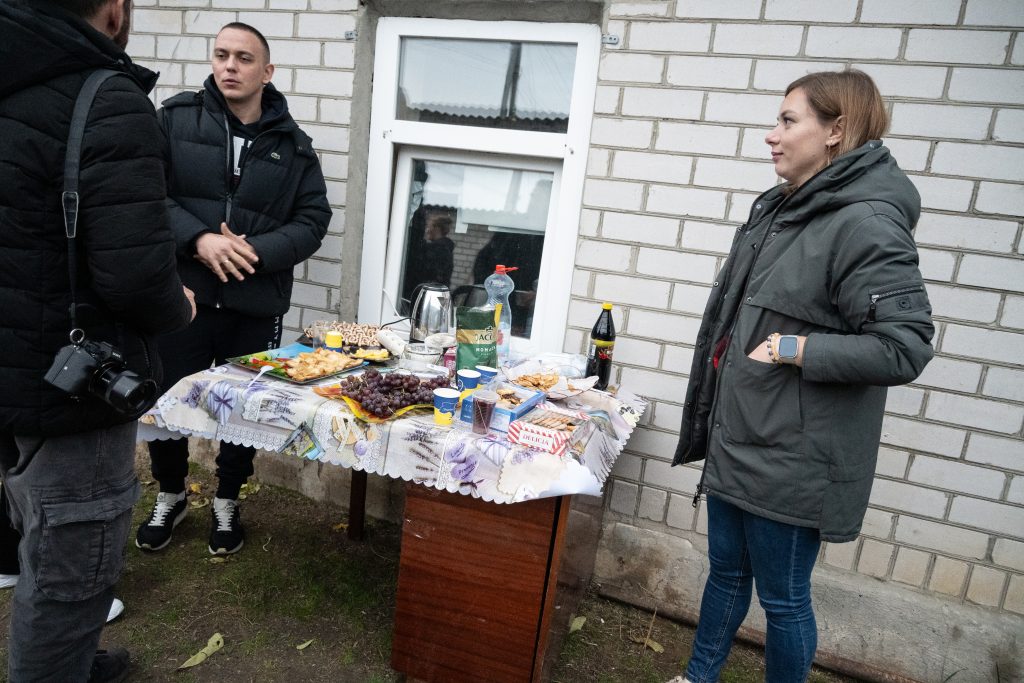
It’s getting dark. In the garden, they’ve set a table with biscuits, fruits, tea, and coffee. We stand around chatting. Some speak Russian, others Ukrainian. A few words in English. Nodding. Many people here are organized with the Independent Miner’s Union of Ukraine. They tell us about how the work in the mines has changed due to the war, how they continue to fight for higher wages and better working conditions but also how they collect donations for union members fighting right now on the front line. One man, a local miner, helps displaced people to find work at the local mines. Another shows us a still from the film 20 Days in Mariupol, pointing at the building which is just hit by artillery: “That was my balcony,” he says quietly. He lost everything and doubts that he will get any kind of compensation, even if the war ends. He wears a headlamp, and we can see only the light and our shadows on the ground as we stand in the backyard, sipping tea.
Another man’s phone plays the sound of running water—it’s his notification tone for air alerts. He starts calling somebody, obviously getting nervous. In the distance, we hear Shahed drones. Someone says they sound like motorcycles from afar. Then comes a deep, booming bass from the air defense system. The drone is shot down.
We drive to Poltava, where we booked hotel rooms for the night, but halfway there, the Solidarity Collective’s car hits a deep pothole and destroys two tires. We spend hours searching for someone to carry the car to a garage which could get it fixed before next morning. After dozens of phone calls and asking around we are successful. Shortly before the curfew starts, we arrive at our hotel.
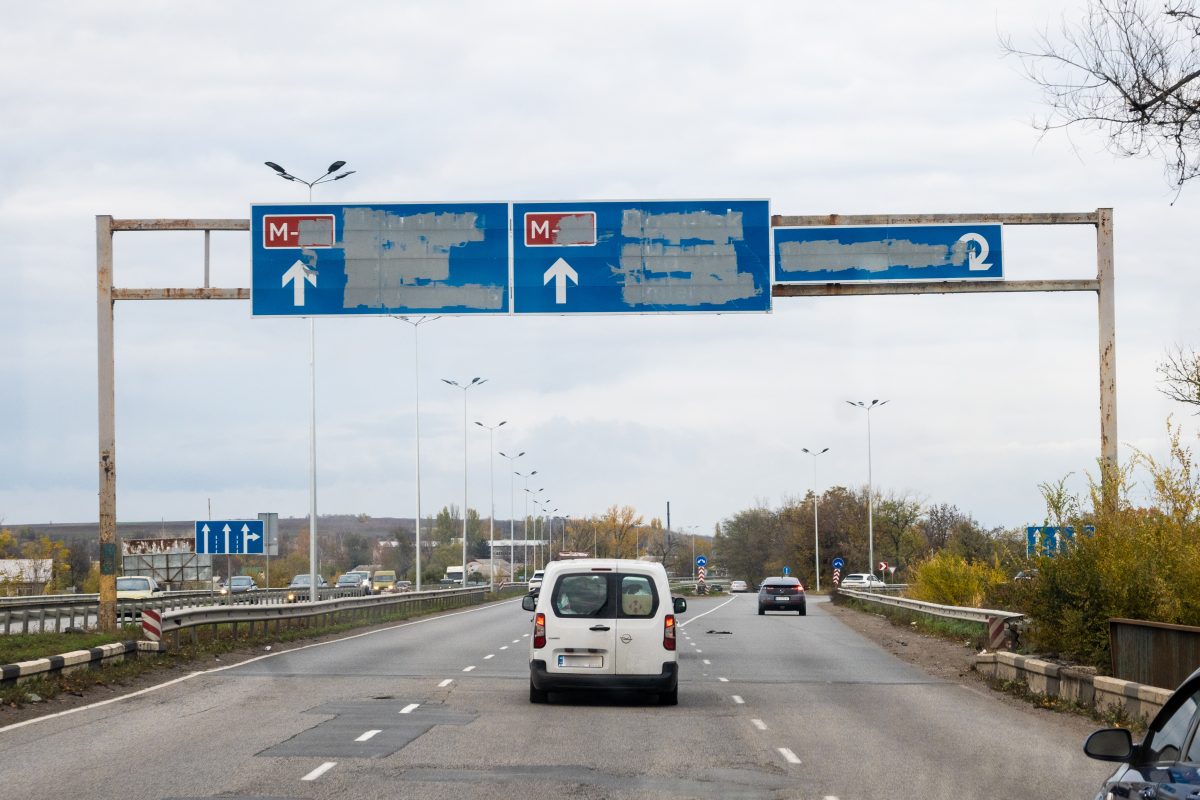
In the morning, we continue to Sumy, a city of about 250,000, only thirty kilometers from the front line. We pass through areas which were occupied during the first months of the war. Road signs are sprayed over—to confuse the Russians, someone says. Billboards hang torn or replaced with army recruitment posters and food advertisement.
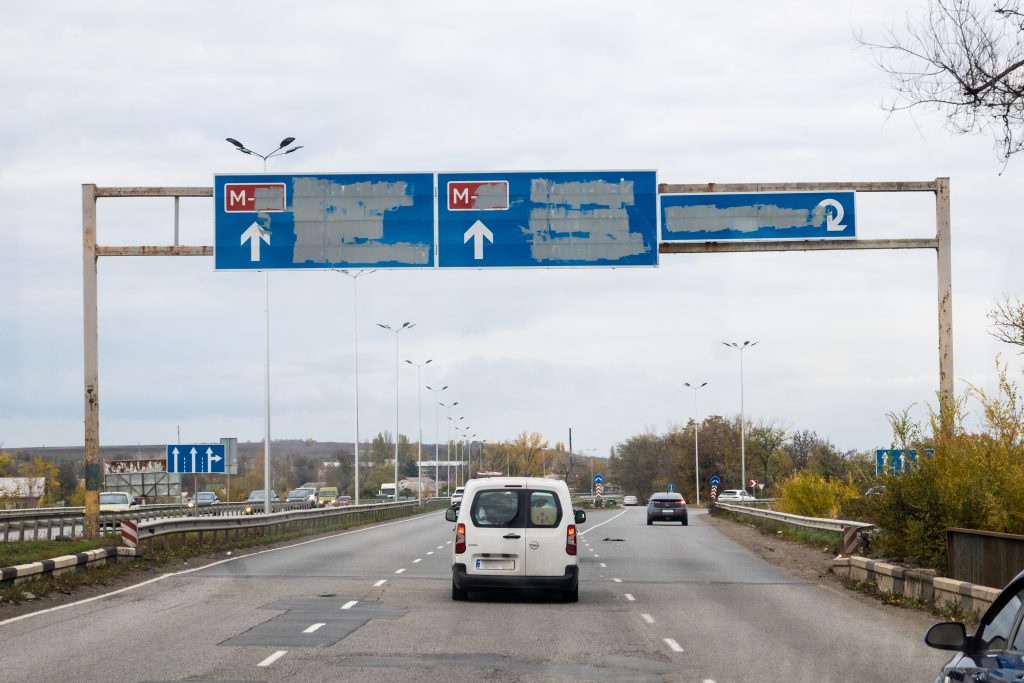
At a gas station several kilometers before Sumy, our Ukrainian friends remind us to keep two tourniquets each in case of bleeding. “If you see a Shahed drone, park under a tree,” one says. “And if you see us running—run too.” With a weird feeling in our bellies, we pass by destroyed bridges, newly-built trenches and checkpoints to finally reach Sumy.
We’re met by Anja, who helps us find a parking spot and leads us through a small alley. A woman in a stylish jacket passes by with two little warmly dressed dogs. We end up in a café, full of spider and spiderweb decorations and scary jack-o-lantern pumpkins. The time slows down. It’s her café, she took it over from people who decided to leave the city. She invites us in for a free coffee. Thirty kilometers from the front line, she offers plant-based milk and cream, and she serves us a Halloween-themed drink called a Spooky. In this café, they offer free coffee for soldiers. Visitors can donate the cost of a drink and leave a post-it note with a message to lift the soldiers’ spirits
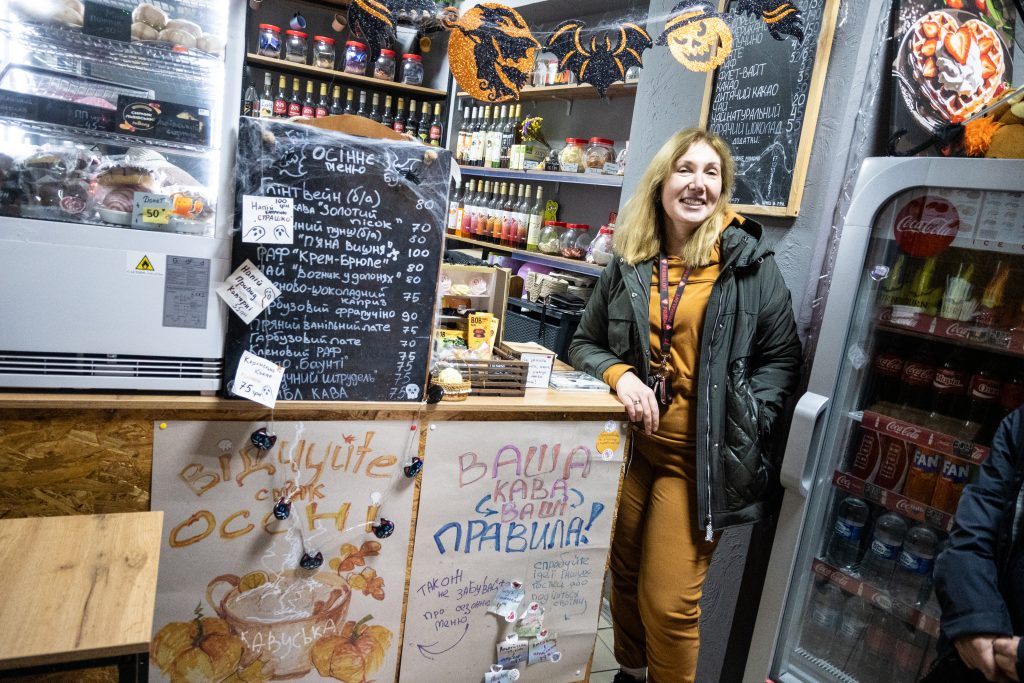
Anja pulls out her phone and shows us photos of herself and other women from Sumy at shooting practice. They receive training in tactical medical aid and how to use a gun from a former army officer. During the day, she also works as a doctor. She keeps herself busy and helps her community in every way she can.
We deliver the donations to a former student’s dormitory now housing elderly refugees from the east. In the common room, pink and white balloons scatter around the floor like a birthday party has just taken place there. People move slowly, some with walkers. Some invite us into their rooms to tell their stories. Most of the people come from small villages near the Russian border which got completely destroyed. Many have already lived in the dormitory for over a year.
We talk to an elderly couple, Volodymyr and Tamara, whose daughter was killed in a shelling attack. Tamara did heavy work all her live, working in a mine and loading and unloading freight trains, in order to provide a home for her children. But all of that is gone now. They say that they are already old and probably won’t live long enough to see the end of the war, and they only hope to not die under shelling or while hiding from bombing in a basement.
Svetlana tells us about how she made it out of Mariupol. After the beginning of the invasion, she had to spend one month in the city, in a hell on earth, as she puts it. There was permanent bombing and shelling, apart from one hour a day, maybe the lunchtime of the Russian soldiers. She saw how quarters which Russian soldiers previously directed them to for evacuation were bombed. In her flat, the doors and kitchen were destroyed by shelling. She and her mother-in-law survived by hiding near the elevator shaft. As she moved through the city to find a way out, she saw corpses lying behind partition walls which read to the front russkiy mir—the Russian world. “Yes,” she says, “that’s the Russian world, only blood, death, and corpses.” After making it to Berdyansk, an occupied city west of Mariupol, she finally got evacuated by the Red Cross. On the way the bus passed 34 checkpoints and one each of them all men were searched and got their telephones checked. Svetlana tells us how, during the time in Mariupol, her brain switched on some kind of protective mechanism. How she used to stare for days at the wall not moving. How she started crying for days just after being rescued and fell into a deep depression, unsure if she wants to continue to live or not.
In these stories, the horror of the war hits us hard, we find it hard to leave our new acquaintances behind, but we have to leave before it gets evening and another night of aerial attacks begins. While the sun settles in a red and dramatic sunset, we drive back to Kyiv.
These were long and short days at once, full of contradictions. Moments when people say, “Everything’s fine,” even as exhaustion shows on their faces, and moments when you sip a Halloween coffee latte while worrying about drones suddenly appearing over your head. Times when you feel intensively the proximity of war and times when you almost forget about it. Listening to the stories of displaced people, hearing about their murdered relatives and friends, and seeing the material consequences this war has caused, it’s hard to not feel enraged at how moralizing and judgmental some Western leftists can be. Our full solidarity goes to everyone living through this war and to the ones who continue to resist.
For their protection, we have changed people’s names. Part 2 of this article will be published on TheLeftBerlin.com soon.
Read also: Meeting anarchists at war – A fairly long report on our solidarity trip to Ukraine