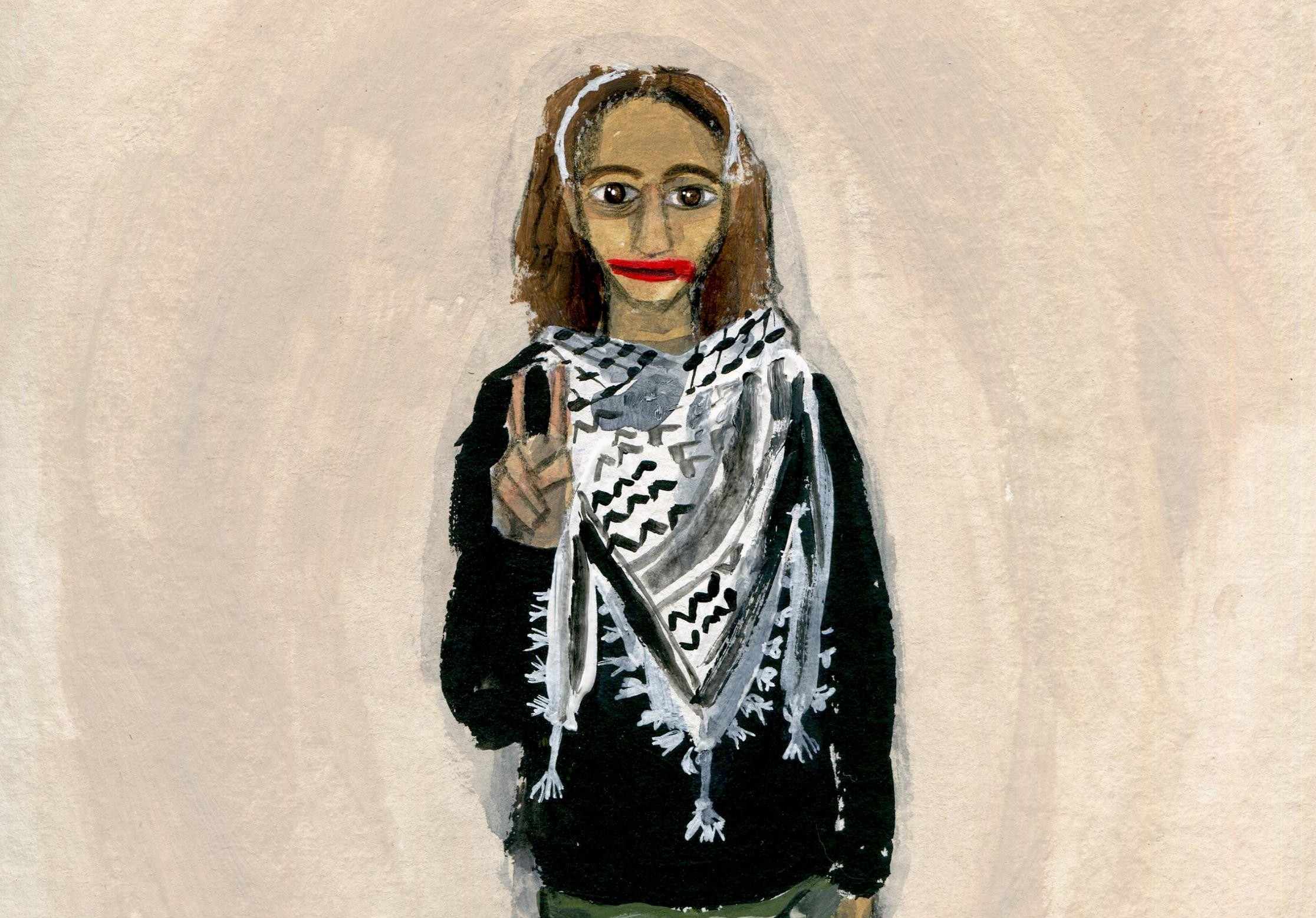
Hi Nina. Thanks for talking to us. Could you start by introducing yourself? Who are you and what is your relationship to the Ulm 5?
Hi, my name is Nina Onèr, and I’m a criminal defense lawyer here in Berlin. I specialize in political cases, and I’m defending Zo, one of the Ulm 5 in the case before the Landgericht Stuttgart.
I spoke to Mimi, Daniel’s mother, a couple of weeks ago, and she said that it’s very difficult getting information about how they are. Are you able to say something about what morale is like?
Of course, I can mostly speak about my client. It’s very obvious that the tension is rising now with the court date approaching, but generally they remain steadfast in spirit, and glad that it’s finally about to start. It’s been such a long time, and they’re hopeful that not only the court, but – more importantly – history and public opinion will acquit them for this direct action against an arms manufacturer
What are the conditions like in pre-holding prison?
It differs amongst the five, depending on the detention facility. Every jail has its own discretion on what it thinks are appropriate measures in order to sustain what they deem “public safety and order” within the facility. Some are being held in solitary. Others are in joint cells – although that is also not necessarily a pleasant experience at all times. Some of them work, which gives you a lot more time outside of your cell, and allows you to shower daily, which is not something that others have the privilege of doing.
The restrictive measures that they face, because of what they’re accused of, makes them a lot more isolated. Everything is observed by the state police. I’m extremely worried that this isolation over such a prolonged period of time is going to have long-lasting psychological effects.
It’s outrageous that in pre-trial detention, the conditions they’re held under are a lot stricter than in jail, after an actual conviction, although here the presumption of innocence should be in effect. In prison there are so-called rehabilitation measures, therapeutic options and group activities.
But the measures in pre-trial detention are a lot stricter, although they haven’t been proven guilty. That’s something that a lot of human rights organizations have been criticizing all over the world. However, Germany sticks to doing that.
The Ulm 5 have been denied bail. Is this usual?
Well, let’s say it’s not completely unusual – the court has upheld the pre-trial detention up to now on the grounds that there was a risk of absconding – so fleeing and not attending the trial, which I think is unreasonable in this case.
In addition to the “actual” charges of trespass and damage of property, the prosecution then came up with the outrages charge under Section 129 of the German Criminal Code (StGB), which I am sure we will still go into – which massively increases the expected sentence. This allowed them to further strengthen their argument regarding the risk of absconding, saying the expected sentence means the risk of absconding cannot be ruled out even if bail was granted – not least because no one knows where it comes from, so the argument.
This perpetuates the absurd image of highly criminal, professional structures that the prosecuting authorities are trying to paint regarding the 5.
Whatever the intention, the effect is that the Five are going to spend nearly a year in prison before they’ve been convicted of anything.
In Germany, bail is just one of the many measures that can replace pre-trial detention. These are five young people who’ve never been convicted of anything prior to this, who filmed themselves during the action, were not masked, and then waited for police to arrive and let themselves be arrested – peacefully and without resisting.
I don’t think there were probable grounds for pre-trial detention in the first place, so I don’t think bail should have been necessary.
But prosecution has made such a point of demonizing the Five – it started back at the arrest when they were being transported from the court in Ulm to the respective jails. Masked policemen were surrounding the building as if we were facing a group of very dangerous criminals. And now they are doing everything in their power to uphold this narrative.
But they haven’t committed any violent attacks at all.
Exactly.
The Ulm 5 targeted an Elbit factory. Could you quickly say something about the role of Elbit?
That specific plant in Ulm is Elbit Systems Germany, which is a direct daughter of Elbit Systems, an Israeli Arms Company supplying the vast majority of arms used in the war in Gaza – mostly drones of all different types and technology for them. That’s why this direct action was aimed at them.
You mentioned Section 129, which was in the news again a week or 2 ago when it was used to justify the raids of 15 community centres in Berlin. What is Section 129, and how is it being used?
The tricky thing about Section 129 is that it has such a broad definition – such a wide range of acts may fall within the scope of the acts required by the definition of the offence which makes it so easy for prosecution to charge people under this Section. Even more so if you look beyond “membership of a criminal organisation ” towards what the alternative element of the offence “aiding a criminal organization” can entail.
Basically, prosecution has and is using this specific section specifically in order to suppress and punish unpopular political opinion.
It’s broadly used in political cases, and is aimed at specific political opinions, views, or actions that are deemed undesirable in the current political climate. It’s also an extremely useful tool, because in criminal proceedings, it allows an extremely wide range of observational measures.This makes it possible to implement extremely far-reaching and intrusive surveillance measures,like telecommunications surveillance and that’s probably how those raids were made possible.
The charge against the Ulm 5 is that they were members of an illegal group. What does that even mean?
Section 129 is about membership of a kriminelle Vereinigung, in English: a criminal organisation. An organisation in this sense is a long-term, organised group of more than two people, formed to pursue an overarching common interest and which pursues this interest by committing criminal offences of some gravity.
The Ulm 5 are charged with membership but as mentioned before, there is an alternative – the supporting of a criminal organisation. This could be anything from distributing flyers to collecting donations.
So once a certain “group” has been classified as a criminal organisation it creates so much uncertainty as to how they can still be supported, even by friends and family, because It has such wide reaching effects – in effect this scares away support, making it extremely hard for these people to be supported by outside groups without the supporters risking persecution themselves.
Is there a parallel here with the criminalization of Palestine Action in Britain?
The criminalisation of PA UK and this classification of the Ulm 5 as a criminal organization politically follows the exact same line of reasoning in my opinion, and the prosecution has adopted the UK’s assessment without question; they must now, of course, reconsider this in light of the ruling by the High Court, revoking PA UK’s classification, but I’m not even sure they are aware of that.
At the press conference a couple of weeks ago, you said it was significant that the trials are being held in Stammheim. Can you expand a bit on this?
I think this fits in very well within the narrative that prosecution is trying to paint from the very beginning. As I said, they’re trying to demonize those five. I expected from pretty early on that we will end up in this high security courthouse.
There was no court house there before. The location is JVA Stammheim – a prison and the initial court house was built in the Seventies – specifically for one of the earliest trials in connection with the Red Army Fraction.
It’s an outer branch of the Oberlandgericht Stuttgart – the higher Regional Court of Stuttgart and usually only so-called terrorism trials are held there.
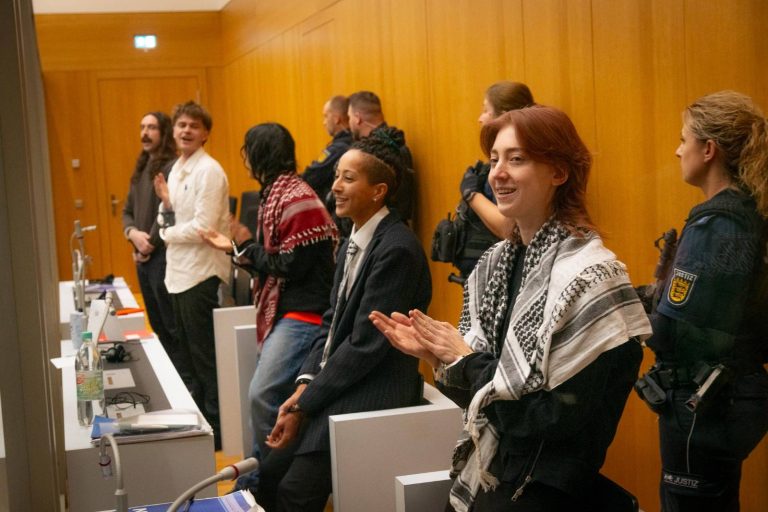
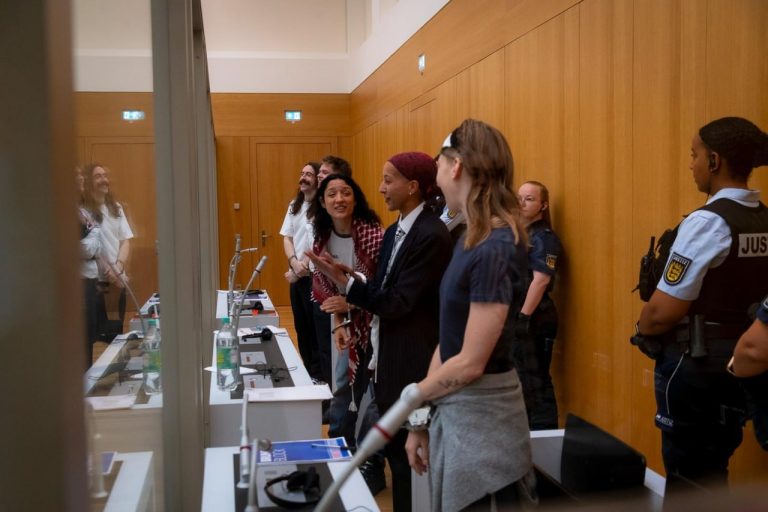
The extreme security measures will complicate everything: access from the public, support from friends and family, media coverage and – most gravely – defence. We are meant to speak to our clients, who are supposed to be seated behind a two meter high bulletproof safety glass, via radio using a microphone or through a small slit in said security glass. All the while, court officers stand guard nearby.
The interested public are going to be searched, have their IDs copied, and will not be allowed to bring food, drink or even pens in. The number of places is limited.
Do you think there’s a deliberate attempt to associate the Ulm five with the Baader- Meinhof group?
Well, maybe not the Baader-Meinhof group specifically, but all this is definitely trying to put them in a terrorist corner.
As a lawyer inside the court, what support do you need from people outside?
Showing up is important. I think that the best anyone can do is just be there, to show that they are not alone, that there are plenty of good people who support them. It’s such a long trial, the individual hearing dates have been so spread out which is just another way of making support really hard. I would urge anyone who wants to support to organize accordingly so that there aren’t 100 people wanting to join on the first day – who then also won’t be able to find a space and instead make sure there’s always some support throughout the planned three months period.
The court knows that these five people have all been living in Berlin, and that family and friends will want to come from Berlin and beyond to attend.
Also, four of the five families aren’t even in Germany, so they’ve got even further to travel
Yes
Is there anything that people who can’t attend the court case can do?
Media coverage is extremely important. This specific case has been covered very little, and only by a small and specific number of media houses in Germany. This is unfortunate and does not do justice to the background. In my opinion it would be appropriate for major news agencies to take up this story, given the motives and background involved.
Sending letters has also been appreciated dearly, because this whole process is aimed at isolating them. It’s been over seven months and we cannot underestimate the power of emotional support.
I notice that while everybody in Britain knows of Palestine Action, even many German activists don’t know about the Ulm 5. Why is this and how can we turn this round?
What we’ve seen ever since October 2023 is that Germany is trying to silence any criticism of the Israeli government in the name of the so called Staatsräson, pleading complete loyalty to Israel no matter what, and trying to put everyone and everything who legitimately criticizes the state of Israel and this illegal war in the antisemitic corner.
This has had such a huge effect on the public that a lot of people have just become completely insecure if and how any legitimate criticism of Israel can be voiced. After two and a half years of witnessing a genocide, we have the obligation, especially as Germans, to universal human rights and to never again look away when they are violated, no matter by whom.
Even the Ulm 5 are being accused of antisemitism
Correct. The prosecution somehow has twisted the action to fit into its way of arguing why this action is antisemitic. I do not want to give away our defence strategy prematurely, but the defence will go to show why this is completely unfounded – and just another way of avoiding looking at the actual motives – during the trial hearing.
How is the defense being financed?
We are court ordered lawyers. The state is advancing the money, but if convicted, the Ulm 5 will have to pay. If acquitted, then the state will end up paying.
How likely do you think that the Ulm 5 will win?
This might come as a surprise to you, but I’m actually convinced that we have a very good shot at proving that this action was justified under either section 32 or 34 of the German Criminal Code. Instead of Notwehr (self-defence), this is called Nothilfe, which is defense of someone else.
By showing that there is an ongoing present attack against the people of Palestine, and that no other measures were sufficient to stop Germany from exporting arms despite wide knowledge that this is against international law, the action was justified.
Once damage of property and entering are justified, this whole accusation of criminal organization just falls apart, because according to the definition a criminal organization is an organization whose purpose it is to commit criminal offences of some gravity – no criminal offences, no criminal organization. So, I’m hopeful.
Some people have been worried because Germany tends not to have jury trials. Does this mean that it’s weighted on the side of the prosecution?
At the end of the day, it’s the court who makes the decision, not the prosecution. And we do actually have two lay judges here, alongside the three other judges. This has its advantages and disadvantages.
Usually prosecution and the court outnumbers the defence. In this specific case we are also many. We are five defendants with at least two defence lawyers each, so we are also strong in numbers.
But the real power imbalance usually doesn’t lie in the number of people in court, but in the resources that prosecution has. Prosecution can, at a whim, send out 50 policemen to investigate. Unlike us, they can call on 100 experts to give opinions without having to worry about how to finance it. But we’re not sparing any resources in our power in order to get across our point.
One of our important resources is public opinion. What can people do to support you?
Given the broad scope of 129 I don’t want to encourage people too much. Everyone needs to look out for themselves. But in terms of support for the legal aspects of the trial itself, we are working on everything we can. We’re in a good position. And if there’s still something we might need, we will ask specifically,
Is there anything we haven’t covered yet that you’d like to say
We talked about how there hasn’t been much coverage of the Ulm Five. Many of us wonder what has become of the anti-war movement from our parents’ generation. We had expected a much wider public to rally behind this kind of action.
This was a direct action aimed at a weapons manufacturer – with the resurgence of the idea of mandatory military conscription and remilitarisation here in Germany, perhaps this presents an opportunity for the anti-war movement to get back on its feet, return to its core values, show up and show support.
As I said, getting the Five acquitted is not just about winning in court, but about winning the public opinion on what this direct action was aimed at.
Maybe there’s some hope in the school strikes.
Yeah, exactly