On April 27, the trial against the members of the Ulm 5 began with a bang at the Higher Regional Court in Stuttgart-Stammheim. They are accused of damaging war materials belonging to Elbit Systems–a corporation directly involved in the genocide in Gaza–in Ulm in September 2025.
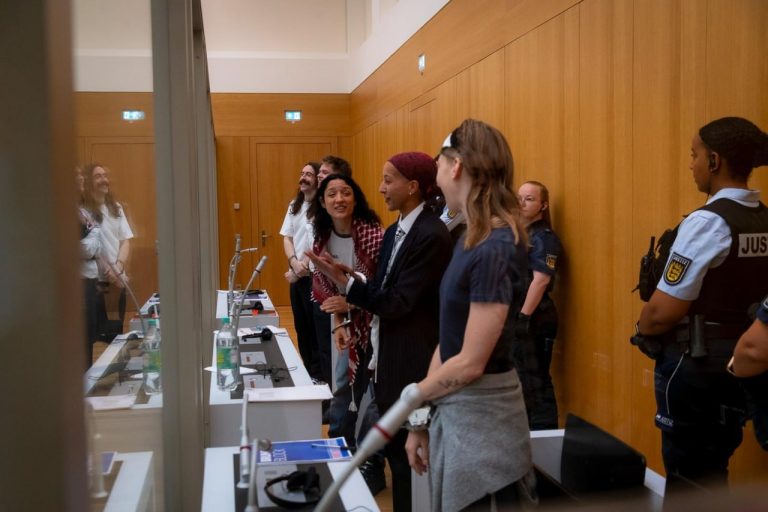
The prisoners were carted to Stammheim from various prisons and led in handcuffs to a glass enclosure separated from the rest of the courtroom where they had no direct contact with their lawyers who were also present.
Scenes from the trial
The lawyers protested and filed a motion to overturn the court’s inhumane measure. What followed was a show of force by the court, intended to intimidate both prisoners and spectators alike, and to make a defense impossible. Motions were not allowed, the defense was not given the floor, and then the microphones were turned off. Finally, the lawyers left the courtroom en masse. After a two-hour recess, proceedings resumed; this time the defense sat together with the defendants. The judge threatened to remove the lawyers from the case and adjourned the first day of the trial prematurely without reading the charges. The next two court dates were cancelled immediately. Spectators had to undergo rigorous security checks—much stricter than at airports, requiring them to remove their shoes, with paper and pens prohibited—and full deterrence was deployed. 10 uniformed officers monitored every movement in the courtroom, ready to intervene immediately. These attempts at Orwellian harassment did not intimidate anyone, and prolonged applause and chants of “Free Palestine” echoed through the monstrous hall as the prisoners entered the arena.
The symbolism of Stammheim
The trial is taking place in Stammheim, the very place that in the 1970s became a symbol of political justice, arbitrariness, and the Federal Republic of Germany’s (FRG; West Germany) declaration of enmity–a state that stopped at nothing, not even the physical well-being of the accused prisoners. The infamous Stammheim trial that was held from 1975 to 1977 against five members of the urban guerrilla group RAF (Red Army Faction) took place in the same location in Stuttgart-Stammheim, just not in the same building. While it is clear that the Ulm 5 and the RAF are distinct in terms of their politics and were active in different contexts, they share the honor of being enemies of the state–the urban guerilla RAF as a general threat to its consolidation in the capitalist and imperialist world systems, and the Ulm 5 in radically challenging the German Staatsräson, the bedrock of its indispensable support for Israel and its genocidal actions.
The very deliberate relocation of the Ulm 5 trial to Stammheim reflects the state’s course. Trials against political dissidents are held at the Higher Regional Court right next to the windowless concrete bunker complex where the RAF were tried in the1970s—a looming eyesore of a building positioned to intimidate all entrants of the Higher Regional Court that happened to cost the taxpayer 15 million DM at the time.
Those who dared to make it this far are tried with characteristic German discipline–unyielding and efficient. It is no coincidence that many Kurdish activists were tried in this location and in rapid succession. On December 4, 2025, the 2nd Criminal Division of the Stuttgart Higher Regional Court (OLG) sentenced the Kurdish activist Welat Çetinkaya to one year and nine months in prison for alleged membership to the Kurdistan Workers’ Party (PKK). Within six months, another trial against a Kurdish activist began here at the Stuttgart Higher Regional Court.
Who were the RAF?
The RAF existed from 1970 to 1998 and saw itself as an anti-imperialist, anti-capitalist and internationalist group. In the wake of post world-war liberation movements in the global south, they fought against the American War (Vietnam War from the “Western” perspective) and championed anti-colonial liberation movements underway in Angola, Guinea-Bissau, South Africa, Mozambique and Namibia. They were inspired by Latin American liberation theology (Camilo Torres), Black Panthers and the Weather Underground in the USA, Che Guevara’s globalised guerrilla warfare (cf. “Let there be two, three, many Vietnams”) and revolts and uprisings in Paris, Prague, Belgrade (Red University Karl Marx) and Mexico City.
The “birth hour” of the RAF was the rescue of imprisoned Andreas Baader from the reading room of the German Central Institute for Social Issues in Berlin on May 14, 1970. He had been taken there from Tegel Prison for research purposes to work on a book with the journalist and later RAF member Ulrike Meinhof.
Baader, liberated by later RAF members and politically active in the extra-parliamentary opposition, was serving the remainder of his sentence in prison for setting fire to a department store in 1968 in solidarity with the Vietnamese liberation struggle. In April 1971 their programmatic text “The Urban Guerrilla Concept” was published and in 1972, during the “May Offensive” (May 11–24), they carried out a total of six attacks: the headquarters of the 5th U.S. Corps in Frankfurt am Main, the headquarters of the 7th U.S. Army in Heidelberg (in which a total of four U.S. soldiers were killed), the State Criminal Police Office in Munich, the police headquarters in Augsburg, the Springer Group’s publishing house in Hamburg and finally the car of a Federal Court of Justice judge in Buddenberg. There were additional injuries and property damage amounted to millions of euros.
Following the arrest of several RAF members in 1972, charges were brought against five members—Andreas Baader, Ulrike Meinhof, Holger Meins, Gudrun Ensslin and Jan Carl-Raspe—before the Higher Regional Court in Stammheim. However, before the trial even began, one of the prisoners Holger Meins had already died. Meins participated in the third hunger strike by political prisoners in the FRG against solitary confinement, for consolidation of the prisoners and for better prison conditions from September 1974 to February 1975. He was killed by insufficient caloric intake during force-feeding. In the last two weeks, he was given only 400–800 calories, and in the last four days, as few as 400 calories—an adult requires 1,200 to 1,600 calories daily. He died on November 9, 1974. The presiding judge in the main case, Dr. Prinzing, was also responsible for the prisoners’ conditions of detention and refused both the transfer to an intensive care unit and, at the last moment, a visit by a medical examiner. Charges of murder or manslaughter were filed against him and others by the defense attorney von Plottnitz.
Following Holger Meins’ death, there were several demonstrations with more than 10,000 people; 5,000 people attended the funeral in Hamburg alone. The 2nd of June Movement, another urban guerilla group from West Berlin, founded in 1972, shot and killed the President of the Berlin Court of Appeal Günter von Drenkmann–a judge since 1937–just one day later on November 10 during a failed kidnapping attempt.
The trial of the RAF5
Even before the main trial began on May 21, 1975, a new scandal emerged on January 1 regarding newly enacted special laws against the RAF. These laws allowed for the defense counsel to be excluded (§ 138a StPO), limited the number of defense attorneys to three per defendant (Section 137(1) sentence 2 of the Code of Criminal Procedure), prohibited multiple defense representation (Section 146 of the Code of Criminal Procedure), and allowed for the trial to proceed in the defendant’s absence even if they weren’t able to (Section 231a).
Following the exclusion provisions (§ 138a–d), Baader’s defense attorneys Klaus Croissant, Kurt Groenewold and Christian Ströbele were excluded one after another from the proceedings by the Stuttgart Higher Regional Court, shortly before the trial began. All three attorneys were later criminalized and also convicted of supporting a criminal or terrorist organization. From the outset, the state—represented by the Federal Prosecutor General’s Office and the court—pursued this goal. They were intent on making a defense impossible, depriving the prisoners of their rights, depoliticizing the trial and deterring the spectators. The state was clear on not wanting to address and debate capitalism, imperialism and the U.S. war in Vietnam (and their involvement in it).
Presiding Judge Prinzing constantly interrupted the attorneys and the defendants, cutting them off or having their microphones turned off. Nearly all of the defense’s motions were denied because they were deemed either inadmissible or unfounded. These included the defense’s requests to call witnesses such as independent medical experts.
The indictment was not read until the 26th day of the trial, on August 19, nearly three months after the trial began. Eighty-four motions for recusal were filed against Prinzing and rejected; it was only the 85th motion for recusal that led to the judge’s removal on the 174th day of the trial on January 20, 1976. This was a consequence of Prinzing having first consulted with the judge at the Federal Court of Justice without authorization and then made extrajudicial statements to the court-appointed defense attorney Künzel.
Meanwhile, the defense and the prisoners’ attempts to address and denounce the prison conditions, solitary confinement, and isolation torture were continuously thwarted by the court.
Worsening conditions of the prisoners
The first 40 days of the trial focused on the possibilities and conditions of the defense, as well as the prisoners’ state of health and their inability to stand trial due to the conditions of detention in the high-security wings. The state’s use of total solitary confinement and torture—specifically “white torture” and sensory deprivation—with the intent of breaking the prisoners’ will was evident from before.
The prisoner Ulrike Meinhof spent eight months in the “dead wing” in Cologne-Ossendorf from June 16, 1972, to February 9, 1973. Previously in 1971, ex-RAF member Astrid Proll was held in total isolation for 119 days following her arrest. Meinhof vividly described the consequences of solitary confinement (ref. 1, p271) :
The feeling, one’s head explodes (the feeling, the top of the skull will simply split, burst open)—
the feeling, one’s spinal column presses into one’s brain
the feeling, one’s brain gradually shrivels up like, like dried fruit, for example—
the feeling, one is constantly, imperceptibly, flooded, one is remote-controlled—
the feeling, one’s associations are hacked away—
the feeling, one pisses the soul out of one’s body, like when one cannot hold water—
the feeling, the cell moves. One wakes up, opens one’s eyes: the cell moves; afternoon, if the sun shines in, it is suddenly still. One cannot get rid of the feeling of motion. One cannot tell whether one shivers from fever or from cold—
one cannot tell why one shivers—one freezes.
To speak at a normal volume requires an effort like that necessary to speak loudly, almost like that necessary to shout—
the feeling, one falls silent—
one can no longer identify the meaning of words, one can only guess—
the use of sibilants—s, ß, tz, z, sch is absolutely unbearable
guards, visits, the yard seems to be made of celluloid—
headaches—
flashes—
sentence construction, grammar, syntax—can no longer be controlled.
When writing: two lines—by the end of the second line, one cannot remember the beginning of the first—
The feeling, internal burnout—
the feeling, if one must say what’s wrong, if one wants to let it out, it’s like a rush of boiling water in the face, like, for example, boiling water that scalds forever, that disfigures—
Raging aggressiveness, for which no outlet exists. That’s the worst.
Keen awareness that one cannot survive; a complete breakdown of the capacity to deal with this;
Visits leave no trace. A half an hour later one can only mechanically reconstruct whether the visit was today or last week.
Compared to this, bathing once a week means: a momentary thaw, a moment of rest—to stop for a couple of hours—
The feeling, time and space reconnect—
the feeling of finding oneself in a house of mirrors, like in an amusement park—to stagger—
Afterwards: incredible euphoria, that one heard something—
beyond the acoustic day and night differentiation—
The feeling, time now flows, the brain expands again, the spinal column sinks down after some weeks.
The feeling, as if one’s skin is thickening.
In September 1975 the court excluded the defendants from the trial, ruling that their inability to stand trial was self-inflicted due to hunger strikes. This was confirmed in principle by the Federal Court of Justice (BGH) on October 22. However, they added that the defendants could participate in the trial if they wished.
The BGH also viewed that the prison conditions—specifically solitary confinement—was a cause for their inability to stand trial. This option to exclude the defendants led to a situation where, for long stretches of proceedings, the trial took place without the prisoners present.
In November, the defense was nearly dismantled: on November 4, attorneys Spangenberg, Golzem and Köncke were barred from continuing to participate in the trial, and on November 7, Jan Carl Raspe’s attorney von Plottnitz was removed as defense counsel.
In mid-January 1976, the defendants took turns reading their Statements on the case (Erklärung zur Sache in German) over the course of two days. These statements addressed, among other things, their revolutionary politics, anti-imperialism, the liberation struggles in the Third World—particularly the Vietnam War—the role of the FRG in these conflicts, and thus the necessity and possibility of fighting in the FRG as well through guerrilla tactics in solidarity.
The murder of Ulrike Meinhof
On May 9, 1976, the next defendant, Ulrike Meinhof, died. She was found hanging in her cell in Stuttgart-Stammheim. The government called it suicide. The left called it state murder. An International Commission of Inquiry, founded in August, concluded in its 80-page final report in 1979 that “The claim by state authorities that Ulrike Meinhof killed herself by hanging is unproven …”.
Jan Carl Raspe in a statement before the court on May 11 said, “We believe that Ulrike was executed; we do not know how, but we know by whom, and we can determine the logic behind the method.” When the trial resumed that day, the defense attorneys moved to adjourn the proceedings for 10 days due to the death of Ulrike Meinhof and the resulting mourning. This was coolly rejected by Judge Prinzing, who later said of the defendant Andreas Baader, “If he had been born before the war, he would have made a quite capable soldier.” The defense attorneys subsequently did not return to the trial until after Ulrike Meinhof’s funeral.
On July 28, the 131st day of the trial, another RAF prisoner Klaus Jünschke was called to testify. After Judge Prinzing interrupted him, he leaped over the judge’s bench, threw the judge to the ground and shouted, “For Ulrike, you pig!”
The trial comes to a morbid end
Shortly before the end of the main trial, on March 17, 1977 (the 185th day of the trial), it became known that confidential conversations between defense attorneys and the prisoners had been wiretapped by the Baden-Württemberg State Criminal Police Office. After this incident came to light, the defense attorneys ceased to participate in the main trial.
On March 29, the fourth collective hunger strike by political prisoners in FRG began, where up to 100 prisoners–including those imprisoned for social offenses–participated at times, demanding the abolition of solitary confinement and the consolidation of political prisoners.
On April 7, three weeks before the verdict was to be pronounced, Federal Prosecutor General Siegfried Buback—a member of the NSDAP since 1940 and subsequently a Wehrmacht soldier—was shot dead by the Kommando Ulrike Meinhof (RAF). A statement from the RAF read, “Buback was directly responsible for the murders of Holger Meins, Siegfried Hausner, and Ulrike Meinhof. In his capacity as Federal Prosecutor General—as the central hub and coordinating body between the judiciary and the West German intelligence services, in close cooperation with the CIA and the NATO Security Committee—he orchestrated and directed their murders. (…)” Buback’s driver and security detail were also killed in the attack.
One day before the verdict was announced, defense attorneys Schily, Dr. Heldmann, Oberwinder, and Weidenhammer held a press conference at a hotel in Stuttgart where they publicly presented their closing arguments and described the trial as “an instrument within a large-scale campaign of psychological warfare against the RAF” and a “declaration of internal enemies”. They sharply denounced the legislative changes, the special laws and court, the biased judge, the defendants’ inability to stand trial, evidence suppression and the structural dismantling of the defense. They cited “prejudice as final judgement” and expressed consternation that it had been impossible to address the defendants’ political motivations during the trial.
On the 192nd day of the trial, April 28, the verdict was finally announced and the prisoners Andreas Baader, Gudrun Ensslin, and Jan Carl Raspe were sentenced to life imprisonment. The defense filed an appeal against the verdict.
On July 30, Jürgen Ponto, one of the most influential bankers in FRG and a personal advisor to Chancellor Helmut Schmidt, was shot and killed by a RAF commando during a failed kidnapping attempt.
On September 5, Hanns-Martin Schleyer, president of the Federation of German Employers’ Associations (BDA) and the Federation of German Industries (BDI), was taken hostage by the Siegfried Hausner Commando (RAF) who demanded the release of 11 RAF prisoners including those held at Stammheim, in exchange for his release. In the process, his three bodyguards and driver were also shot. Hanns-Martin Schleyer was a staunch National Socialist who joined the SS as early as 1933 (promoted to SS-Untersturmführer in 1941) and was head of the Nazi Reich Student Union in Prague. From 1943 he worked at the Central Association of Industry for Bohemia and Moravia that was responsible for the Aryanization of the Czech economy and the procurement of forced laborers for the Nazi regime, eventually rising to head of the Presidential Office.
The state, led by Chancellor Helmut Schmidt (SPD)—a Wehrmacht officer who participated in the Siege of Leningrad, during which 1.1 million people perished—did not comply with this demand. The approximately 100 political prisoners were all immediately isolated from one another. On September 30, the Contact Ban Act was passed–which took effect as early as October 2–that retroactively legitimized the total ban on contact between defense attorneys and detainees that had already been ordered during the Schleyer kidnapping.
On October 13, the Palestinian militant group Matyr Halimeh hijacked a passenger plane carrying 86 people from Palma de Mallorca to Frankfurt am Main and demanded the release of 11 RAF prisoners and two PFLP prisoners from Turkish prisons. The plane flew through several stops—Rome, Larnaca, Bahrain, Dubai, and Aden (where the pilot Jürgen Schuman was shot)—and finally landed in Mogadishu where it was stormed by the German GSG 9 on October 18. During the operation, the Palestinians Zohair Youssif Akache, Hind Alameh, and Wabil Harb were killed, while Souhaila Andrawes was the only one to survive.
On the morning of October 19, Andreas Baader and Gudrun Ensslin were found dead in their cells at Stuttgart-Stammheim. Jan Carl Raspe was seriously injured and died shortly thereafter in the hospital. Irmgard Möller, who was also imprisoned in Stammheim, had stab wounds to the chest and survived. Baader and Raspe were killed by gunshots, and Ensslin was found hanged. The state called it suicide, the left called it murder. While former RAF member Karl Heinz Dellwo today speaks of “suicide under state supervision”, for the sole survivor of the Stammheim night, Irmgard Möller, it was always murder and an attempted murder against her. To this day, there remains a demand to fully release all documents in state possession.
Thus, all defendants in the Stammheim trial of 1975–1977 were dead. No decision was ever made on the appeal. The verdict is not final. Hanns Martin Schleyer was eliminated by the RAF on October 19.
The dissolution of the RAF and the Ulm 5
The RAF continued to exist until 1998. Recently in March 2026, the Federal Prosecutor’s Office filed new charges against former RAF member Daniela Klette for three RAF attacks between 1990 and 1993. She was held responsible for several attacks on supermarkets and armored cash transport vehicles. They were operations to raise funds or, to put it plainly in proletarian terms, proletarian appropriation. The state’s goal was to bury her alive under a merciless German justice system. On May 12, in her closing statement before the Verden Regional Court, Daniela Klette outlined her political career, in which she “condemned the genocide of the Palestinian population in Gaza—as well as the ethnic cleansing carried out through sheer terror in the West Bank” and called for “systemic change,” “because inherent in capitalism, beyond competition, but also fascism, racism, war, violent displays of power within the political system and between people, patriarchal violence against women and queer people, against people with disabilities, and the destruction of nature”. On May 27, she was sentenced to 13 years at the Verden Regional Court.
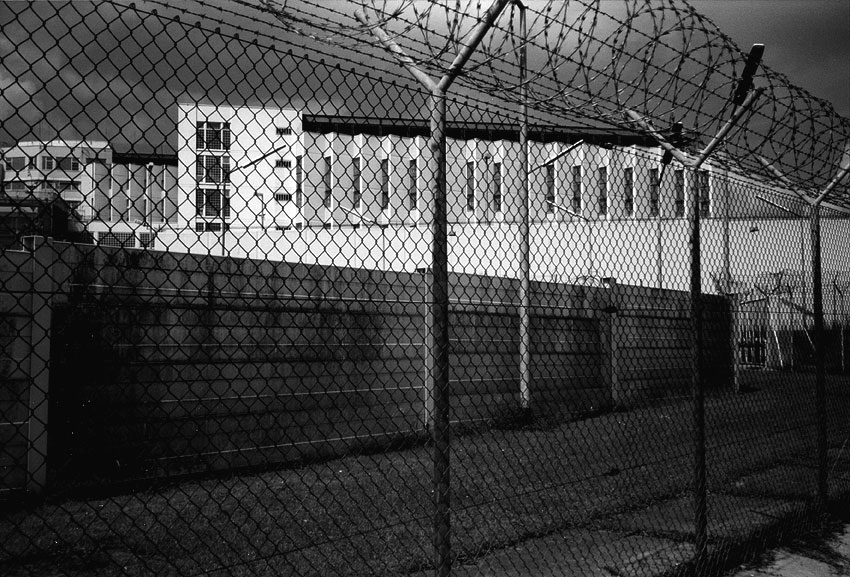
Stammheim stands as a symbol of the 1970s, representing both the prison as a place of oppression, repression, and isolation—where prisoners were subjected to such treatment until death—and the trial characterized by state arbitrariness, special laws, and depoliticization: a political justice system which fights its opponents to the bitter end. The current Stammheim trial against the Ulm 5 follows this tradition. This is the historical consciousness that the state has internalized and is now once again attempting to fully exercise its power against those it has marked as enemies. Spectators are not even allowed to bring paper and pen into the courtroom, and the prisoners, locked away in isolation from one another, sit behind secure glass boxes without direct contact with their lawyers.
It is essential to counter the state’s repressive measures with both public awareness and resistance, and above all to highlight the political dimension, for the campaign to render Elbit Systems’ weapons unusable is connected to the genocide against the Palestinians in Gaza and the German government’s complicity in it. It shows once again that Germany has learned nothing from its history, for “Never Again” applies now. It is the responsibility of everyone who wishes to stand in solidarity to ensure that the Ulm 5 are not left alone in making these connections visible, through acts of resistance.
Further readings:
in English:
- Smith, Moncourt: The Red Army Faction, A Documentary History – Volume 1: Projectiles
- For the People and The Red Army Faction, A Documentary History: Volume 2: Dancing with Imperialism
in German:
- Pieter Bakker Schut: Stammheim. Der Prozeß gegen die Rote Armee Fraktion
- Stefanie Bart: Erzählung zur Sache.
- Rote Armee Fraktion: Texte und Materialien zur Geschichte der RAF. ID-Verlag