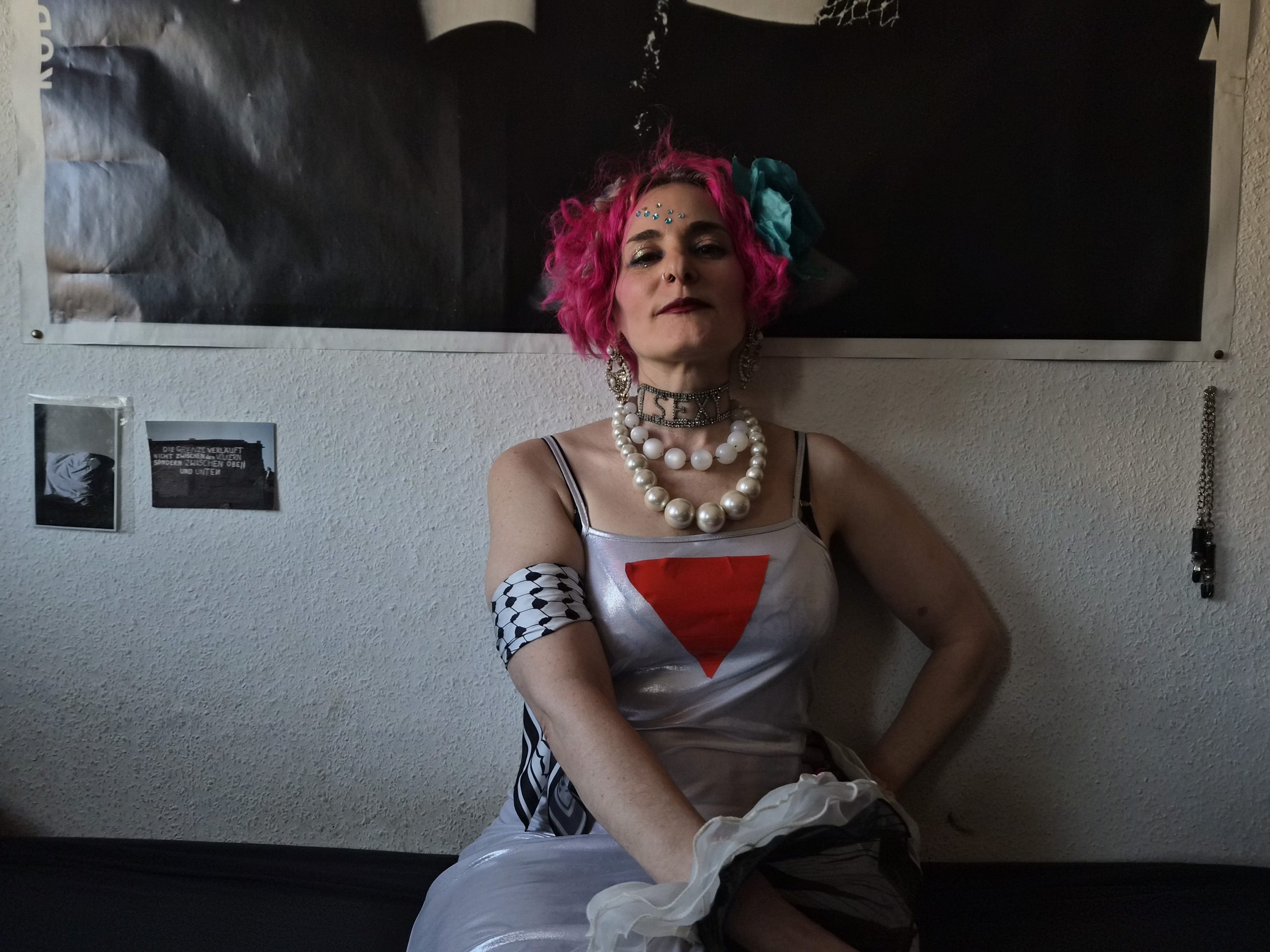
Hi Liad, thanks for talking to us. Could you just start by saying who you are?
My name is Liad Hussein Kantorowicz. I am an activist, an artist and a musician. I consider myself a queer trash DIY diva, a perpetual migrant, and a Jew from Palestine who’s been living in Berlin since 2010. I’m about to leave for good.
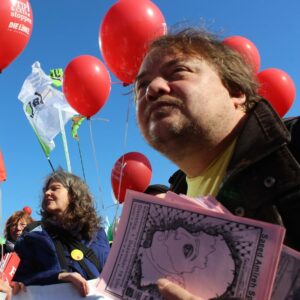
I think one of the first times I met you was 2014 at a demonstration in Kreuzberg “Deutsche Linke Wach Auf!”, organized by Jews and Israelis, calling on the German left to do something about the bombing of Gaza.
Yeah, I remember this very clearly.
There are several issues that have been a long-standing part of my history and who I am. These are also very embedded in my artistic work. The liberation of Palestine, queer liberation, and the rights of sex workers have been very fundamental. So it is not surprising that we met in a political context.
You’ve been here for 16 years, you know what Germany is like. I won’t ask why you want to leave Germany, but why now?
First of all, because I’ve had it. It’s been very clear that it’s time to leave for quite a while. The beginning of the genocide made it very explicit. It also made very explicit to me what has been implicit all along: I cannot continue to stay here and to be an artist in the political context that we are in, because the presence of this country puts hurdles in my way.
The ever present political content of my work has been unwanted by the German state from the moment that I came here completely blind, and not understanding this. Doors have been shut in my face, and I’ve experienced every form of political censorship: repression, being denied access to funding, and excluded from artistic institutions. I’ve even been pulled directly off stage mid-performance.
Of course, Palestinians and allies working on Palestinian self-determination have also experienced this in their artistic work. I just don’t want it to be all about me or to completely sidestep the central subjects of repression in Germany, which are Palestinians first and foremost.
It’s not the only reason that I’m leaving, but I do see a very sharp decline since what I see as the glory days of Berlin, when the city was known internationally as the place to be. It feels like the sinking of the Titanic, and I’m trying to jump off before it sinks.
Before you go, you have one last event on Sunday. What are you planning?
It was planned as a solo exhibition, a retrospective of my artistic life in Berlin. It looks at the three factors that made me the artist that I am. One is the product of my artistic labour; the second is Berlin as a city that shaped me and my work; and the third is the wide and extravagant and incredible underground queer arts and culture scene that operated here during these special years.
The exhibition makes a correlation between my departure and the departure of Berlin from its status as the place to be; as the hyped city of the world. I also feature my speculative research as to the material conditions that enabled it to achieve this very unique status and what caused its fall from grace, including the ending of its ‘cheap but sexy’ appeal.
When the city becomes expensive, the many, many artists who reproduce the artistic scene and feed off of each other now have to go to work for 40 hours a week in order to sustain themselves. Alternatively, they leave Berlin. They de-facto stop being Berlin artists.
Political repression is another factor. Berlin has always walked a tight-rope. On one hand, there’s the constant political anti-Palestinian repression. On the other hand there were very wide margins in the cultural spectrum that enabled all sorts of radical and progressive thought and creativity, including around Palestine self-determination. Not just for this radical thought to exist, but also for it to develop.
Anti-Palestinian political repression has been there all along for any of us who work beyond Palestinian cultural heritage, and deal specifically with Palestinian self determination or anything that could be constructed as ‘Zionist.’ In the post October 7 world, this repression has become explicit.
This has had direct effects on funding. One consequence is for institutions to accept the censorship and to roll it down to the artists with whom they collaborated.
Another consequence is the threat of cutting funding. You get a cease and desist order, or have to go underground and unfunded. I do believe that this kind of political repression in arts—but also in politics—is what’s making a lot of people leave, particularly those people who are not just in the arts but in activism and in radical and progressive political thought.
We are fucking tired of political repression, and we are either not continuing to come to the city, so it can no longer serve as a cosmopolitan hub for progressive and radical thoughts and actions, or we are just living outside of it, particularly those who are more marginalized and more persecuted.
Let’s talk about the specifics of this repression in the context of your exhibition. It was supposed to be in the Pink Dot Gallery. What happened?
It’s super ironic. The exhibition is supposed to open this Sunday, the 21st of June. Yesterday, Wednesday, I received a call from my contact person saying that the exhibition has been immediately and unequivocally cancelled, under threat from the cultural senate of Berlin.
It should be said that this exhibition has nothing directly to do with a critique of Israel, anti-Zionism or Palestinian self-determination. It is, as I said, about Berlin, and a retrospective of my work. As such, it deals with the topic of political repression, but this exhibition is not about anything that has to do with anything that is politically contentious.
It is very clear that this is a case of political persecution as a personal vendetta against me. I don’t think that I am able to say more.
You say there were phone calls. These were phone calls to the gallery?
Yeah, by the Senate of Berlin, threatening to withdraw all of the funding if they enable this exhibition to go on.
Of course, this is not new. This is what happened with Oyoun, and there has been the threat of withdrawing funding for other events which suggest that Palestinians are human beings.
Exactly, I’m one of many artists in the city, whose work has undergone political persecution and censorship since October 7. This is not unique, but again I know that this is about me and my political positioning rather than the content of what is being shown in the gallery.
I just find it extremely ironic, because the exhibition is about my departure from the city and the departure of Berlin from itself. One of the reasons for Berlin’s decline was, as you know, the sharp rise in political repression. This cancellation very blatantly proves it.
What do you think it is about you that the Berliner Senat finds so threatening?
Let’s make it very specific. The totality of what I do, my artistic work as well as my political work, is explicitly anti-Zionist in a plethora of representations that are now illegal in Germany, specifically the link that is made in the adaptation of the IHRA definition of antisemitism by the Berlin Senate. This links antisemitism with any anti-Zionism or any critique of Israel. This is very clearly what makes me a target.
Let’s be clear about this. The Berlin Senate is cancelling a Jewish artist in the name of protecting Jews?
Yeah, or is staying true to its Staatsräson. It should be said that the gallery openly displayed the fact that I am Jewish on its website as a part of the promotion for the show, but it has been very clear to me that being Jewish is not going to protect me any more in this country, as long as I am not the good Jew that the state wants to save.
You’ve got a letter from the police?
That’s an additional goodbye gift from the city of Berlin to me upon my departure. I have been handed police charges against me. They are charging me with supporting a terrorist organization.
This is based on a social media post, which is a promotion of my upcoming single Liadland is Illegal. I sing an a cappella version of the song, and I’m holding signs of everything that is illegal in Germany. This is what the song is about.
Among them there is a sign that says, “From the river to the sea.” This is what the police contend is support of Hamas. I have reasons to believe that this post led not only to this police pressing charges against me, but was also named as evidence by the Senate of Berlin as proof of quote-unquote “antisemitic positions” on my behalf.
How are you reacting to this repression?
First of all, I’m not going to let the Berliner Senat shut me down whatsoever. I’ll read you a small part of the statement that I wrote:
“I’m well aware that I’m one of the many artists that faced this kind of political repression, which is also a means of cancelling and shutting down of exhibitions, but just like the content of the exhibition contends, it is the collective product of Berlin’s extraordinary art and music scene that brought Berlin to its glory as the place to be, and with it come us: the artists. We are what makes the art that we make interesting, progressive, groundbreaking, and worthy of international attention. It is our perspectives that we bring as diversely marginalized people to it, and this means the political positionalities that diverge from that of German hegemony and power. We are the ones who make the city and the Senate for Culture is supposed to work for us, not the other way around. In light of that, I absolutely refuse to cancel this event.”
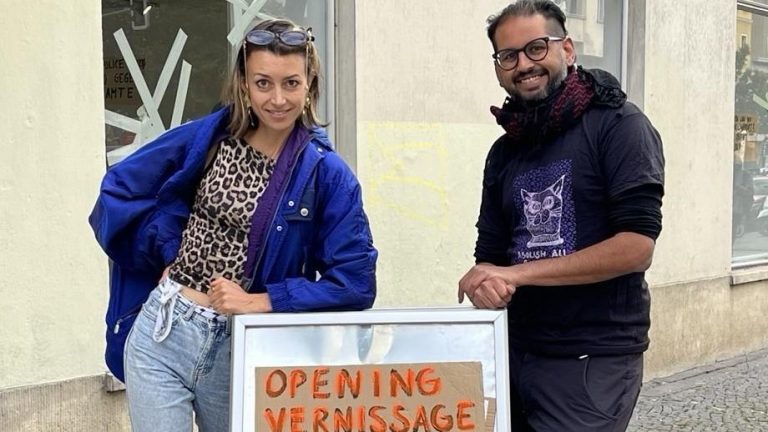
There has already been an alternate event planned at Am Flutgraben, who have very graciously offered to host it. The exhibition will not happen as an exhibition, and instead of the Vernissage, the opening, we will have a Finissage, because I will not let the Berlin Senate of Culture or Berlin or Germany close down my exhibition. I’m the only one who will be the one closing my exhibition. This is why it’s a Finnisage.
We’re doing a one day exhibition within it, with the program as originally planned. The exhibition Yallah Bye: Liad Hussein Kantorowicz Berlin Works 2010-2026 will be on display in a somewhat reduced form.
Another thing that will be in it is short performances every hour on the hour, each representing a different year of my time in the city, re-enacting a major artwork that I created that year, while also contextualizing the conditions of political repression that shaped it.
At 10pm which is the last hourly time slot, we will focus on 2026 and I will premiere my Liadland is Illegal, a part of what brought me down. This was originally supposed to be my going away party as well, and it will be. It’s the last cultural event that I’m having in the city before my departure, and I guess there’s no better way to go out with a bang.
So it’s on Sunday, in Am Flutgraben 2. What time?
It’s between 3:00 to 10:30pm.
Is there anything else that you think people can do to stand up against the repression?
First of all, holding this event is an act against political repression. It’s an act of resistance. So I invite people to join me, I invite them to share and support this case. In the face of political repression, if we have to choose between being funded by the German and Berlin government but bowing to their rules of censorship or going underground and unfunded – let’s choose the latter so that we can continue.
And what’s next for you? You’re going to Barcelona?
Yes. Going anywhere is a give and take, an exchange of one situation with pluses and minuses with another. But this one has both less of the political repression that is holding me back here, and also more sea and Mediterranean vibes that are as close as possible as I can get to my homeland of Palestine, to which I am not going back.
I’ll be happy to continue my artistic and political work in a place that can foster what I do, rather than fight against it.
Is there anything else that we haven’t covered that you want to talk about?
I did finally receive a certificate where the Consulate of Israel has made official that I have renounced my Israeli citizenship, something that I’ve done as a political act, and which we anti-Zionist Jews, can do to fight against Zionism and its relevance in the world.
That’s one more thing to celebrate on Sunday
Absolutely. Thank you for reminding me that it absolutely needs to be not just marked, but celebrated.