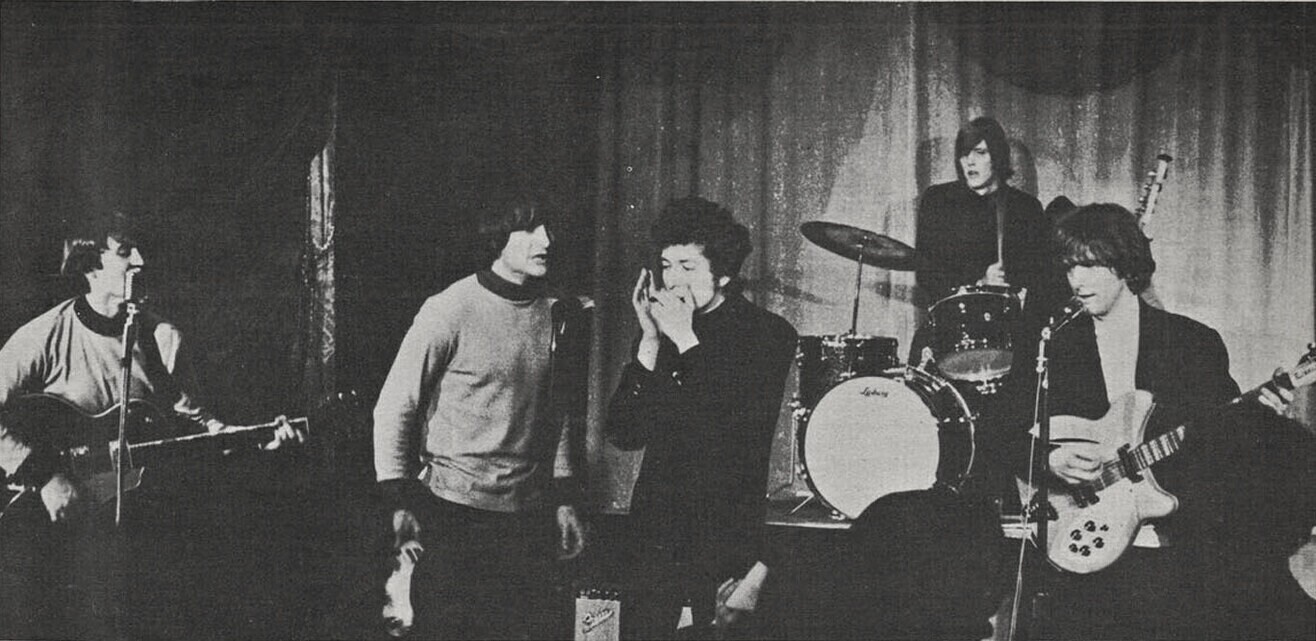
In March 1965, Bob Dylan released his fifth album, Bringing it All Back Home. The album shocked many of his fans in the folk music community. One side of the LP (remember them?) was recorded with a backing band which used electric instruments! On 20th July, Dylan released the single “Like a Rolling Stone”. Five days later, he took the stage at the Newport Folk Festival backed by an electric band. According to some reports, they were booed off. Veteran folk singer Pete Seeger allegedly took an axe to Dylan’s amp.
What has any of this to do with politics? In the first half of the 1960s, Dylan had been winning a reputation as a political singer-songwriter, and the main representative of a folk scene which championed “authenticity”. Many of his songs were certainly radical. “Masters of War” (1963) was about militarism following the Cuban Missile Crisis, “A Hard Rain’s A-Gonna Fall” (1963) attacked nuclear proliferation, and “Only a Pawn in their Game” (1964) explored how racism is used to divide working class whites and blacks.
In August 1963, Dylan played the March on Washington, where Martin Luther King made his “I have a dream” speech. He famously visited the bedside of Woody Guthrie, one of the most political musicians ever, whose guitar carried the slogan: “This machine kills fascists”. And certainly, many of Dylan’s friends—like Dave van Ronk and Suze Rotolo, Dylan’s girlfriend who appears on the cover of The Freewheelin’ Bob Dylan—were active Leftists. But Dylan was always more a fellow-traveller than an activist.
After going electric, both Dylan’s music and lyrics became more ambiguous and adventurous, which meant that he moved away from his earlier more didactic folk songs. Even then, he could still pull out a “George Jackson” (1971) or “Hurricane” (1975) when needed. Both songs were written about the imprisonment of members of the anti-racist movement with which Dylan still identified to some extent. Then again, there were the religious songs after which Dylan found God, for which there is little excuse.
By the way, many reports say that the booing at Newport was a response to bad acoustics, and Pete Seeger certainly denies that he meant to disrupt Dylan’s performance. He later released a letter saying: “No one could understand the words of ‘Maggie’s Farm’ and I clashed over to the people controlling the PA system. ‘No, this is the way they want’—They said. I shouted, ‘If I had an axe, I’d cut the cable,’ and I guess that is what got quoted.” But that’s not the main point.
Radical music often has its gatekeepers who insist that good music must have an explicit political message, and conform to a pre-defined musical style. The music which Dylan produced in the decade following Newport includes some of the greatest albums ever released and belies these prejudices. Truly radical music does not follow any rules. By doing things which have never been done before, it challenges old assumptions. This is why Dylan’s Newport performance was a breakthrough both musically and politically.