German election results this September have been shocking. The AfD got 44% of the vote in Sachsen-Anhalt – the first time a far-right party has won a state election in Germany since the Nazi era. There is a serious chance that they will become the first such party to lead a state government.
In Mecklenburg-Vorpommern, they did nearly as well, getting 38.2% of the vote. It is only by the strength of the local SPD that the AfD are kept out of government. In Niedersachsen they got 15.9% – more than 3 times as much as the previous election. In Berlin, where everyone is talking about the Linke victory, the AfD nearly doubled their vote to 16.3%.
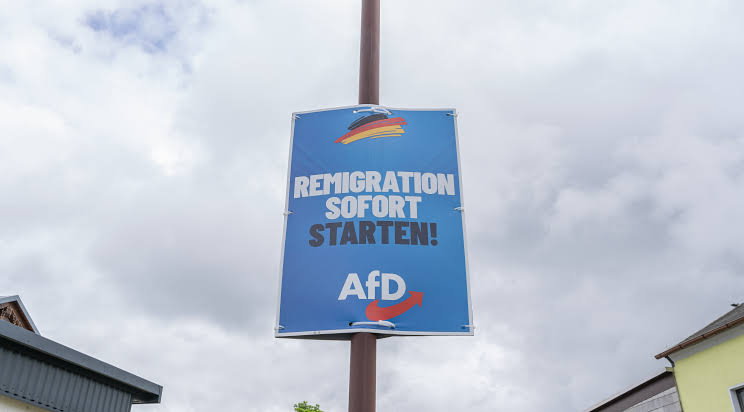
Ulrich Siegmund, the probable next president of Sachsen-Anhalt, attended the notorious Potsdam meeting in 2023, when leading AfD figures met with Identitarians and hardline Nazis to discuss Remigration – the forced deportation of millions of people. Siegmund has already promised that, if he becomes president, he will use the state’s rising military budget to enforce Remigration.
I agree with journalist Hanno Hauenstein, who argues both that the AfD is a fascist party, and that not all its voters are 100% committed to the party program. Many people are voting for the AfD as a protest vote, or because none of the other parties is offering a solution to their very real problems. This does not mean that these voters can’t radicalise further.
While none of the other parties are offering a credible alternative, the AfD is at last proposing a concrete solution – even if this solution will further bankrupt the German economy and immiserate millions.
Reasons for the AfD success
The main reason for the AfD victory is that the German economy is tanking. CDU Chancellor Friedrich Merz promised to halve the AfD vote. Instead, it is the CDU whose vote has halved while the AfD’s has doubled. Merz is now the least popular political leader in the world.
Sachsen-Anhalt is the poorest state in a country where the German economy, since 2023, has endured recession: in the words of Michael Roberts – “the longest period of economic stagnation since the fall of Hitler in 1945.” Unemployment is rising, and social services are being cut. Merz has just announced a “pension reform” which will leave people working longer.
An analysis by the Rosa-Luxemburg-Stiftung concluded: “The AfD is not only gaining ground among those who already identify as politically right-wing. It is also particularly strong among the working class, reaching those who fear social decline and tapping into a widespread sentiment—namely, that the realities of their everyday lives are largely ignored in the political sphere.”
The AfD campaigned in Sachsen-Anhalt on the need for Politikwechsel (political change), “money for Germans,” against war, and for an “East Germany identity.” As Merz threatens to introduce conscription and massively increase the military budget, the AfD – a thoroughly militaristic party – can call for peace and set itself aside from the mainstream parties.
The SPD (Sozialdemokratische Partei Deutschlands) is a Labour-like party which is in coalition with Merz. They are not seen as an alternative. The last SPD-led government was just as militaristic and pro-deportation as Merz’s. In October 2023, SPD Chancellor Olaf Scholz used the front page of Der Spiegel magazine to say, “We have to deport more people and faster”.
The Greens occasionally use radical rhetoric but they very much aspire to be a party of government. They were part of Scholz’s government, and party co-leader and foreign minister Annalena Baerbock also called for increased deportations. The two most militaristic German foreign ministers since the Second World War – Baerbock and Joschka Fischer – were both members of the Green party.
The political Left
This leaves us with the political left. Nearly three years ago, Sahra Wagenknecht departed the Left party, Die Linke, to form the Bündnis Sahra Wagenknecht (BSW). Wagenknecht is one of the best known figures on the left, and a regular chatshow guest. She is both anti-militarist and socially conservative. Around the formation of a government in Sachsen-Anhalt, BSW has said that they will abstain, which could be enough to hand the AfD power.
Wagenknecht has regularly opposed trans rights, and – following a knife attack in Solingen – attacked “ten years of uncontrolled migration.” Nonetheless, unlike die Linke, the BSW has an identifiable pro-Palestine position and is against the war drive. This alone has led some Palestinian friends of mine to support them.
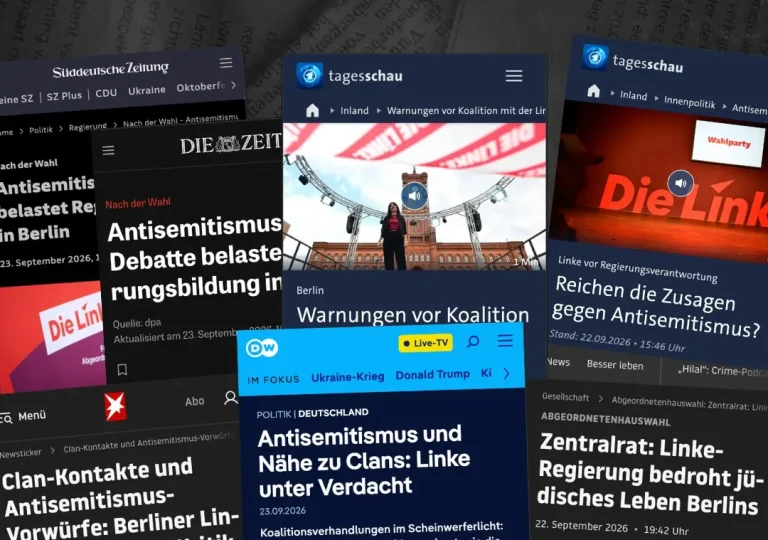
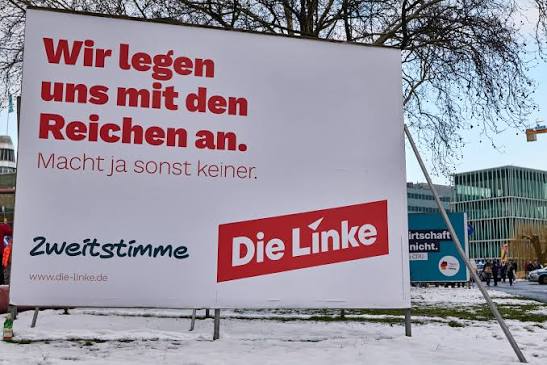
Die Linke is caught in a bind between wanting to support social movements, but wanting even more to win elections. After organising an election concert in Berlin–where a hip-hop artistcalled out “Death, death, to the IDF”, and “Yallah, yallah, Intifada”– party leaders, including mayoral candidate Elif Eralp, immediately denounced the rapper.
In the run up to the election, there was a massive campaign from the media and bourgeois parties against so-called “left wing antisemitism.” The Tagespiegel reported on the possible expulsion of Palestine activist Hannah Bruns. After accusations of being “close to criminal clans” – itself a racist trope – Ferat Kocak, the most identifiable left-wing MP, was forced to suspend his parliamentary activities.
This continuing contradiction between radicalism and trying to please potential coalition parties damages Die Linke’s claim to be an anti-establishment party and opens space for the AfD.
Is Eastern Germany different?
Die Linke is the successor party to the SED (Sozialistische Einheitspartei Deutschlands), which ruled Eastern Germany as a “socialist” party-state for forty years. Many disappointed voters in the East cannot vote for a party which they see as very much part of the political establishment.
Carolin Würfel, a journalist from Eastern Germany, pointed out in the Guardian that the AfD’s leadership is largely from the West. She notes: “It’s also worth asking whether a party like the AfD went east only because east Germans are more susceptible – or because the visible inequalities there are excellent material to organise around.”
There are some reasons why eastern Germany is different, but this is mainly because of the almost total destruction of most East German industry after the Berlin Wall came down. Two million jobs were lost in 1989-90. In the contemporary East, unemployment is now much higher and there is much less hope.
But remember, the AfD is not just enjoying success in the East. At last year’s general election they got at least 15% of the vote in every Western state but one.
AfD street fighters
I have said that the AfD is a fascist party. But it still does not have a coherent body of street fighters. Instead it has followed a similar strategy to Rassemblement National in France, first building up electoral respectability.
This does not mean that the AfD has no street fighters to call on. It partially emerged from PEGIDA, which was launched in 2014 and was able to organise large demonstrations against Syrian refugees. PEGIDA was more explicitly Nazi – its founder Lutz Bachmann was forced to stand down after pictures were released of him dressed as Hitler.
Although PEGIDA was not an AfD organisation, they had a significant overlap of members. More recently, there has been a rapid increase of Nazi attacks on CSDs (Christopher Street Days), the German equivalent of Pride, and there are definitely places where it is not safe to go out at night as a non-white passing person, although Nazi street fight elements remain relatively isolated.
Electoral opposition to the AfD
I’d like to look at three strategies being employed to try and stop the AfD – an electoral strategy, a ban, and street mobilisations.
The electoral strategy seems the most common sense of these. The AfD is doing well in elections, surely the best way to stop them is to offer something better? This does not always lead to progressive results. As the AfD has been gaining support through racism, the main parties have tried to offer better racism. Scholz and Baerbock’s policy of mass deportations has been eagerly continued by Merz.
All this has achieved is to move the Overton window – the terms of debate – to the right, and to justify the AfD’s racist claims that the real problem is migrants, not failing capitalism. And as French fascist Jean Marie le Pen used to say: people prefer the original to the copy.
A second electoral strategy is that of the Brandmauer, also known as the cordon sanitaire, or firewall. On one level, this strategy makes perfect sense. The AfD is not a normal political party. It is a fascist party, with which we should not attempt to debate or negotiate to join in government. It is important to politically isolate the AfD.
But the electoral side of this strategy has led to calls for a broad alliance of all parties forming a coalition government to keep the AfD out of office. Over a year ago, Die Linke Leader in Thüringen, Bodo Ramelow, was calling for an electoral alliance with the CDU. This would just strengthen the AfD’s identity as an anti-establishment party.
The BSW, the Wagenknecht Party, absolutely rejects the firewall. So much so that in Sachsen-Anhalt they campaigned on breaking the firewall, saying that the main enemy is the CDU. This strategy is even more catastrophic than the firewall, and only serves to normalise the AfD.
AfD Ban?
Another strategy which is being hotly debated is that of banning the AfD. A common argument against state bans is that they demobilise street activity by telling people to wait at home for the court to decide. In this particular case, things are more complicated. In the short term at least, there have already been several demonstrations calling for a ban.
Nonetheless, in the longer term a campaign for a ban could have a demobilising effect. A court process to ban the AfD will take years and surely lead to calls to us to stay off the streets while the judges do their work.
Besides which, asking the state to ban political parties is playing with fire. Germany has a precedent here. In 1952, the SRP – successor to Hitler’s NSDAP – was banned by the Bonn government of West Germany. Four years later, the same government banned the Communist Party.
Finally, the AfD has won much of its credibility by claiming to be an anti-establishment party. When all the other parties gang together to ban a party which is running at over 20% in the polls, this is just asking them to mobilise their base and to drag them into more violent activity.
Opposition on the streets
The final strategy, and one which is central to any fight against the AfD, is street mobilisations. This has been happening, but not consistently. In 2024, shortly before the elections, when reports came out of the Remigration conference, 300,000 demonstrated in Berlin, and 180,000 in Hamburg. However, there were few serious mobilisations after the elections.
More militant actions aimed at preventing AfD conferences from happening, have also mobilised tens of thousands. These were impressive turnouts, but not enough to break through police lines, and now these blockades have started to lose the power of surprise.
There has been a further wave of demonstrations around the Sachsen-Anhalt election. 15,000 demonstrated in Magdeburg on the day before the election. On the weekend after the election, 100,000 demonstrated throughout Sachsen-Anhalt. Again, these are not alone big enough to topple the AfD, but are hopefully the sign of something bigger.
On 26th September, the DGB – the German TUC – has call a number of demonstrations against cuts. It remains to be seen how big these demos will be, and how serious the unions will mobilise, but once more this is an opportunity for socialists both to marginalise the AfD fascists, and to pose an alternative to the austerity politics which have enabled them to grow.
The fight against the AfD is not over. We need to follow a double strategy of offering a credible answer to the crisis – an answer of militancy and solidarity – combined with confrontation with the street Nazis who have been enthused by the AfD’s electoral victories. The time to fight is now. No pasarán!