Hi Hanno, thanks for talking to us. Most of our readers probably know who you are, but for those who don’t, can you briefly introduce yourself?
Thanks for inviting me. I’m an independent journalist and writer. I’m currently writing a book on German memory culture, and I work in politics and on culture. I also host a podcast called Nullpunkt – and a Substack newsletter under the same name.
Today we want to talk about the recent elections, particularly in Berlin. Berlin has voted. Should we be celebrating?
I do think that this is a special moment. It’s a historic win for Die Linke, and very much a “fuck you” to the politics of extreme policing on the streets of the Berlin; especially for marginalized groups. What we’ve seen these past three years is a CDU-led government that has engaged countless debates over so-called “problem districts”, swimming pools, Silvester riots – all of which with eerily racist undertones.
Besides, prices in the city are going up everywhere. From my personal experience, but also from my research, I think everyone shares this feeling: That the city is less affordable. That it is pretty much impossible to find an apartment. In the 2000s and 2010s there was a promise of Berlin being ‘poor, but sexy’ – a capital where things are possible that are no longer possible in other big cities around the world. That promise is fading.
People want a different politics – and Die Linke’s win reflects that sentiment. I think they were the only party that successfully managed to capitalize on that general feeling, with a very fierce grassroots Mamdani-style door-knocking campaign, with a clear understanding of how social media works, and with a different vision than that offered by the liberal centre.
Central to the Linke campaign was Enteignen—the expropriation of the big landlords. They now look set to form a government with the SPD who are very much against Enteignen. What are the chances that the big landlords now will be expropriated?
This is really the core question that you’re touching on here, Phil. The SPD has signaled opposition to expropriation. They are suggesting a more reformistic approach. But the SPD also has little leverage now. It’s lost so much that it isn’t really clear if the SPD would be the driving factor in this likely to come Red Green Red coalition.
Die Linke is facing a challenge with expropriation now too, though; because they need to find a way to secure power, but also not simply turn into an administrator-type party like the ones they were mobilizing and organizing against these past few months. They have to fulfil their promise of expropriation – or, to be more precise, socialisation. That was, after all, the core promise of the entire campaign.
If they don’t, that could lead to them losing trust from the people who kept their momentum going and made this big win possible. I think that’s a core challenge for die Linke—how to force the other parties into making concessions to go through with the expropriation plan. The Greens have signaled that they are open to it, so I’m personally hopeful it’ll happen.
At the same time, yesterday Merz announced federal legislation against expropriation. There is a lot of resistance before the new Berlin government has even formed. It really feels like the CDU has become somewhat of a lobby group for housing giants. But there’s a practical question, as well: how do you do it, concretely? Where will the money come from? Any new Berlin government will inherit a budget in minus. There are models for how to implement it – like taking a vast amount of credit and refinancing it through rent.
Die Linke has a second problem, which is the Schuldenbremse—the debt brake—which means that Germany is not in a good financial state, and regional governments have got increasingly less money. This means that die Linke is going to have to manage failing capitalism. How can it deal with that?
Merz has shown on a federal level that the debt brake is stretchable when it comes to rearmament, militarization, weapons for Ukraine and so on. I think it’s ultimately a question of political will. There is a way in which we are now going beyond the debt brake orthodoxy. Die Linke has political leverage. They need to find a way to successfully make the point that this is a topic important enough to go against the economic orthodoxy of the past few years.
Mamdani’s reforms were helped by a very vibrant housing movement in New York. What’s the role of social movements in helping Die Linke fulfil their promises? Housing demos are not as big as they used to be, but the trade unions have called a demo on Saturday.
I think that these movements are crucial in order to keep the pressure up and push the topic further. If you look at Deutsche Wohnen & Co Enteignen, this is a case in point for why independent organising is so central. DWE didn’t necessarily grow out of the party. It came from the margins. People need to understand that this is an issue that is not just in the hands of one party, not just of an upcoming administration. This is something that comes from the bottom up and that affects everybody in the city.
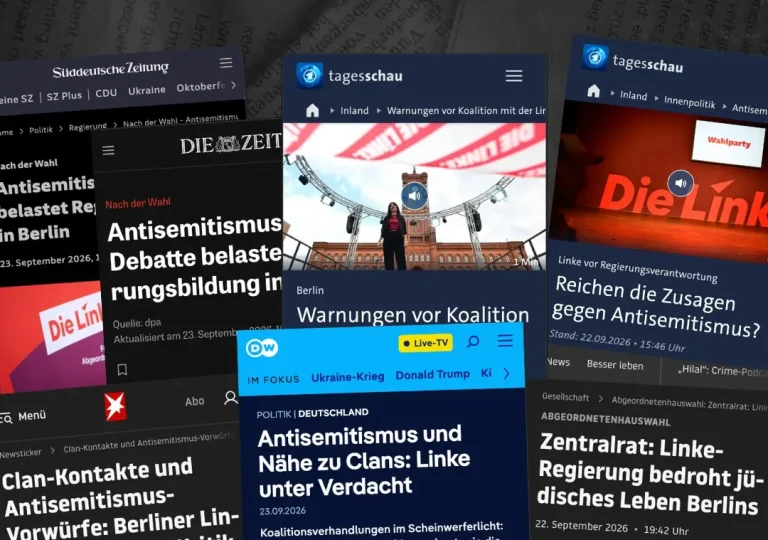
Could we move on to the media coverage of the election? You’ve posted about accusations of antisemitism in the run-up to the election. This has continued with talk about die Linke supporting “criminal clans”, which is itself a racist term. And there was an article in the Spiegel saying Jews are no longer safe in Berlin. Who is doing this and why?
What we’re seeing after this win of die Linke—and in many ways before, as well—is an exacerbation of a tendency that we’ve seen over the past years, specifically after October 7 and the genocide in Gaza. Accusations of antisemitism are focusing on the Left instead of the Right, even though you won’t find a statistic that supports this emphasis. It’s not a new discussion, and it hinges on a specific interpretation of antisemitism which tends to conflate it with accusing the Israeli government of war crimes or genocide – as die Linke does; or of criticizing Israel in a more fundamental way, as anti-Zionists do.
I think we’ve seen somewhat of a meltdown over this in the past few days. To me, it seems to be the joker card that some of the centrist and right-wing parties are playing in order to delegitimize the left and forgo the expropriation issue. I’m not saying that antisemitism cannot exist in the left party – or in left movements. Antisemitism is a ubiquitous phenomenon that exists everywhere in society, and it should be confronted and addressed when it emerges. But I think it’s also clear that many of these current ongoing accusations against the party are not based in truth or fact.
The concrete examples that are discussed are a rapper chanting “death to the IDF” at a campaigning event and an alleged clan leader showing up at a die Linke event (he was asked to leave shortly thereafter). To me these seem like fringe phenomena. Whether or not one can call them antisemitic, I highly doubt that.
One should discuss these issues. But the fact that these are then taken as evidence for assessing that the entire party has an issue with antisemitism? Why aren’t we talking about the fact that the last CDU government embezzled very large sums of money for antisemitism prevention to highly dubious actors, some of whom are spreading conspiratorial thinking?
Why aren’t we speaking about the AfD, whose chairwoman just a few days ago reiterated her absurdly revisionist claim that Hitler was a communist? Why don’t we talk about Alexander Gauland, the AfD’s honorary leader, who regularly writes antisemitic articles? We’re politicizing antisemitism to the point that no one takes it seriously anymore. I am not Jewish, but I certainly don’t think this trend is good for Jews.
Die Berlin Linke is not going to free Palestine, but are there measures that you think it can and will make in terms of, for example, the policing of Palestine demos in Berlin?
I’m generally not a big fan of the police, but I know that there are ways in which police can de-escalate if they want to. As a journalist, I have looked extensively at videos of police violence in Berlin over the past three years. I’ve also witnessed it in demos I covered. It has been absolutely shocking. I’ve seen German riot police act out in ways that should concern everybody in this country, not just the pro-Palestine left, which I like to call the anti-genocide left.
I think it should be a priority for this new Berlin government to make sure something like this doesn’t continue to happen. People should be able to exercise democratic rights without being beaten up in the streets.
There weren’t just elections in Berlin this week. There were also elections in Mecklenburg-Vorpommern, where the AfD was scarily successful. Even in Berlin they nearly doubled their vote. How big a threat is the AfD?
The AfD a fascist party, and it has just won two states—Saxony Anhalt and Mecklenburg. It won’t be able to form a coalition in Mecklenburg-Vorpommern since the SPD under Manuela Schwesig was pretty strong there, as well. But in Saxony-Anhalt it could still happen. That would give them a lot of leverage, especially in areas like police and education. This would be the first time since the Holocaust for an outspokenly and explicitly far-right party to potentially run one of Germany’s states. This could have a lot of damaging effects, especially in education – if, say, they de-emphasize the Holocaust in schools curricula.
Similarly, they campaigned against inclusion of people with disabilities in schools, which really has eerie resonances with the eugenicist legacy of the Nazis. Dagmar Herzog has written about this extensively. How it connects to the intelligence fetish of fascist movements around the world. These are things I personally am quite terrified about. I’m just hoping that there will be ways in which people can organize to help marginalized people in these areas of Germany.
Assuming the AfD comes to power in Sachsen-Anhalt, it is clear that there will be things that it can implement concretely. But I’m also terrified it will just embolden more violence. I’m thinking of scenarios like Mölln and Solingen—attacks on refugee homes. That’s something we’re likely to see more of, which is obviously quite terrifying.
At the same time, although there’s a growing amount of racism in Germany, I don’t think that all the 44% who voted for the AfD in Sachsen-Anhalt are 100% committed to the party program. People in these states also feel frustrated with centrist parties, with their foreign policy, their policies on pension and on healthcare, and more concretely with Friedrich Merz. There is a lack of political vision on the part of the centrist parties, which have increasingly defined themselves through the Brandmauer, the firewall, to the AfD. That’s pretty much everything they have to offer. And when it comes to migration, their policies often just end up looking like a watered-down version of what the AfD is proposing already.
As part of the Brandmauer, we’ve heard people like Bodo Ramelow from die Linke in Thüringen saying that the threat of the AfD reaching parliament is so great that we need electoral alliances by everyone from the Linke to the CDU. What do you think of this strategy?
I don’t think it’s a good strategy at all. The Brandmauer should mean refusing cooperation with the AfD – not erasing political differences between parties that are opposed on issues like the economy, migration and so on. I think an electoral alliance between the Left and the CDU would confuse voters further about what these parties actually stand for. It reinforces the idea that the AfD is the only genuine alternative. I think die Linke would do well by organizing political momentum. In a way, Berlin was a case in point in how to go about that.