We live in an age of ingredient obsession, where labels are read like confessionals and the exact origin of what we consume becomes shorthand for responsibility and wellbeing. “Organic”, “unprocessed”, “corn-fed”, “free-range” and “farm-to-table” are everyday aspirations in parts of society privileged enough to find morality on the supermarket shelf. Oils are ranked, grams are counted, transparency is requested at every stage, and for some the small print on packaging becomes more important than the price tag.
But when we don’t feel like cooking, we open an app and order dinner from a system built to keep its own less-than-palatable “ingredients” off the receipt. The small print that would, if it existed, mention extremely inhumane working conditions, social security fraud, risk pushed onto workers and customers, and a subcontracting business model that prizes entrepreneurial “freedom” over the people who prop it up.
How the subcontracting model works
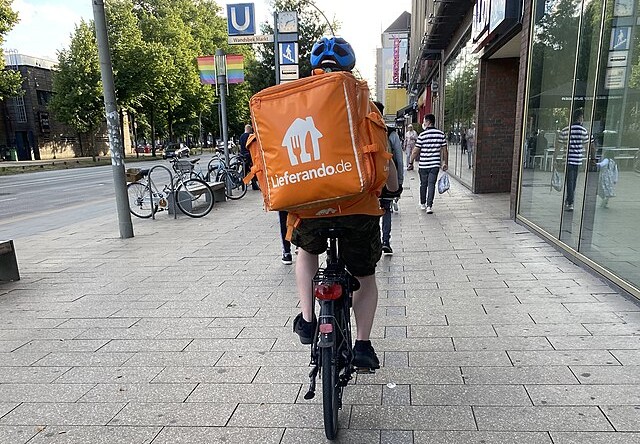
In Germany’s food delivery sector, this is a structure which companies such as Wolt, Uber Eats and Lieferando have increasingly shifted toward. Lieferando was long considered a shining example in the industry, with the majority of its drivers directly employed by the company and having works councils in place. However, last year they announced plans to lay off 2,000 couriers.
When this happens, permanent contracts are phased out, the directly employed riders are let go, and the delivery work is outsourced to external fleets that appear days later offering the same jobs back, only now with fewer rights, lower wages, and little in the way of insurance or sick pay. On paper, the employer has changed, but on the street everything looks identical. It’s a murky world, even for Lieferando’s high-vis orange branding.
Once riders are in the subcontracting maze, they report to a so-called fleet manager who—despite being their de facto boss—offers no contract, insurance, or security. More often than not, it’s just a WhatsApp number, a delivery app login, and the hope they don’t block you or disappear before payday. If they do, you have no proof you ever worked, only the absurd risk of being fined (or worse, deported) for unauthorized employment you never got to choose. Meanwhile, the multibillion-euro platform that actually directs your labour shrugs and points at the subcontractor, who points at the fleet manager, who’s likely pointing at the departures timetable in the nearest airport.
“They call it subcontracting, but it’s not,” says Lieferando Works Council (LWC) leader Samee Ullah. “We’re just pushed into the hands of middlemen so they can make money. In Germany a subcontractor usually gives you instructions for the job. Here the instructions still come from Lieferando or Uber Eats but employment rights and protections disappear.”
The extra ingredients in your food order
Trying to understand any business model that relies on legal loopholes to exist can feel complex and labyrinthine—which, of course, is the point. To help unpack it, we’ve highlighted the things everyone should be aware of before tapping “order now”.
Here are the extra ingredients in your delivery that don’t appear on the receipt.
1. Conditions of forced labor
The delivery apps sell a story of flexible side hustles and entrepreneurial freedom. What they actually rely on is a workforce that can’t afford to walk away.
In Germany, most of the riders aren’t hobby cyclists topping up a comfortable income. They’re migrant workers and international students whose right to be in the country is tied to a fragile combination of paperwork and payments.
Increasingly drawn here by aggressive marketing promises of affordable education and high-paying tech jobs, many have to open a “blocked account” and deposit €12,000–14,000 before they even land. By the time they’re riding through winter traffic, they’re already in the red.
Add to that the cost of cramped, overpriced rooms, private university fees, and limited access to other legal employment, and the fear of falling behind is never far away. If riders default on tuition or fail to prove sufficient income, they don’t just receive a stern email from a bank—they risk losing their student status, their visa, and their legal right to remain in the country.
This is not a labor market where people can weigh up offers and choose the best one—it’s a trap in which saying “no” can mean homelessness, debt collectors, or worse, deportation. So, when your food arrives a few minutes early, it may well have been carried by someone riding not just against the clock, but against a countdown built into their passport and bank account.
2. Theft from the social state
If a restaurant failed to pay VAT, we’d call it tax fraud. When delivery platforms and their fleets hollow out entire sections of the welfare state, it’s called innovation.
Germany’s social safety net—health insurance, pensions, unemployment benefits, and paid leave—depends on employer contributions tied to formal employment. But in the subcontracting world of the delivery sector, large platforms are allowed to step delicately around many of these obligations.
Riders are reclassified as “self‑employed”, pushed onto the books of the aforementioned small fleets, and hired under “contracts” that amount to little more than WhatsApp or Telegram messages.
The end result is simple: less money goes into the collective pot. Health insurance funds are deprived of contributions, pension systems lose out on payments, and accident insurance is left to pick up the bill when a rider is hit by a car. These costs don’t disappear, they’re pushed onto the public.
And then, when the numbers don’t add up, the same racist politicians who cheered on entrepreneurial freedom turn around and blame migrants for stretching the system.
3. Delivering while sick
When it comes to food and eating out, we’ve every right to be concerned about potential contaminants. We expect regulators to keep salmonella, listeria and mold at bay. If a kitchen cuts corners, we talk about hygiene scandals and public health.
In a normal employment relationship, health and safety laws are meant to guarantee that people don’t have to work while they’re ill—that they can stay home with pay and not gamble their rent on a blocked nose and a fever. In the subcontracting world, these protections are non-existent, because riders are hired through opaque fleets and middlemen who think of sick pay and workplace safety as little more than a fantasy.
For customers, that means something very simple: there’s no real guarantee that the person bringing your food could afford to stay home when they’re ill. If they have a temperature, a bad cough, or a stomach bug, they almost certainly ride anyway because not riding might mean not eating, not paying tuition, or not meeting the conditions of a visa.
4. Risk for profit
Delivery apps like to describe themselves as neutral intermediaries. They don’t own the kitchens, they don’t own the restaurants, and crucially, they don’t even own the bikes. This absence isn’t an accident—it’s by design.
Everywhere you look in the delivery chain, risk is pushed downwards. Riders are expected to rent or buy their own e‑bikes, often paying around €150 a month just to keep the wheels turning. An e‑bike becomes a depreciating asset workers can’t really afford but have to shoulder if they want the job. If the bike is stolen or if the battery disappears while they’re running up four flights of stairs to drop off a pizza, that’s their loss.
And once bike rental and equipment costs are factored in, many riders report that their effective earnings fall close to—or even below—Germany’s statutory minimum wage, despite the promises of competitive pay.
Even the act of charging a battery becomes an unpaid hazard. Sometimes they just get warm and buzz, but other times they explode into flames and turn a shared flat into a blackened shell. No push notification pops up from the app to say: “By the way, one of our riders lost everything last night so that you could get your burger on time.”
When accidents happen—crashes, fires, long‑term injuries—the costs fall either on the individual or on the public services that patch them back together. The platforms that orchestrate the work keep their hands clean and their balance sheets light. Everything that might go wrong is quietly billed to someone else.
5. Speed over safety
Food delivery lives and dies on the promise of speed. This urgency is marketed as convenience but in reality it’s backed up by a systematic refusal to invest in safety. Many riders have been in Germany for only a few weeks or months but are legally allowed to drive or ride on licences from countries with completely different traffic patterns. Instead of training, the companies provide little more than a branded jacket and an app login.
For Aju John, a Berlin-based lawyer and researcher who’s supported delivery riders in legal disputes, that combination is not accidental—it concentrates the risk on those least equipped to carry it.
“This is a job that even those with no experience are easily able to get into. They are especially attractive for those whose previous work experience and education are not valued in the German job market. Even those with no experience of the circumstances on German roads. Neither the fleet partner nor the platform corporations provide them with any training. In the first six months of your stay here, you are actually allowed to use an Indian driving license to drive around in Germany, and deliver for such companies. These are completely different driving circumstances. And who bears the risk of a traffic violation or an accident happening at that time? It’s either the worker or the state, rarely the corporation that is profiting off this risk.”
The last ingredient in your takeaway is not just someone rushing through the rain. It’s a system in which other people’s safety is routinely traded for speed and convenience.
So what can we do?
The point of all this isn’t to say “never order food again” and cut people off from one of the few income sources available to them. But if you care about what’s in your food, it’s time to care about the labour architecture that gets it to the door. There are a few concrete things we can all do to help:
1. Back the riders’ petition and follow LWC.
Lieferando’s Works Council is working on a petition demanding that the company halt outsourcing plans, protect existing jobs, and commit to direct employment with full social insurance contributions and enforceable labour rights.
Add your name to their contact form here to get the petition emailed directly to you once it’s ready. For more information on the Lieferando workers fight, please follow and contact the group through here.
2. Practice everyday solidarity.
If you order, tip generously and in cash. It’s one of the few ways to get money directly to riders without a cut being taken on the way.
3. Support the broader fight against subcontracting with UAS.
United Against Subcontracting is a collective of workers organizing to improve the conditions for precarious workers in Berlin and across Germany. Follow them here.
Survival as a business model
It’s common to call standing shoulder to shoulder on a crowded platform, or waiting for a rush-hour train to a secure job, the “rat race.” If that is our benchmark for stress, what do we call the race delivery workers are expected to run?
This isn’t about people who arrive in Germany being naïve or unaware, as part of the press would have you believe. It’s not a story about poor personal choices. It’s about a system that concentrates the risks at the bottom, strips away stability, and then treats the outcome as personal responsibility. Please sign the petition, tip well, and enjoy your meal!
The article was modified on March 11 to update the status of the LWC petition.