You can read the first part of this report here
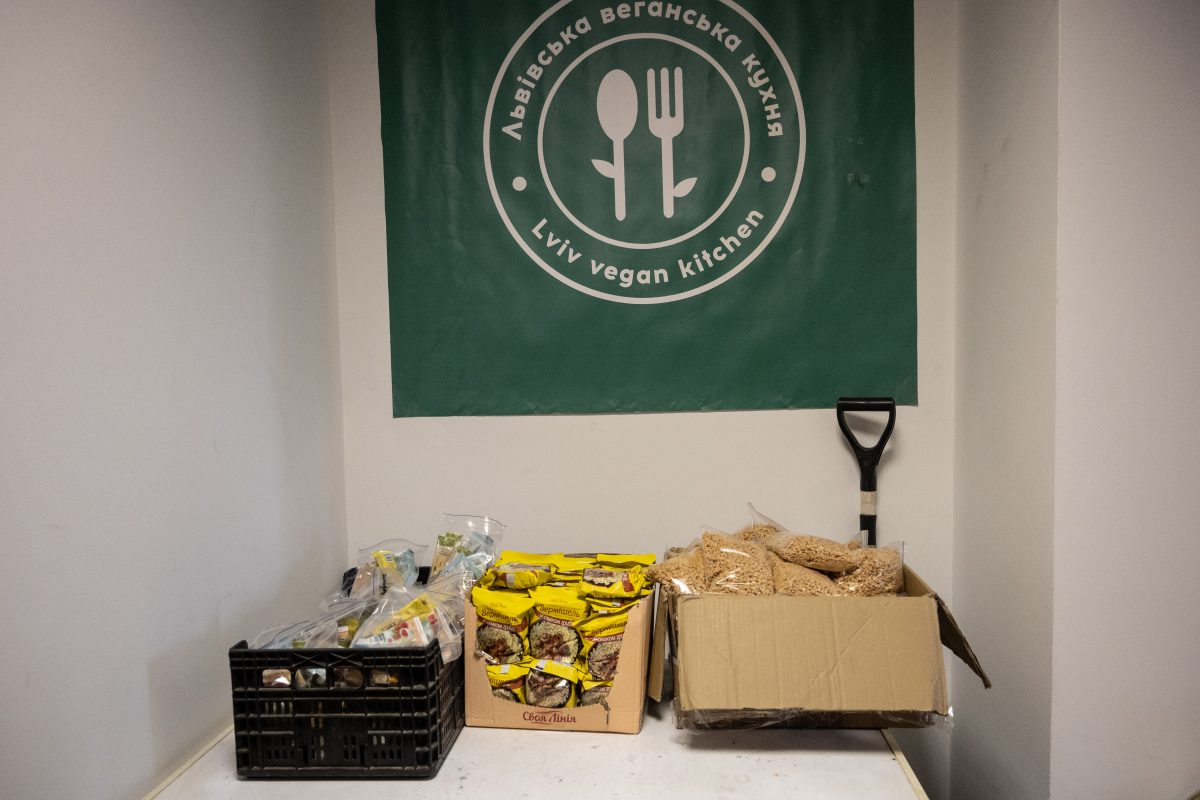
Our next stop is in Lviv, where Shelter from the Lviv Vegan Kitchen opens his doors to us.
Shelter is a vegan activist, food relief enthusiast and volunteer army combatant. Right after the beginning of the full-scale invasion, he joined a territorial defense unit, but after a couple of months, he returned to Lviv to become a vital part of Lviv Vegan Kitchen collective. At the same time, Shelter is now serving on rotation basis in a voluntary artillery unit. One reason to join a voluntary unit was also to have bigger freedom of choice where to go and what to do.
In wartime, people find their own ways to help — their own spaces where they can feel they’re contributing something. For the crew behind Lviv Vegan Kitchen, that space is food. The collective formed in the early days of the full-scale invasion in 2022, when thousands of refugees were fleeing west. They decided to cook for them, funding everything entirely through donations.
Until June 2024, the kitchen served up to 500 hot meals a day to internally displaced people. When donations ran dry, that part of their work had to stop — but the collective didn’t. They realized there was another gap to fill: food for vegans on the frontline. Military rations provided by government are not vegan and in case there is a kitchen in the unit, meat or cheese are being mixed in the dishes so there is no vegan option.
So the kitchen started to cook, bake and send packages to the front – falafel, seitan, syrniki (Ukrainian curd pancakes), cookies, and other durable vegan meals that can survive long journeys and rough conditions. They even came up with their own protein bar recipe, which, according to soldiers, is a huge hit.
We visit their storage space. It’s DIY, improvised, and full of heart: shelves stacked with carefully labeled bags and boxes, a chest full of vacuum-packed seitan and falafel. Everything run with surprising order and precision. Here, Shelter prepares the packages with vegan ready-made food but also fills zip bags with basic spices, makes sets of instant soups and tomato paste, weighs out yeast flakes and soy granules; so soldiers have everything to prepare themselves a decent vegan meal. To receive a package from Lviv Vegan Kitchen, they only need to fill out an online form — and somewhere along the supply line, one of Shelter’s packages will find its way to them.
Learn more about Lviv Vegan Kitchen: www.lvivvegankitchen.com
You can support them with donations here: telegra.ph/How-to-donate–YAk-zadonatiti-06-13
On the long drive to Kyiv, we download mobile apps that send alerts about air raids. Not long into the drive, our phones start buzzing and wailing one after another. Air raid alert for Kyiv. Air raid alert for Sumy region. The app politely advises us to “find the nearest shelter and stay calm.”
By the time we roll into Kyiv, the city of nearly three million feels strangely calm. Public transport stops at 10 p.m., metro stations close soon after, and by midnight the curfew empties the streets.
The next day, we meet two members of the Student Union Priama Diia, which translates as Direct Action. One has long curly hair tied back in a ponytail and wears a sweater that reads NO PHOTO. The other, with a shaved head and dangling earrings, smiles as they wave us over at the metro station. Across the street, we see a factory, which is bombed on a regular basis, without glass in the windows.
As we walk together through the neighborhood, we pass another burnt-out building. But around it, life moves on — people heading to work, carrying groceries, chatting at market stalls. In spite of the ongoing war, Kyiv is very much alive.
We arrive at a self-organized space inside the art university. The room feels full of care — they invite us to sit on DIY sofas made from wooden pallets, covered with a colorful crocheted blanket, next to a small bookshelf stacked with zines and books. Abstract geometric paintings hang on the walls, and smaller pieces are displayed on minimalist shelves. It feels like a living room gallery or a social center.
The student union Priama Diia has been around since the early nineties, passing through several generations of activists, ceasing to exist just to be reborn after some years. The two members tell us how, in 2023 — a few months after the start of the full-scale invasion — they began rebuilding the union from just three people. They saw how urgently students needed a voice, especially in the time of war. Now there are around 300 members across different cities in Ukraine.
Their work ranges from fighting scholarship cuts and dormitory evictions to confronting psychological abuse and power imbalances from teachers. They push to make education fair and accessible — “for the benefit of students, not the deep pockets of the one percent,” as they put it. They organize events, protests, and publish zines about how students live and find strength for activism during the war.
For the union, education isn’t a privilege or a commodity. It should be free and accessible for all. It should be anti-capitalist. They see the student struggle as part of the wider labor movement — not just a fight for better study conditions, but part of the broader struggle for human liberation.
You can learn more about Direct Action Student Union here: www.priama-diia.org
In the afternoon, we meet several activists in the office of Solidarity Collectives. Above us hang anarcho-feminist and antifascist flags; on a shelf a painted portrait of the Russian anarchist Dmitry Petrov who died in 2023 in Bachmut fighting Russian imperialism; on the floor, a few paintings by the Ukrainian anarchist artist David Chichkan, who was killed in 2025 at the frontline. One shows three soldiers with anarcho-feminist and anarcho-syndicalist flags on their uniforms — small emblems on their chests and sleeves. Behind them stretch white clouds across a blue sky, and within the clouds, a faint portrait of Nestor Makhno, as if the sky is mirroring an inspiration of the current struggles.
Then we meet Mykola from Solidarity Collectives — yellow curls, small silver earrings across the earlobe, a retro jogging jacket that would fit right into Berlin, and black cargo pants. He looks tired, smoking hand-rolled tobacco.
The collective consists of anti-authoritarians who came together when Russia’s full-scale invasion began. They support anti-authoritarian comrades fighting on the frontline and those affected by the war — providing humanitarian aid, building FPV drones, and support animal rescue.
Mykola tells us about the endless rotation of volunteers, a too small group of active people, how everyone is tired. At the start of the invasion, he worked in humanitarian aid, driving to bombed-out villages in the east to bring materials and help displaced people rebuild their homes. One day, he returned to find those same houses reduced to rubble again, their inhabitants once more forced to flee. The futility of Sisyphus work hit him hard. Now, he builds drones for anti-authoritarian soldiers at the front.
You can learn more about Solidarity Collectives here: www.solidaritycollectives.org/en
What connects all the collectives we meet today is a deep exhaustion. After nearly four years of war, burnout has become one of their biggest challenges. There’s always another crisis, another person who needs help. No time to rest after their work and activism. Yet through all the fatigue, they remain kind and patient — their smiles sometimes delayed, but genuine when they arrive.
Suddenly, a power outage. These happen often now and are increasing due to the Russian attacks on Ukraine’s energy infrastructure. Sometimes they’re planned, sometimes not. Local energy suppliers or the municipality provide tables of planned outages on their websites or Telegram channels, so people can get prepared.
For the night following our meeting at Solidarity Collective’s office, a massive air attack is expected. Telegram channels fill with warnings. Locals seem unfazed: “Air alerts happen every day,” they say, “you can’t live in a shelter forever.”
Around 1 a.m., one of the comrades wakes us. We quietly gather our things, step into the cold, and head to a nearby garage serving as a makeshift shelter. We spread our mats behind parked SUVs, slip into our sleeping bags, and listen to the sirens and the distant rumbling of air defense. Or is it someone snoring, and we’re making it up? A family with small dogs passes by, carrying their own camping things. We spend the night there.
By morning, we learn it was one of the biggest aerial attacks since the start of the war — over 700 projectiles, among them drones, cruise missiles, and decoys raining across the country. We open a picture of visualized attacks through this night, and the whole map of Ukraine flares: Strike UAVs “Geran-2/Harpyia,” cruise, ballistic, and air-launched ballistic missiles — “Kh-101, Iskander-K, Kalibr,” “Iskander-M,” and “Kinzhal”, decoy drones identified as “Gerbera.”
Some of us look up the military terms online, still unsure what they are and what they mean. The official statements say Russia is targeting energy infrastructure and “military objects,” but factories, homes, and civilians are hit just the same.
In the evening, we take the metro to Podil, a vibrant neighborhood in Kyiv. Someone needs a bathroom, and a comrade tells us you can ask anywhere in Ukraine for water or a toilet — no one will refuse or demand payment. Climbing a hill where local activists planted a tree in memory of Dima Petrov, an anarchist killed in this war, it’s already dark, and we stumble through the night until we find the tree. From the top, Kyiv unfolds before us — huge and glowing. You can see the left bank too, and the bright spinning lights of the Ferris wheel. Then, an air alert siren cuts through the air. Phones buzz with notifications. Someone checks the attack map, but a comrade from Kyiv reassures us: “They don’t target places like this. Don’t worry.”
We head downhill. Podil feels a bit like Dresden’s Neustadt — backyard raves, student bars, late-night shops, gay clubs, beautiful facades. The people look great, confident; even here, some wear puppy masks. A few streets further, it feels like an industrial zone.
We wanted to see how young people live here. Someone asks Iryna from Feminist Lodge what the clubs in Kyiv are like. She smiles, writes down a few names, and says: “They’re good, but the best raves are in Kharkiv. People there party differently. They’re so close to death that they’re more alive.”
Suddenly, another power outage occurs. The neighborhood goes dark. Convenience stores and bars turn on their generators. It’s loud, dark, and smells of gasoline — but life goes on.
On the following evening, our group meets Kateryna who runs an anarchist library that currently exists only online. We meet at her former flat where the books are stored right now. She can’t live here anymore as the neighborhood keeps getting attacked from the air. “It’s too stressful,” she remarks.
Kateryna greets us in her small kitchen with tea, waffles, and jelly fruit. She has long curly hair and speaks Ukrainian, but switches to Russian to make it easier for us to understand. She shows us how they digitalized the collection. She is happy that even soldiers on the front borrow books from the library. “It gives me hope,” she says, “when they write that the books help them pass the time and feel less alone.”
She shows us her former bedroom: a mattress on the floor, pushed as far from the window as possible. The window is not existing anymore, the frame is taped over with plastic and duct tape; the glass is completely eradicated due to the shelling. Across from the mattress, a bookshelf holds anarchist and feminist books; Emma Goldman’s face looks out from her memoirs, translated into Russian just a few years ago. Kateryna digs out some local feminist zines.
The anarchist library in Kyiv is existing since 2013, in 2017, Kateryna started to take care of it, it got the name Vilna Dumka (“Free Thought”) and found a place in an anarchist bar. It also held bar nights, workshops, and other public events, but had to close down due to the high rent. As the public place is not available anymore, people can lend books online. On her phone, Kateryna scrolls through their online catalogue — around 300 titles, from classical anarchist theory to activist memoirs, feminist texts, and writings on ecology, animal liberation, migration, and labor struggles.The goal of the library is to make theory and practice of anarchism available to anyone who wants to learn more about the ideas of freedom, equality, and the struggle for human rights, especially today, when people in Ukraine are fighting for their freedom and independence.
You can find out more about Vilna Dumka here: vdbooks.org
On the way to our accommodation, we pass people wearing eccentric make-up. Some women wear cat ears, others wear goth white and black drawings on their faces. Someone in a white wedding dress with a white veil over their face, strides by a line of tanks on the roadside in Kyiv. It’s Halloween.
After the weekend on a humanitarian trip in Pavlograd and Sumy, we meet on Monday in an antifascist gym where we hold a discussion — sitting in a circle on the training mats, boxing bags hanging behind us, a green Antifascist Action flag with the Rojava symbol above, a queer flag to the side. We talk with local activists about solidarity work, about how Ukrainian refugees are treated in Germany, about their legal status, and about the problem of “toxic antimilitarism” among some Western leftists, who refuse to support those resisting Russian imperialism. Someone mentions the Berlin book fair that excluded Eastern European comrades who do solidarity work — a small example of a bigger issue.
This gym where we’re sitting is self-organized. They offer boxing and calisthenics training, and host political events when they can. Many of their trainers are now fighting at the front.
On the following day, we drive back through Poland to Germany. Somewhere on the highway, the internet signal disappears — like slipping into a dark hole.
We changed the names of people to protect them.