This article is the sixth piece in the series Neo-Nazis and Anti-Fascism in Germany since the 1990s. The rest of the series can be found here. It is also the first part in a two-part interview with Migrantifa Berlin, the second part will come out soon.
TLB: Can you tell us how and why Migrantifa Berlin was founded?
Sam: We were founded after Hanau. After the attack, different migrant and antiracist groups in Berlin called for meetings, and Migrantifa was a working group that formed there. It emerged out of a very strong need to simply talk about what had happened and to break out of this sense of isolation. I think many of us felt that in Germany, after racist attacks, it’s often not a topic of interest for the majority of society. For example, Carnival celebrations went on right afterwards.
Mala: We more or less developed as a group over the course of that first year. There were also, I think, two other specific frustrations that brought people into this group. One was experiences within a predominantly white German Antifa scene. These were people who had been politically socialized on the left, often from Berlin or that had lived in Berlin for a few years, but who were mostly active in majority-white spaces. And there, they very often experienced that racism as a category of analysis was almost absent, or at least not sufficiently taken into account.
On the other hand, there was frustration with a more liberal, anti-racist environment. We noticed it especially during the summer of 2020, when the majority of society was engaging with Black Lives Matter for the first time. In the group it became clear that many people that were part of those liberal anti-racist spaces brought similar frustrations, just in a different direction. I think people from both of these experiences wanted to move beyond isolation and were looking for a new form of organizing,a new kind of analysis.
Sam: And I’d say we started with a bit of a bang – with the “Day of Rage” on May 8th. We organized a demonstration on the day in 1945 when Nazi Germany lost the war, with the idea to highlight those continuities. Then, we organised demonstrations in Hanau for the six-months and the one-year anniversaries of the attack, and we took part in May Day. And through that, we kind of became the group we are today: an anti-racist group with a revolutionary standpoint and a class analysis. At the time, this filled a big gap in Berlin.
TLB: Could you also tell us in a bit more detail what happened in Hanau?
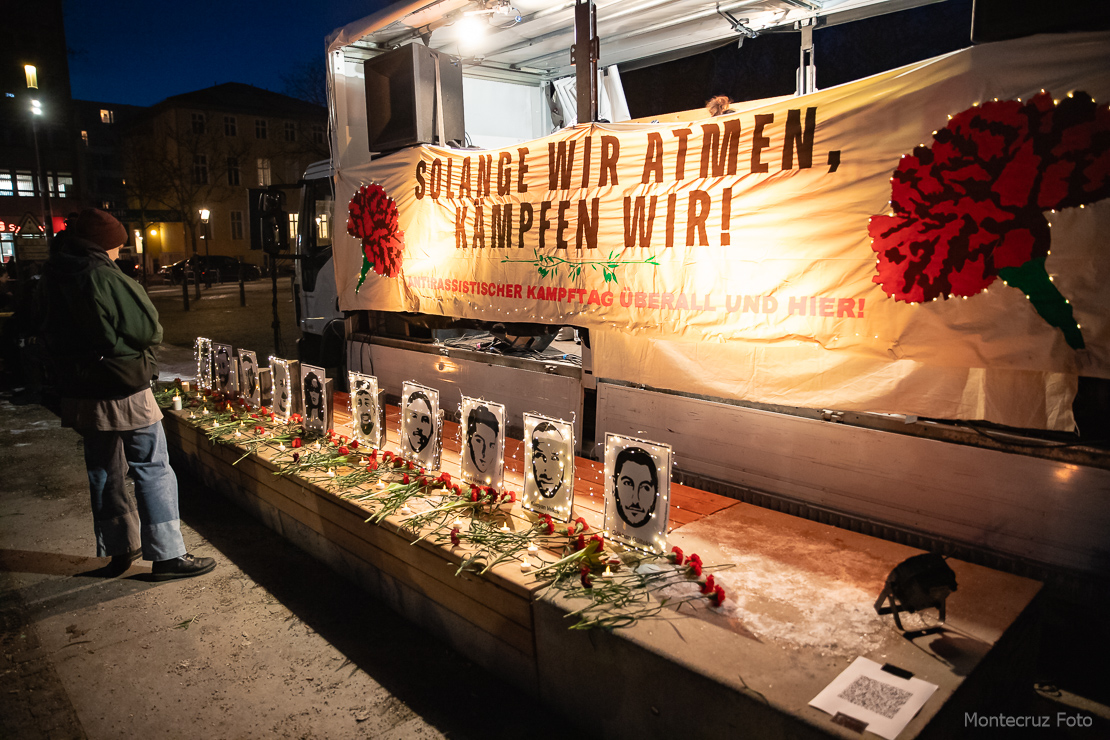
Mala: A racist went into a shisha bar and a Kiosk on the evening of February 19, 2020, and shot 9 of our siblings. The shisha bar as a place in Germany is often a place where police raids happen. In Hanau, during one of those raids – or afterward – the emergency exit was locked by the police. Because of that, people there couldn’t escape.
People called the police emergency line and no one answered. To this day it’s unclear why. Immediately after the attack, instead of receiving emergency medical care, injured people were asked for their ID. Politicians later made statements like, “Next time we’ll do better.” This shows that there is a system behind these cases, not just a crazy person picking up a weapon in a vacuum. Basically, every generation of migrants has its own Hanau. For some it’s Rostock, Mölln or Solingen. For others, it’s the NSU or Hanau.
Sam: Every time new information about the incident came out, it was because the research was initiated or demanded by the relatives and survivors themselves. There was essentially no real investigation by the authorities.
For many, that was a key turning point in understanding that the way we interpret Hanau can’t be based on saying, for example, that the police or authorities failed to prevent the attack. Because they did exactly what they have always done. I think naming and framing this structural dimension differently became very clear through Hanau.
TLB: I remember that at the first rally in Hanau after the racist murders, one speech called for “Migrantifa Jetzt!” and then groups like yours formed in different cities. How are these groups connected?
Sam: We always say that Migrantifa is a movement, and we are one group that emerged from this movement. The term itself existed long before Hanau, but I think the concrete impulse after Hanau – across the whole country – was Migrantifa as self-defense. Many different groups, forms, and local initiatives started gathering under that label in response to that call.
Over the years it became clear that in some cities, such as ours, it developed into a more concrete group. In other places, it remained more of an umbrella term. We’re not part of a single unified structure. Instead, we’re independent, decentralized groups who cooperate, and new groups keep appearing in different cities across Germany and the German-speaking parts of Europe – even six years after Hanau.
TLB: How do you connect your work and organizing to migrant antifascist organizing in the 1990s? What do you see as your lineage of organizing?
Mala: That’s actually very important to us. Often, people become politicized and feel like they need to do something, and think they’re the first ones doing this – like the first antiracist group with a revolutionary perspective. That’s obviously nonsense. But those of us who aren’t part of the official historical narrative have to preserve and dig up this history ourselves and talk about it.
One of the first things we did was organize a reading group on Antifa Gençlik. That’s one of the groups we refer to – a group active in Kreuzberg in the 1990s. KÖXÜZ was another group that published a magazine in the 90s. Café Morgenland was also an antifascist group that did a lot of organizing. Of course, we might have ideological disagreements, but these are migrant-shaped antifascist groups in Germany that we refer to and learn from.
TLB: Could you give an example of something they did that’s important for you today – or something important for you not to repeat?
Sam: A big point was migrant self-defense. That was actually one of the reasons that one of the older groups eventually dissolved – because of a Nazi who didn’t get back up, let’s say. But another key point is analysis: asking why all of this is happening and what exactly is happening.
For example, Café Morgenland observed in the 1990s that things got drastically worse after German reunification – during what people call the Baseballschlägerjahre [this period was also covered in this series]. One comrade said something like: “We moved from trying to prevent racist attacks to a point where it’s already considered a success just to name them after they happen.” It’s important to consider this shift.
Mala: In terms of concrete struggles: the refugee movement, not just Oranienplatz but also earlier self-organized movements in the 1990s, or migrant labour strikes at Ford and Pierburg. In Kreuzberg in the 1980s, migrant women occupied buildings and said: “We need childcare here.” Many of us were born, raised and socialised in Germany, and there was this realisation that here – whenever there has been right-wing or racist violence – there have always been forms of resistance. All of these things are struggles we refer to. They’re important for building a combative sense of self; to see that the people before us weren’t passive. There was always struggle.
TLB: Why, in your perspective, are specifically migrant antifascist groups necessary?
Sam: For me, a lot of it is about being able not just to make connections between issues but also to develop practice out of those connections. In the German antifascist tradition there’s often a very strong understanding of things like research, dealing with repression, and the practical “craft” of Antifa work. But connections between struggles often weren’t built.
For example, the huge lack of solidarity from many Antifa structures with Palestine solidarity in recent years is something that simply couldn’t happen in our group – because those connections are our starting point. The question isn’t whether we label ourselves “internationalist,” but whether we develop an internationalist position because of the experiences and political traditions we come from.
Mala: I’ll answer on a more basic level. It’s a bit tricky to talk about this, because it can quickly sound like we’re organizing purely along identity lines, something which we see as reactionary. We organize along political analysis. But we also say, “come if you are affected by racism.”
We also don’t sit in a circle sharing experiences of racism, but we start from a relatively high level of shared understanding [of racism]. In groups that don’t focus on racism and where people aren’t directly affected, you often have to start from the very basics. That work is also important though, and we do it with such groups every day.
TLB: What is your relationship with majority-white German left groups?
Mala: A lot of cooperation, actually. We simply see whether we can come together along political lines. For example, we’re based in a space called the Rote Lilly in Neukölln, organized by the Stadtteilkomittee Neukölln. We’re also part of alliances with mixed groups. Our main criterion is whether there’s a left revolutionary perspective.
Sam: Exactly. And that applies equally when we work with non-white groups. Political analysis is central – not identity alone. Sometimes that actually creates more friction than working with white groups.
TLB: Some of our readership might find this surprising, that it’s possible to work with majority white German left groups.
Sam: In that case it’s maybe worth emphasizing that despite all criticisms and contradictions with white left structures, we also have to insist on where we are organizing. The threat of fascisation in this country doesn’t come from white leftists. Historically, Germany has been an important site of leftist thought and struggle. And we shouldn’t forget the massive destruction of left and communist organisations in the 20th century – that rupture still shapes things today. There isn’t a huge tradition of experienced older comrades. That rupture matters.
Mala: We have a slogan: “Migrantifa means class struggle.” With that, we mean the entire working class. We also explicitly claim the history of German communists as part of our own history. We are in this country and we relate to that history. The Rote Lilly is named after a revolutionary woman from Neukölln. Maybe that’s something that distinguishes us from traditional Antifa groups. They do very important work: fighting Nazis by all means necessary is correct and important. But because of the work they do and often their analysis, Antifa groups have tended to isolate themselves from society. We explicitly try not to do that, because we want to be a movement.