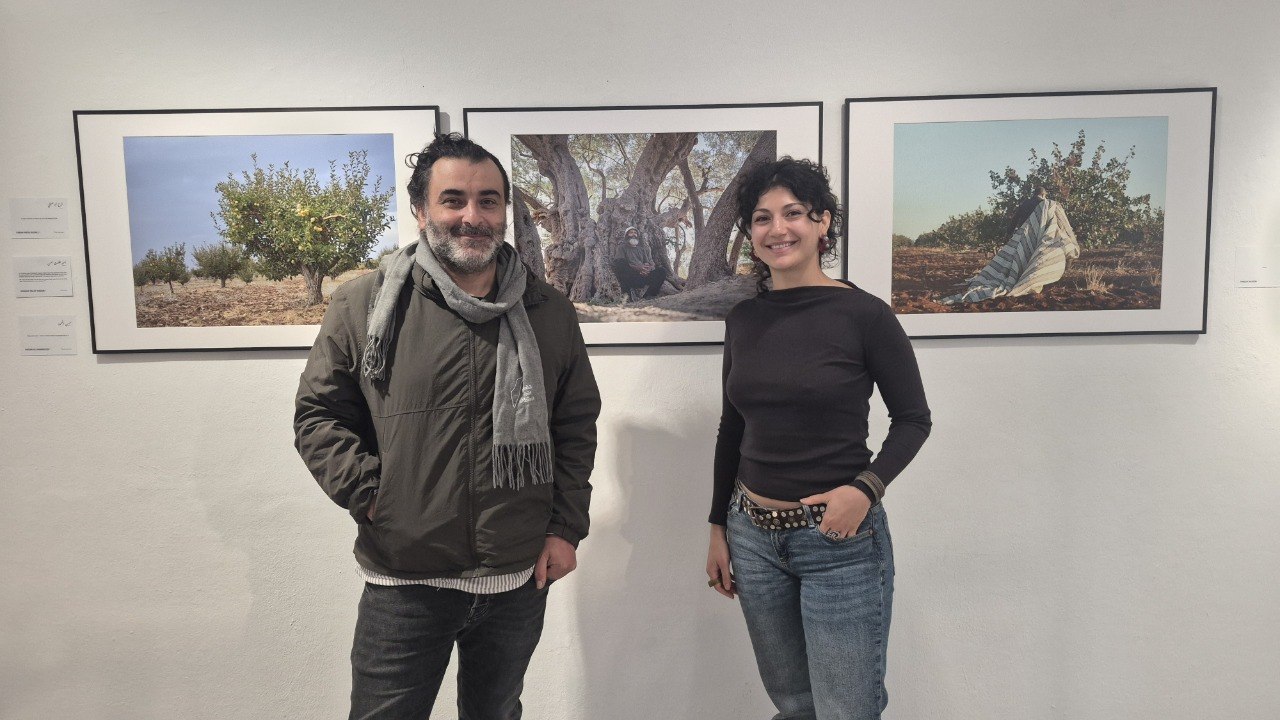
Thanks for talking to us. Could you start by introducing yourselves?
Mohamed Badame (MB): My name is Mohammed Badame. I am from Galilee in Palestine, and have worked in Berlin for 14 years. My background is as an activist for a human rights organisation, teaching in a school in Palestine, but I switched my career to photography. I am also the founder of Untold Palestine.
Haya Khoury (HK): I am Haya Khoury. I am originally from Lebanon, and now live here working at the intersection of arts, politics, curation, and cultural production.
And you have an exhibition on at the moment in the Galerie Nord.
MB: Yes. We believe that we, as Palestinians, do not have full access and control over our images, our narrative. Since Palestine was first occupied, the Zionist movement has given a narrative about who we are. Their idea of a “People without land for a land without People” is a story about Palestinians that we read in the Western media all the time.
Palestinians do not have the chance to tell the story as they see it. This is why we built the platform Untold Palestine, to free ourselves, as photographers and storytellers, from the Western media machine, and to tell our story as we know it is. We publish many stories, photos, and videos from Palestinian storytellers and journalists.
We take these stories to exhibitions and publish them in magazines because we also need to give financial support, so Palestinian journalists can work free from the colonial media that controls the scene. There are so many photographers and journalists in Gaza, and when these photographers are killed, no one can speak about their rights.
Our platform was established for photographers from Palestine. We also work with photographers from Syria, Lebanon, and Jordan.
This exhibition is our third exhibition. Our first exhibition, Gaza Habibti, ran in 25–30 countries. Our goal is to show others Gaza’s stories and lives. We focus on the human stories; we believe that if people are in solidarity with Palestinians in the time of war, it should not just be when there are bloody pictures.
Solidarity with Palestinian or with other Arabic and African groups should show hope, music, dance, activity, art. The main point is that we try to break all the stereotypes about Palestinians, Syrians, Arabs, and Africans – not because we want to sell this as ourselves, but because we are like this. This is what the mainstream media elides.
There are a lot of photo exhibitions of Palestine elsewhere, and most of them are either demonstrations or of rubble. Now there’s a little bit of rubble in your exhibition, but the pictures here are mainly of people. What’s the thinking behind this?
MB: We have photos from Jordan, from Palestine, from Lebanon, from Syria. Without a caption describing location, you will not likely recognize which photo has been taken where. We are the same nature, the same people, the same issues, the same education, the same history.
The most important thing is this: moments of happiness:- people dancing, drawing, making art. This is the reason we fight–not just for the land. People have this life, and this is what has led the resistance for many years. We believe we should struggle and fight that our people have the chance to have life as normal as all the people in the world,
Why these four countries – Palestine, Jordan, Syria, and Lebanon?
MB: It is part of the colonialist history in the area. All these countries were once one, called Bilād ash-Shām. I could travel to Lebanon anytime I want. I could go to a concert in Syria, then back to my harvest in Palestine. There were no borders.
Sykes-Picot divided all of these countries, all of these lands, all of these people. In this exhibition, we tell the story that we are the same, and all of the conflicts and divisions in our area were made by the colonial machine.
And of course, the places where you definitely ca not visit are West Jerusalem, Haifa, and Jaffa.
HK: For sure. But as a Lebanese, I ca not go anymore to any of Palestine. Jordan is becoming more difficult. The Sykes-Picot Agreement and agreements after the Second World War divided these countries, contributed to nationalist sentiment in our small lands, and enhanced these borders.
The borders do not mean anything. If you look at the pictures, unless you know the location already, you would have absolutely no idea where the photo was taken. We called it Khayal, which means imagination. These places exist in our mind, in a place where there are no borders, because this is reality for us.
But the reality is also that we have limitations, we have visa problems, we have borders where we are very much separated. It is a moment for us not to convince anyone that we deserve this, not to convince anyone that we are human. And also not to constantly have to fight for our rights. It is not that we have the right to be. We are here.
What is the relationship between art and photography and more general resistance?
HK: I think it is a tool. Some people know how to fight using writing. Some people use their cameras. Some people use their voice. I feel like art and photography is another tool for us to resist, to defend ourselves, to show our narrative.
MB: If I invest my 1000 Euros in a camera, let this camera be a witness to the attacks on human rights. I can use this camera and the stories to protect and defend my people, to define the human rights of everyone.
How can you use it in the specific context of Germany?
HK: In Germany and Europe, there are many layers and filters of censorship which affect our right to speak on a personal and collective level, whether directly or indirectly. I feel like art still has a romanticism or beauty that is unable to be censored.
Everything you see today is not pictures of war or border. You do not see any border, but it tells you about it. Maybe not directly, but I feel like even the picture of an olive tree is extremely powerful on a historic level. We’ve created a safe place to talk about this in Germany, and a safe place for us to be here and participate.
MB:I also think that Germany, France, Italy, and all these countries, talk about freedom of speech and freedom of journalism. They hold conferences. They describe themselves as free. But they do not give any platform to Palestinian journalists or Palestinian photographers. Quite the opposite. They try to hide and to stop any story that came from this side. 250 journalists and photographers have been killed in Gaza. Our responsibility is to hold these photos and their work, and to show the people.
In the exhibition there are photos from colleagues who were killed in Gaza. There is no photographer here who has not suffered directly from the wars, from the occupation, from the oppression. They might never be present here themselves. So our responsibility is to take their voices and to continue to show their work, and the message that they exist. If you do not show their work in der Spiegel or die Süddeutsche, okay, we will fight to show their work.
How do you want people to react to your work?
HK: Maybe we have different opinions, but I could talk about myself because I also worked on the communication aspect of it. It was important to understand who we are talking to. Who is our audience? First and foremost, our audience is our diasporic community. We do not really need to tell this community anything. We want them to be seen and feel reflected. We want the space to be relevant for them.
For the second target audience, which is either the international or German community, I do not need to prepare what I expect from them. It is not one of my objectives. Our curation goes hand in hand with how much we want this exhibition to be authentic. For it to be authentic in my opinion it must hold the voices of photographers from different regions.
I feel there is no space to think about what I want an audience to feel which is far from our reality.
MB: One of the messages of photos is to be a kind of activism. So now, I will be very happy if Palestinian, African, and Latin American people come here, see the exhibition, and feel that it is part of them. They can really see themselves in every photo because it is our childhood, and also our pain.
Every neighbourhood here was destroyed. When some people viewed the photo of Yarmouk camp, they saw themselves there. They have this pain and suffering. At the same time, this is also a good way to bring this into focus for a German audience, who typically continue to say that what is happening in the Arab world is very complicated, blah, blah, blah.
It isgood for them to see for themselves. When they look at the photo with the apartheid wall in Palestine–just before the 1990s we had the same kind of wall, here in Berlin. How can you celebrate the fall of the Wall here, meanwhile,around the West Bank, there is 700km of wall, and you do not have any feeling about it?
The point is to bring forth discussion. There are plenty of means to educate yourself. But ask yourself the question: what is my role, and which side am I on?
I have a more general question. The film NAZA has just come out, and I feel very conflicted. On the one hand, it is a very good film which conveys important information. On the other hand, while NAZA gets standing ovations at film festivals, Palestinian art is largely overlooked. How can we make a Western audience listen to Palestinian voices?
MB: As a photojournalist in Palestine, we give everything. More than 70,000 people have been killed. There are no facts beyond this. Everything that describes the situation is welcome. But we do not need to spend all our time telling people that we are victims, we are suffering.
Making them listen is not my responsibility. It is their responsibility to do their own research. I think that the “voices” of the bombs are now loud enough to hear them. Every film, every movie, every act from anywhere is welcome. But I think that the time that photographers, especially Palestinians or Syrians, need a certificate from other places to say we are good enough – this time is over.
I wonder if the audience here is paying attention to NAZA because Israelis made it. I wonder whether they hear my voice as well. This is an ethical problem for them to resolve.
HK: I would like to add that this is a general question, but it is also a question that we struggle with every day. Who are they talking to? Why did they get such applause? And maybe another Palestinian director would not. But should widen the perspective and to recognise what has happened in the past three years.
How many demonstrations have happened? How many people went on the street for how many hours? This counts, and these are worth the 36 minutes of standing applause. We should acknowledge that a change is happening, and all the tiny work on grass roots or major initiatives are making a difference. People are listening more and more to our narrative.
That being said, we were in attendance at a talk by Gabor Maté a few weeks ago, and he said that the West and the colonials will always stand and clap for their fellow colonial. Maybe, as Arabs, we will never be able tonever be able to enter this conversation. Maybe we do not need to ask if this is a one-sided or a conversation between two colonial powers. Maybe it is not the place for us to be there.
There’s going to be a fundraiser on Saturday. What will be happening there?
HK: We are starting with a poetry performance by two of the parallelgesellschaft collective, followed by a dance performance by Lujain Mustafa from Syria. This will be followed by a concert by Joss Turnwell and Charlie Khalil Prince. Then we have a DJ set, and we will finish the festival with another performance.
And this is all in the Galerie Nord, where people can also come and see the exhibition?
HK: We start at 6pm. All donations will go to the Untold Sham collective, which is a way of financially supporting the stories.
Have you got any other projects that you are working on for the future?
MB: We believe that we should create our own income, and not have to take money from people who make conditions on what we can do. In our exhibitions, for every photo we sell, fifty percent goes to the photographer, and the other fifty percent to our projects in Gaza or for Untold Sham.
Other money goes directly to the storytelling program which supports our colleagues in the Arab world, because we believe that we have learned from Gaza that people have some motivation to work, to produce videos and photos, and to tell their stories. This is the way that they can be free from commercial agencies so they can publish photos and keep control about captions and what is published. This is the way that we spend our money
If people cannot make it on Saturday, can they still send you donations?
HK: We have an online website yuraart.org, where we have a collection of photography. Khayal is up on our website. There is also a donation button for fundraising. So, if comfortable, supporters can either donate directly or support by purchasing our merchandise.
The exhibition is also staying in Galerie Nord until the 23rd of January.