This article is the third piece in the series Neo-Nazis and Anti-Fascism in Germany since the 1990s. The rest of the series can be found here.
Overlaps between neo-Nazis, Germany’s military, and police forces are not new. Scandals break disturbingly frequently, often to a chorus of promises from the relevant authorities that they will stamp the problem out. Looking at some of the most prominent scandals from recent decades, the same people who Germany’s politicians claim are meant to protect us look more like a threat themselves. Whether its army officers planning false-flag terrorist operations and training neo-Nazi networks, or Sicherheitbehörde with thorough ties to neo-Nazi networks and rendered incompetent by their own racism, Germany’s military and police forces have a violent recent history.
Bundeswehr and the Uniter Group
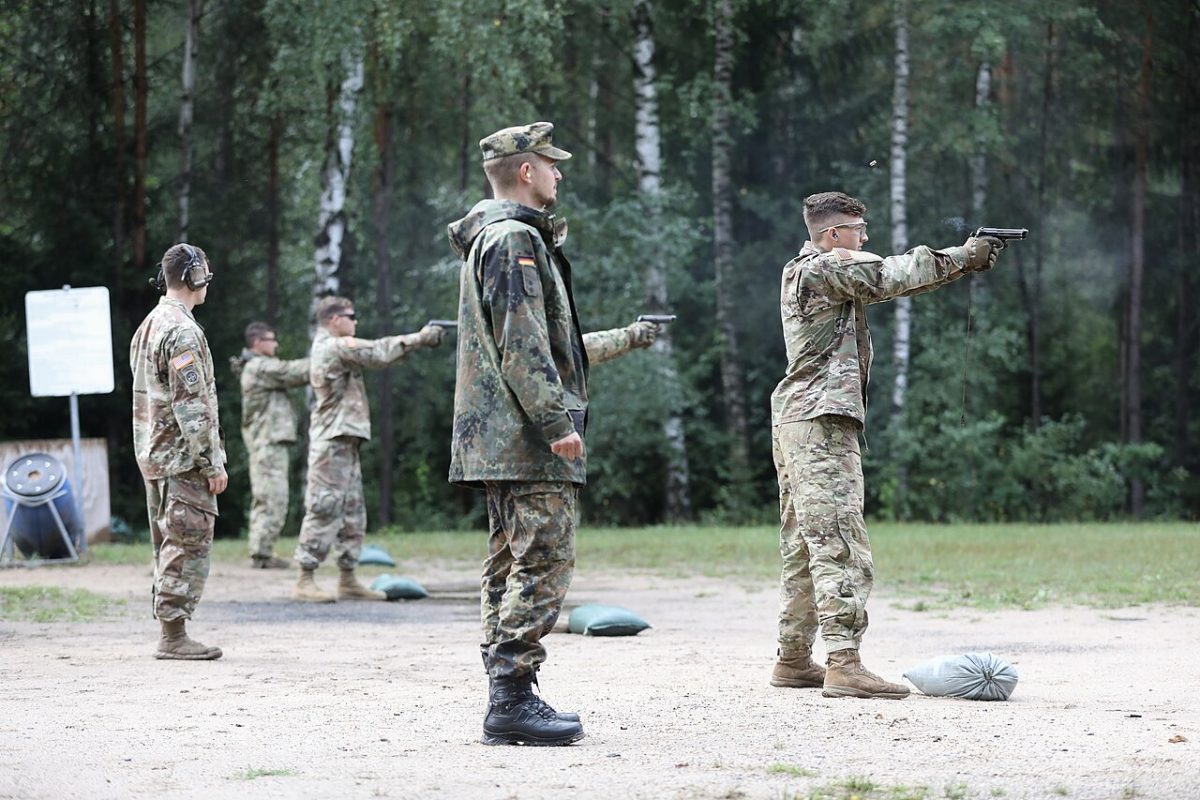
While the current government continues to pump increasing amounts of money into the Bundeswehr, its employees greet each other with Hitler salutes, place swastikas around their workplace, and wear SS uniforms for themed parties. In one of the more recent scandals at the end of 2025, 19 soldiers of an elite unit were fired for showing the Hitler heil alongside sexual misconduct. Germany’s defense minister, Boris Pistorius, stated that he was “shocked”. Except these acts are anything but surprising. In 2024, the army registered 280 cases of suspected right-wing extremism, although we can assume many cases were not reported. Of those that were, only 97 resulted in the offending soldier’s dismissal.
The extent of the problem can be illustrated through the story of Uniter, a former registered Verein [club] in Germany with extensive ties to the military and far-right networks. Founded in 2012 and led by André S., an elite kommando in the Bundeswehr, Uniter was described as a prepper group and a cult—one ceremony allegedly included drinking red wine from a human skull. It carried out weapons training for its estimated 2,000 members across Germany, and printed badges so that they would be able to recognise each other after “Day X”. One of their shooting competitions was named after a Turkish man murdered by the neo-Nazi NSU Complex.
Their work was organised through numerous group chats, mostly broken down on geographical lines. These group chats served as broader networks for Uniter, who led the chats while maintaining a degree of separation from them. Not everyone who was in the chats was a member of Uniter. The “Nordkreuz” chat, focused on northern Germany, is the most notorious. One member, Marko G., is a police officer who runs a private shooting range. He made the news in 2019 when 55,000 bullets and an uzi gun—which is illegal in Germany—were found on his property, most of which had been stolen from the Bundeswehr and police. The uzi was reported as stolen from a Bundeswehr unit, but when Marco G. claimed in court that he bought it at a street market, the judge took his word for it. Mecklenburg-Vorpommern’s internal minister, Lorenz Caffier, even trained at this shooting range and bought a gun from Marco G.
The story of Franco A. is another example of how deep the problems are rooted into the German army. A member of the group chats who knew the leader André S., he was reportedly not a member of Uniter, although he had two of their “Day X” patches at home. Franco A. was educated in the elite Saint-Cyr military academy in France, one of the handful of German soldiers selected for the program every year. As reported in a lengthy New York Times article, in 2013, he submitted his masters thesis to the program in which he argued that the Jewish Torah was the origin of all subversion and a plan by which Jews would achieve world dominance. Migration to Europe, he argued, was diluting racial purity and should be considered a form of genocide. When the thesis was reviewed by French and German commanders, the French commander recommended he be removed from service. The German commander, who held decision making authority, simply made him re-write the thesis and submit it again, saying he had gotten carried away.
Jump to 2017, and the now elite German soldier Franco A. was caught retrieving a gun he had hidden in the Vienna airport. Upon running his fingerprints, the police received a match to a refugee named David Benjamin. The year before, Franco A. had put on a fake accent and registered himself as a refugee, claiming he was a Syrian Christian of French descent. Investigators found a list of further potential targets at his house, including the Antonio Amadeus Stiftung, and various politicians. He was sentenced to 5 years in prison for planning a false-flag terrorist attack. Uniter has since been disbanded, and the group chats shut down. The vast majority of the group chat members, however, have not been outed or faced any repercussions.
If the actions of Uniter shocked Germany, more concerning is that many more soldiers with similar views appear to still be in the Bundeswehr. Ammunition continues to disappear from the Bundeswehr at an alarming rate, and sieg heil scandals and cases of suspected right-wing extremism pop up regularly in the military. It is hardly a stretch of the imagination to believe that another group chat already exists, and that other plans are already being struck.
Police, Verfassungsschutz and the NSU Complex
The problem is not limited to the military. In May 2025, the federal government admitted that at least 193 German police officers were currently under investigation for right-wing extremism or conspiracy theories. Police officers regularly make the news for things like passing on information to neo-Nazi cells, misplacing more than a ton of ammunition which most likely went to neo-Nazis, or meeting in a bar with the neo-Nazi responsible for arson attacks targeting migrants and anti-fascists in Neukölln. Racist beliefs are widespread in the police: one recent government-backed study found that men who looked Arabic or Turkish were assumed by police to be lacking in respect. The racist beliefs held by many police officers are not only dangerous because of the power the officers hold, but also because of how it impacts their investigations. The government study mentioned above states that “police can fail to recognise ‘non-Germans’ as victims of hate crimes[…] In the worst cases, there can even be a reversal of blame.”
These problems extend to the Verfassungsschutz as well. The German intelligence service for internal affairs, its name literally refers to the protection of the constitution. The apparatus has the powerful ability to declare organisations as extremist or hostile to the German constitution—whether the group is left-wing or right-wing—and therefore place them under intrusive observation. But the Verfassungsschutz itself has run into controversies for its connections to the far-right, including an ongoing debate on whether its staff can be members of the AfD. In an ongoing political drama, the organisation has even begun to collect information on its former head, Haans-Georg Maaßen, due to his right-wing extremism.
The mixing between neo-Nazi movements and Germany’s security forces has been documented for decades, but in 2011 the suicide of two men in a camper van outside of Eisenach brought a new wave of attention. The two men had just attempted to rob a bank and, realising they were about to be caught, killed themselves. From here it did not take long until the third accomplice was found alive, and reports emerged in the German press of a right-wing terror group that had been active for over a decade.
The National Socialist Underground (NSU, or NSU Komplex) had murdered 10 people; 8 men with Turkish backgrounds, one Greek man, and a police officer. They also carried out arson attacks and bank robberies across the country. It is also possible there are more murders, which have not been tied to them. The murders were carried out in part to provoke fear in migrant communities. Tellingly, even before 2011 many of these murders made the news, and people had recognised a pattern. But instead of suspecting right-wing racist murders, the media described them as Dönermorde (döner murders). The police recognised the pattern in that the victims mostly had Turkish backgrounds, and drew the conclusion that these were gang murders. While the police was thrown off by racist assumptions, the Verfassungsschutz was deeply enmeshed in the far-right circles of the NSU.
It turned out that the Verfassungsschutz had already infiltrated these networks with so-called V-Leute. V-Leute are paid informants who report back on the groups they are members of. The sheer volume of V-Leute in the neo-Nazi scene has led to the critique that the Verfassungsschutz was effectively bankrolling the NSU. Yet instead of drawing on these informants, when the murders came to light a member of the Verfassungsschutz reacted by shredding the files of 7 V-Leute who might have relevant information, as one staffer later admitted in court. Another Verfassungsschutz staff member, Andreas T., was even present for one of the murders. He was sitting in an internet cafe, chatting about an affair on a dating website, while Halit Yozgat was murdered in the next room over. Andreas T. claimed not to have noticed, something that Forensic Architecture later argued was impossible. To this day, the exact extent of networks and people supporting the trio who carried out the murders is still unknown, although several supporters have been tried. Some evidence, such as the NSU’s extensive database of potential victims filled with detailed notes (“Good target, but too old”) and some 10,000 entries, points to a much larger support complex than has been uncovered so far. What exactly the Verfassungsschutz knows about the NSU is also still unclear.
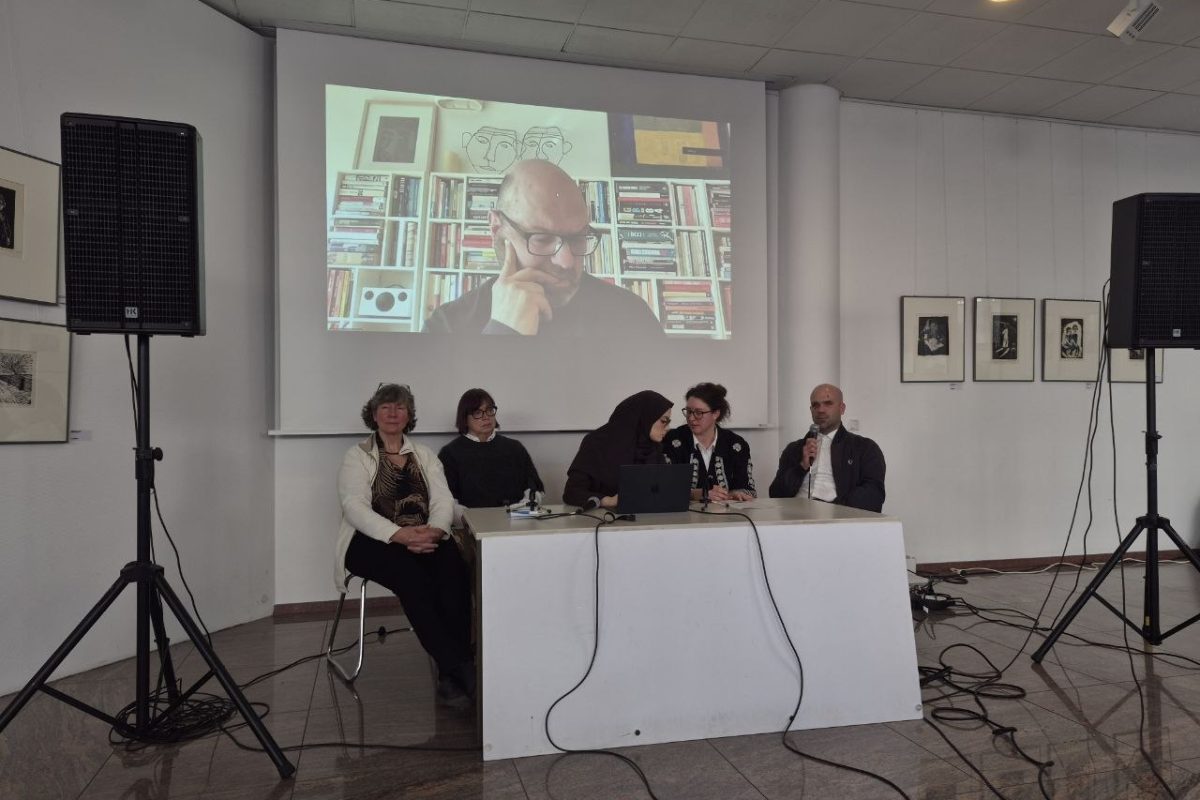
The thorough failure of the police and Verfassungsschutz was a partial reason for why the NSU murders have become so entrenched in discussions of far-right violence, but also for the wave of activism which resulted from the murder spree. Much of this work has gone through NSU Komplex Auflösen (Unraveling the NSU Complex), a group made up of activists and family members of the victims, which organised a grassroots tribunal under the same name to counteract the failures of the state. This organising work anchored the NSU Komplex into German discourse, while also providing the platform for attempts to provide clarity and knowledge about the NSU Komplex, such as the Forensic Architecture work on Andreas T. These efforts brought not only more information about the attacks into public discourse, but also actively created space for the voices of the family members.
What we don’t know
News of another cache of ammunition or another group chat with racist memes still breaks regularly in Germany. The AfD has a growing relationship to Germany’s civil service, which includes the police, Bundeswehr, as well as teachers; they had 220 civil service members stand for them in elections between 2020 and 2025. For every leaked police group chat like this one uncovered in 2023, filled with memes of sexual violence, racist jokes, and started by a Polizeioberkommissar (police chief inspector), there are an unknown number which have not made the news. While we know about the 20,000 rounds of munition that were stolen from the Bundeswehr at the end of 2025, the Nordkreuz story highlights that small amounts of ammo slip into the hands of neo-Nazis on a regular basis. Each scandal that breaks is a sign of the still growing but largely still invisible ranks of neo-Nazis in positions of authority in Germany—until the next attack.